Jerry West as the 1st Modern GM, Reggie Miller as a Knick, and More About How the 1996 NBA Offseason Relates to 2020

Besides the obvious situation the league finds itself in, this NBA season has been without recent precedent in one other way. For the first time in more than a decade, the 2019-2020 NBA league year does not include a “Super-Team” among its two conferences. Sure, there are super-star players coordinated together in different cities in an effort to bring themselves a title. You don’t need to look any further than either Los Angeles team in order to see that. But largely, of the major contenders that will exist when the NBA makes its hopeful return at the end of July, it will be a group- the Bucks, Raptors, Nuggets and Jazz, for instance- devoid of the kind of “Big Three” (or more) that has run roughshod over the league since the Lakers and Celtics came to blows in the 2008 Finals.

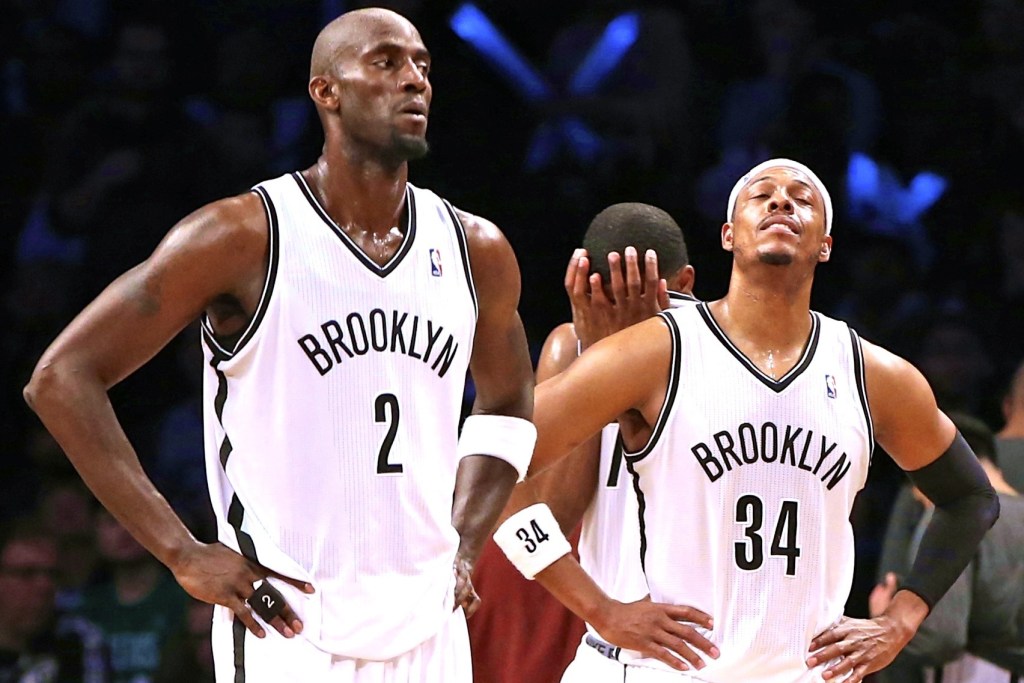
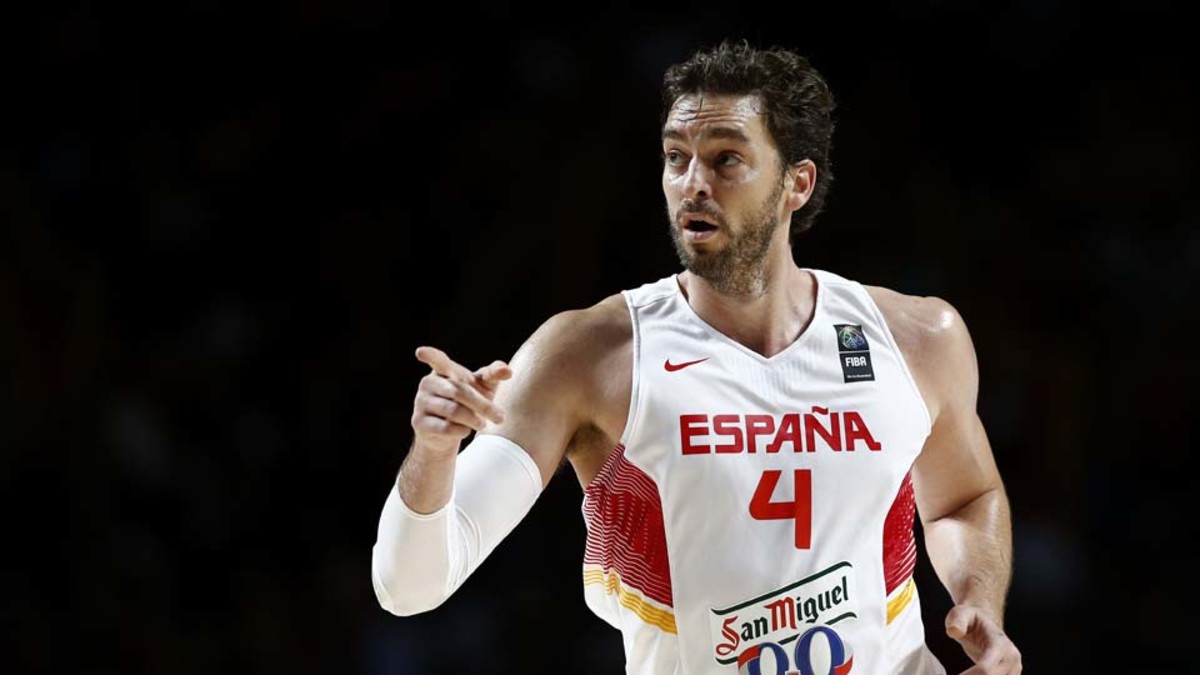
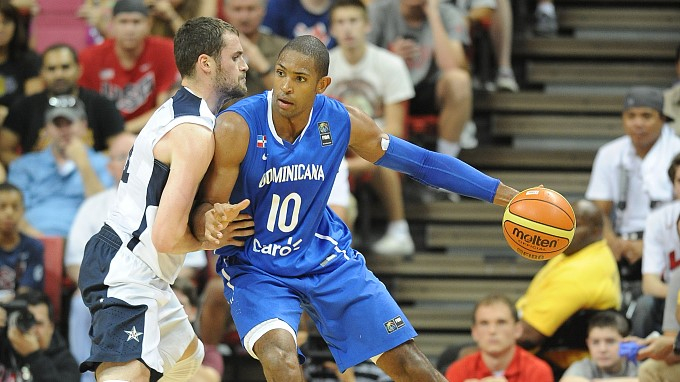
In a year where a vile disease has forced nostalgia upon us sports fans, it is ironic that the 2020 NBA landscape looks a lot more like the landscape of the ‘90s than 2019. The answer for how we got here in 2020 is one of simple circumstance. Super-teams have burned themselves out. They aren’t sustainable. Prime players age out of their prime (see photo). Egos eventually collide and big pieces want to go their separate ways. One or two poorly placed injuries take a Super-Team out of contention. LeBron-led teams burn through their assets trying to keep their best player and best chance to win a title in the best position to do so. Most of this is a matter of circumstance and league rules, and while a lottery trip for the Golden State Warriors combined with a healing roster could disprove my theory, for the moment it stands unrefuted.

Super-Team Players aged out of their prime.

But what about the past? Why were Super-Teams, at least in the way we think of them today, conglomerations of established star players, not a thing before 2008?

Well for one, the health and structure of the game made the 2010s possible. While the NBA has been a salary cap league both now and in the 90s, in the past Collective Bargaining Agreement between the league and its players it was established that no player can be paid more than 35% of a team’s cap room. He also cannot be signed for more than 5 years. This is known as the Super-Max contract. No such thing existed in 1997, because contracts had no such restrictions. Knicks’ star center Patrick Ewing soaked up 76 percent of the Knicks salary cap in the 1997-1998 season. Spurs center David Robinson took up 46 percent of it in the same year. When players from the 90s say that in their day they wanted to win on their own as a matter of pride and when they claim it’s in bad taste to team up with other stars, just know that is its easy for them to sing that tune. The climate of the time never really presented them the opportunity for anything else. The rules of the time lent themselves to that type of one, or at most two, stars per team- prove to be the bigger alpha- mentality.

What if that wasn’t the case? In 1988 Tom Chambers officially became the NBA’s first unrestricted free agent, and while the first several off-seasons of NBA free agency were fairly hum-drum, the first small step towards the culture we are more familiar with today would occur in the summer of 1996.

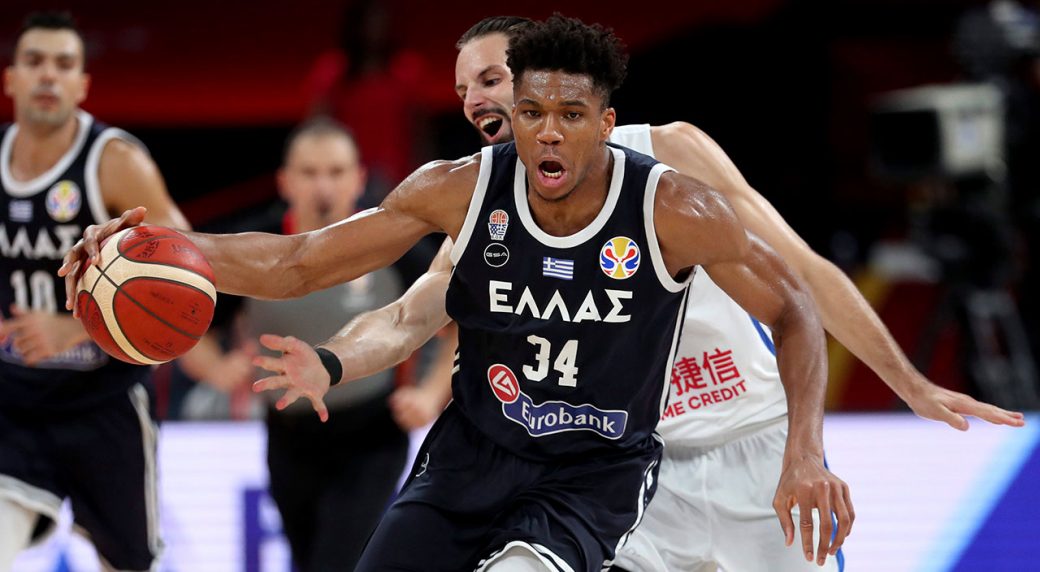
It wasn’t a large step, but it was an important one. As I stated before, the rules of the time in 1996 made it hard to accumulate top-level talent through free agency. How both players and front offices behaved made it nearly impossible. Strangely, what has brought on player empowerment and the ability to move from team to team is the massive television contracts that have pumped revenue into the league. With the league flush in money, both a salary cap in general and maximum contracts dictated by a percentage of that cap have made it so that Giannis will only receive 25% of his team’s cap if he decides to return to the Bucks in 2021, but he will still make vastly more than Patrick Ewing did when he sucked up three quarters of his team’s cap. Being less greedy individually has allowed for the players to get what they want in other ways, namely the ability to choose where and with whom they want to play. They choose their own destinies now, something that could be considered priceless. Meanwhile, Super-Teams have been great for television ratings, feeding into the cycle and keeping the money machine running.

Back to 1996. If the ’96 off-season were to occur under today’s standards, it would be right up there with 2010, 2014, 2019 and the like in terms of interest. Players that were available and on the market during that off-season include: John Stockton, Alonzo Mourning, Hakeem Olajuwon, Gary Payton, Reggie Miller and Shaquille O’Neal. Naturally, because of the way teams and players handled the cap at the time all but one of those players returned to their respective teams for the 1996-1997 season.

To prove that it was a matter of how teams and players managed themselves, I actually investigated the moves of a number of the biggest free agent spenders that off-season seeing if I could put together something resembling a modern-day Super-Team. I did this based on the free agents involved and the amount of money those teams used to bring in new players. The closest resemblance I could get was with the New York Knicks, having them forgo the signings of shooting guard Allan Houston and point guard Chris Childs. Without those transactions they would be able to sign vaunted rival sharpshooter Reggie Miller in a move that would rival some of the ones that would occur in real life twenty years later. Adding a third piece to create a true big three however would prove difficult. Signing Miller would mean not swapping power forward Anthony Mason to Charlotte for more expensive forward Larry Johnson. Instead, the closest I could get to spending the same amount of money the Knicks did without going over was to instead trade Mason for Portland point guard Rod Strickland. Strickland was traded by Portland in the real-life summer of ’96 for Rasheed Wallace. A Strickland-Mason trade would still supply Portland with a power forward and would give the Knicks a former Assist champion to run their offense. Having not signed Childs, the Knicks would certainly like to have Strickland, but to consider him a member of a true “Big Three” would be stretching it. A squad of Ewing, Miller, Oakley, Strickland, John Starks, Charlie Ward and Buck Williams (who I was still able to add with leftover cash) might be on par with something like some of the 2-star teams we have seen this season (maybe like the Sixers), but to refer to them at the Super-Team level isn’t quite accurate.

Now of course, the Knicks didn’t do what I just described in 1996. The story of what did happen lies in the one exception in the one big free agent that did leave his respective team that summer, Shaquille O’Neal.

In that ’96 off-season Shaq, wanting to be paid like the star player he knew himself to be, decided to spurn the Magic and skip Orlando to head to the Los Angeles Lakers. What he did could be considered the first step toward the player empowerment that we see today.

However, it takes two to tango. O’Neal couldn’t leave Orlando without another destination in line that both had the want and the means to bring him on. Queue Jerry West, former Lakers’ star and top Lakers executive at the time. West oversaw a 1995-1996 Lakers team that saw a 36-year old Magic Johnson come out of retirement (again) mid-season to try to further LA’s playoff chances. Beyond Magic, their best player was one-time All-Star small forward Cedric Ceballos. Predictably, the Lakers lost in the first round of the playoffs to the Houston Rockets and Johnson went back into retirement for good.

The writing was on the wall for West that although a Johnson-less Lakers were competitive, their .571 winning percentage before Magic’s addition would have been good enough for the 6th seed in the West, they were not building a genuinely championship-level team. Stuck outside the lottery, West needed to a way to bring in a star player in some sustainable way, so he forged a relationship with Shaq before and during that summer and did one thing that no General Manager had really ever done before.

He cleared cap space. (That’s right, this big lead up has all been for something a nerd could do with a spreadsheet. Look, it might not be glamorous, but it’s a really big deal).

Much like the moves we see by GMs on the regular today, this strategy had to be pre-meditated. This is proven with my Knicks experiment. The only two teams to bring in more than $10 million worth of new players to their roster and payroll in 1996, a big year of free agent opportunity, were the Knicks and the Lakers. New York did it by apparently having cap room. Ewing’s contract hadn’t exploded yet in 1996 and the Knicks spent $13.8 million on new additions, while only shedding $3.3 mil in non-returning players. Meanwhile, West and the Lakers added $11.9 million total in new players that summer, but their total payroll only increased by $1.1 million. Here’s how:

Basketball-Reference.com doesn’t say for certain, but I am to believe that the amount of money that came off the Lakers’ books with Johnson’s retirement would be about $2.5 million. That would be in line with the salaries he would have made in similar previous seasons. With that assumed, the Lakers then sent center Vlade Divac to the Charlotte Hornets for some kid straight out of high school on a rookie contract named Kobe Bryant. That trade for that netted Kobe was at least in part a move to clear cap to bring in Shaq. A few days later West then dealt rotation players Anthony Peeler and George Lynch along with 2 second round picks for 2 future 2nd rounders. West played quite the price for those future 2nd rounders, but that obviously wasn’t the end game, getting Lynch and Peeler’s combined $3.6 million off the Lakers’ books was.

Between the removal of Divac, Johnson, Lynch and Peeler, West removed $10.8 million from team payroll. How much did he pay Shaq for the 1996-1997? $10.7 million. West nailed it. He did something that was unheard of in 1996, and while no team would even attempt to strategize their cap room in an even greater way until the Magic tried in the 2000 off-season, this would be the beginning of the league never being the same.

Or perhaps it will be the same again someday soon. We live in uncertain times right now and for the first time in even longer than the 24-year period that I have described here, the NBA’s money-making machine is sputtering for circumstances that neither the player’s nor the league can control. It is almost certain that next year’s salary cap will stagnate, probably even go down, and the players and the league are going to need to either get together and decide that either they are okay with that or they need to come to some sort of solution. A financial system built on the basis that revenues perpetually increase is about to break, and while it’s going to be far from the end of the league as we know it, regulations will likely change in some way. If they don’t, then maybe that 25% of the cap that Giannis is supposed get won’t pay him more than Ewing.

Maybe the chemistry of how teams are put together in the league will be altered. But, this is no longer the dark days of the league being riddled with horrible General Managers. Changing times require creativity in order to succeed, the kind of creativity that West exemplified in 1996. Oddly enough, West could still be one of the executives to lead this next generation of changes. We don’t know what the next step will be, but we are certain to find out. In an era where information is more available than ever, someone is certain to get it right. For all the turmoil, maybe the NBA off-season, which has in a way become its second season, will find a new way to excite us.

The Gasoline Gang: A Cleveland Indians Bullpen Theory- Eric Plunk

By the off-season before the 1992 MLB season, the Cleveland Indians were well on their way to putting the building blocks in place that would one day become “The Dynasty That Almost Was”. Though this era of baseball was as bittersweet as that nickname suggests, there was a lot to cherish from those teams, including six American League Division Titles in seven years and two World Series appearances.

That off-season was likely most memorable for the additions of future long-time centerfielder Kenny Lofton and more short-term power first baseman Paul Sorrento, but there was one more incredibly significant addition that happened that winter as well. Eric Plunk.

That’s right. I said it. Eric Plunk. Probably best remembered for his giant 90s style glasses, and his unfortunate last name, Plunk would pitch for the Indians for the better part of seven seasons before being traded to Milwaukee in July of 1998. He pitched in a staggering 373 games all told during those seven seasons out of the Indians bullpen and helped solidify the bridge between starting pitchers and closers for the very successful teams that came between 1994 through 1998.

However, by the end of his tenure in Cleveland, things had taken a turn for the worse. Namely, with how fans perceived him as a pitcher. The reliever gained a horrible reputation for being what I will call a member of the “Gasoline Gang”.

What is the Gasoline Gang you may ask? In regard to relief pitching, it’s easy as a fan to get hung up on one or two bad outings or blown leads that are especially memorable. Remembering all the small leads relievers effectively preserve in the 6th, 7th and 8 innings usually proves much harder. They tend to be non-descript. Conversely, ever since one very memorable, warm Miami night in late October of 1997, Indians fans have had a very harrowing relationship with relief pitching. This has led me to a theory.

At any point in time since 1997, there is at least one relief pitcher in the Indians bullpen that makes fans queasy every time he steps on the mound. The purposely not-referred-to-by-name Jose Mesa (darn it, I just did it…) would be a perfect example. Further, whoever the Indians’ manager is at the time usually loves to also use this pitcher in question in high leverage situations (also see Mesa, darn it… I did it again). However, if you ask a fan, they will likely say putting one of these pitchers in a game is like throwing gasoline on a fire.

Hence, the Gasoline Gang. A group of pitchers over the course of the Indians’ last 23 years that I will be reviewing as a recurring segment for this space. The premise here will be to separate from the echo-chamber of fandom and decide whether or not each of these players really deserved the torment that they received, or whether there are more of those uneventful but successful late innings then we remember.

Our first nominee for the Gasoline Gang is the aforementioned Plunk. Why? I will let Plunk’s manager with the Indians explain. The following is an excerpt from Mike Hargrove’s biography: Mike Hargrove and the Cleveland Indians: A Baseball Life (a great read, by the way):

[F]ans were calling him Kerplunk, and things like that… One time I brought him into a tough situation to face Frank Thomas, and as I was coming off the field a guy ran down the aisle right to the dugout, and he’s screaming at me. The veins are popping out of his neck, and his face was purple. I’m thinking ‘this guy’s going to have a stroke’. He’s screaming ‘Bring in Kerplunk? You dumbass! What are you doing?’

Mike Hargrove and the Cleveland Indians: A Baseball Life

From what I understand, the idea behind calling him “Kerplunk” was that balls that the Indians’ righty would pitch would end up landing not just over the outfield fence, but into Lake Erie with a loud “Kerplunk”. Clearly, for some, this perception was a potential harm to their health. That’s the legend at least.

Now what is the truth? Were the fans right to be so weary, and honestly kind of abusive, regarding Eric Plunk? Let’s take a look at the numbers.

As previously stated, Plunk pitched for the Indians over the course of seven seasons. From his time with the Tribe one thing is easily obvious. He was an innings eater. No one pitched more relief innings than his 462 for the Indians over the course of those seven seasons and in fact, no one else pitched more than 350.

Additionally, those 462 innings would count for the 10th most out of any relief pitcher in Major League Baseball between 1992 and 1998 (even without including the innings he pitched after the trade to Milwaukee). Out of the 28 relievers that pitched 400+ innings between those seasons, he ranks in the top half in ERA, adjusted ERA- (where he ranks 5th!), strikeouts (3rd!), WAR and Win Probability Added (WPA).

Among those 28 relievers is a respective who’s who of the best set-up men and closers of the time. Names like 1997 World Series MVP John Wetteland, Hall of Famer Trevor Hoffman, 2-time All-Star Roberto Hernandez and fellow trusted Indian reliever Mike Jackson pervade this list. If nothing else, these are the 28 most depended on relievers of this mid 90s era, essentially one per team. And there Plunk is, holding his own in many major statistical categories.

So, what gives? What bridges the gap between what we know to be true about Plunk, and how the fans perceived him? Something that Hargrove said, and I initially left out, is ultimately key to all of this.

Toward the end of his time here fans were calling him Kerplunk, and things like that…

This. This is the key. I ran the same statistical analysis that I just described for Plunk, but I ran it using two separate time frames. First, I ran it from 1992 to 1996.

And Plunk was masterful. His 355 innings pitched out of the bullpen were once again the most of any Indians reliever and this time were the 6th most of any reliever in baseball. Of the 21 relievers that pitched 300 innings or more over that course of time he finished 4th in ERA (2.81) and 3rd in ERA- (63, lower numbers are better, and 100 is average), 5th in WPA (7.35), 6th in WAR (6.2) and 7th in FIP (3.39). All in the top third of his class.

If all that sounds like a bunch of mumbo jumbo, just know that he gave up earned runs at a lesser clip than Randy Myers (36.2 saves per season), pushed his team towards wins more often than Hernandez (2.71 ERA) and was more valuable to his team than Mel Rojas (84 1/3 innings pitched per season) over the course of those 5 seasons.

He still seems great, probably even better! But then, I ran the same stats again, this time for the combined 1997 and 1998 seasons. The results aren’t nearly as pretty.

For one, Plunk’s usage went down greatly. No longer was he in the top 10 in relief innings, but rather his 106 2/3 IP (excluding his innings after the trade to Milwaukee) would rank 102nd among relievers. Remember how he was ranked 3rd in ERA- among that smattering of the most depended upon relievers of his era? This time he ranks 96th out of the 122 relievers that pitched 100 innings or more over the course of the 1997 and 1998 seasons. He also logs both negative WAR (-0.1) and WPA (-1.49), meaning he performed worse than a “replacement level” pitcher and did more in the aggregate to cause his teams to lose than to win. His WHIP of 1.47, coming in at 89th, is his best statistic.

Clearly, Plunk was really darn good, until he wasn’t. That one thing that made him special, that ability to eat innings, was likely the thing that led to his demise. By the time, the 1997 season rolled around, the 13-year veteran had pitched in 578 Major League games and had logged 1041 innings. He had made 50 or more appearances in six of the last seven seasons and threw fewer than 71 innings in a season just once in his career.

And THAT is likely why he started getting called “Kerplunk”.

He would bounce back a little bit after the Milwaukee trade and post a 3.69 ERA for the remainder of the season for the Brewers, but 1999 would be Plunk’s last season in the show. As rubber-armed as ever, he would pitch another 75 1/3 innings and make 68 appearances, but he would do it to the tune of an ERA- of 110, the worst of his career as a full-time reliever.

Verdict

So, does Plunk make the Gasoline Gang?

Hardly. A dependable and sometimes dominant performer for five of his seven years with the Tribe, Plunk posted the kind of numbers that you would love to get out of a setup man in any era that involves bullpens. His bad reputation is likely caused by two factors. For one, his unfortunate performances came at the end of his tenure with the Indians, leaving them as the last thing that Indians fans remember. His performance in 1997 ALDS Game 1 vs the Yankees (see below), for instance, would be the type of meltdown fans would remember more than a smooth 1-2-3 7th inning in April. The second factor is the curse of Hargrove’s continued trust in the bespectacled righty. Even in Plunk’s final month as an Indian, when you think confidence would be wavering, Plunk came into games where the Indians either led by 3 runs or less, were tied or were losing by 3 or less in 4 of his 7 appearances. He allowed at least one run in every one of those opportunities. Hargrove and the Indians’ front office just cut ties too late.

Ultimately, the sum of his tenure with the Tribe is greater than some weak moments towards the end. I’d rather choose to remember Plunk as the guy with the goofy glasses that bridged the gap to the closers’ role and did it proficiently night after night. Anything else isn’t worth the stroke-inducing frustration.


Have a thought about Plunk or any of the other 90s Indians? Disagree with my decision or have a suggestion for who should be the next former Indian reliever to be up for the Gasoline Gang? Leave a comment or reach out to me at my literally brand new Twitter account @PUSTCLE

What Re-Opened Sports Leagues Can Teach the Four Majors About the Importance of a Quick Return

It is a regular opinion that the sport first out of the gate to bring a return to major American athletics to the general public in the face of the COVID-19 pandemic will reap major rewards.

That’s the view for today, and its no wonder then why the NBA, NHL and MLB are just as thirsty to return to action as their respective fanatics are to consume their products upon re-establishment. While news from each league has been encouraging at different levels, its increasingly likely we will see at least some of these major leagues return as spring continues to turn into summer and as we continue to combat the vile and ugly pandemic that has threatened life as we know it.

Naturally, the chief reason for these leagues to aspire to a speedy return is their finances. The loss of television and attendance money alone will trouble each and every one of them. There are MLB teams that find themselves to be cash-poor and looking to continue to run business with stability. They need revenue to ensure not having to fire non-player staff, in the name of maintaining a healthy business. Meanwhile, the NBA remains concerned with its own money in-take as well, and how that will effect its revenue-based player payroll system. This alarm is especially significant when the league has already lost one major revenue stream during this past season when it alienated itself during Houston Rockets’ General Manager Daryl Morey’s foible with the Chinese government. The NBA’s financial system is predicated on the idea that revenues continue to increase, and this year could effectively break that set-up. Lastly, the NHL even at a base level would certainly like to draw the cash it generates from televising its playoffs with NBC, recouping the brunt of their television contract. Yes, dollars and cents are the first and major reason to want to come back this year and crown champions.

Obviously, there is also patriotism involved and a feeling that the show must go on for these entities. Sports are the public’s pleasant distraction, and if there was ever a time for such events- a time for a little normalcy for a few hours- it is now.

The fact remains though, getting back on the field, hardwood or ice is a matter of opportunism. It is a chance for leagues to get eyeballs in your direction and to captivate an audience. Its a chance for one of your franchises to win a topsy-tervy championship and become denoted as the new “America’s Team”. For a league like the NBA that continues to brim with popularity among younger crowds, this is obviously a big deal. However, for the NHL and MLB, it might feel like a way to turn a tide that might be heading the wrong direction. This could be a chance to ensure a greater interest and welfare for the future or your sport for years to come.

All of this reasoning relies on one specific premise, and that premise, assuming the safety of all participants, is that it is of the utmost importance to get your product in front of the public and get it there yesterday. But really, how certain are we that this premise is true?

The fact is that we aren’t. It is merely hypothesis, but as the world starts its slow turn back towards business as usual, that will include sports. Further, while the major leagues are still ironing out their specific details, we have see returns for other, individual sports with less complications. We have also see the return of select foreign sports leagues. Perhaps any of these could work as a barometer.

First out of the gate was the Chinese Professional Baseball League, actually located in Taiwan, which has done a phenomenal job of keeping its people safe during this pandemic. The nation sports a record of 42 days without a person-to-person transmission of COVID-19 within its borders. All of that is to say, they were a relative godsend when they opened their baseball season on April 12th (delayed one extra day by rain), more than 3 weeks sooner than any other postponed sports league in the world. But, did public interest really dictate that they were a godsend for sports fans like I suggest?

The fast answer seems to be that it pays to be first through the gate. Modestly, the CPBL decided to permit American viewership access to broadcasts of the 2019 champion Rakuten Monkeys’ games for about the first week of their new season. This decision led to over 1 million views each for multiple games during their first week of play, all of which came from a rudimentary Twitter stream that much of the public didn’t even know about. When the trail week ended, the leagues’ other three teams began to scramble to put together their own plans on how to broadcast games. Now, each team is streaming its home games via Twitter and there are even subscription service opportunities for American viewers if they decide they want to see every game. While its foolish to perceive that the CPBL now has some sort of foot-hold with American baseball fans, I do believe they were able to use this opportunity to improve their brand and provide themselves with more international recognition. I’d consider it a success.

The next far east baseball league to get through the gate can’t say to have been as fortunate, at least with American viewers. The Korean Baseball Organization opened up on May 5th, with the power of the World Wide Leader in Sports behind them and a complete lack of other live sports products around them to compete with. With that much going their way, the KBO gained only 173 thousand viewers on their first night. A lot of that can be explained by timing. The game was shown at 1 AM eastern time in the United States, but the fact that the KBO was incredibly outpaced by the lesser quality CPBL while having the backing of ESPN, either speaks to the power of the internet or lack of interest by the American public. Perhaps both. Had the games performed better though, best believe ESPN would have considered tape delaying games for prime time spots. The need just wasn’t there.

A better barometer though could be comparing popularity domestically within South Korea’s own borders. Opening Day was a big hit on the internet enabled sports app Naver TV in South Korea, where nearly 4.5 times as many viewers tuned in as did on the previous year’s Opening Day. While regular television ratings were only slightly up, it is certain there was some extra interest that manifested online. However, beyond Opening Day now several weeks ago, facts and figures about the KBO’s TV ratings are hard to find both domestically or for in America. ESPN editor Daniel Kim remarked during last Monday’s NC Dinos-Doosan Bears broadcast that Korean TV ratings were up, but not as much as you would expect. Meanwhile, the only further state-side ratings that I can find for the KBO come from Twitter’s @SportsTVRatings who suggested ESPN’s first Wednesday telecast of the KBO posted a paltry 68 thousand viewers. Truthfully, if the KBO’s tv ratings were doing that well, ESPN wouldn’t make them so hard to find. Further strengthening such speculation is Sports Media Watch’s reference to the KBO’s ratings as the low end of the spectrum in their predictions. Its clear to say, the American KBO experiment hasn’t been a good one, and while internet-based interest in Korean seems good (Kim didn’t say if he was just talking of TV ratings and not streams, but I would believe so) television ratings don’t seem to be through the roof in South Korea either.

What about a foreign sport other than baseball though? The German Bundesliga soccer league kicked back off on Saturday the 16th, and while its American home Fox Sports, has regarded their return in a luke-warm fashion, there seems to be some genuine interest from its American fandom. For one, last weekend’s games broadcasted on FS1 garnered viewership numbers in the 360 thousand range. Not only is that more than double the viewership of the biggest KBO game (admittedly the Bundesliga benefited from not being on in the middle of the night as well) but these are the best ratings any Bundesliga matches have ever received while being shown on FS1. They were also the 6th and 7th games all-time in American viewership for German soccer. That includes games that landed on the flagship, over-the-air Fox network. Meanwhile, the third game of the weekend, which didn’t have the privilege of including either Bayern Munich or Dortmund (like the Lakers and Celtics of the Bundesliga) had 33% better viewership than any other Bundesliga game that had ever been hosted on FS1 before last weekend. Fox threw a crappy hand at German soccer by leaving it on FS1, and while American viewers didn’t necessarily blow the doors off in terms of tuning in at large, interest really did appear spike in some lesser way.

But before we end, let’s look state-side. Both UFC and NASCAR have returned to the public psyche in recent weeks, and while they are both individual-based sports and clearly a little more niche than the four majors, there could still be something to be learned from them.

UFC had its first major showing with the presentation of UFC 249 more than 2 weeks ago. For the preliminary fights that could be seen over regular cable, viewership was up a startling 42% from a comparable night in 2019. However, ratings for those same prelims were also 3% worse off than similar ones held this past March that were both pay-per-view and competing with other concurrently running sporting events. Beyond the prelims, the actual main event seemed to perform strongly, bringing in 700 thousand pay-per-view purchases for a fight card that didn’t include a name that would regularly suggest that level of interest. To hammer home this point, UFC’s top brass Dana White gushed over the interest in interviews. The profile of UFC’s return was dictated by the combatants and media as well as the quarantine, and even without a perfect card, it appears that they had a strong showing.

Meanwhile, NASCAR seems to be performing in a healthful way as well. Last Sunday’s return at Darlington held 38% better viewership than the last race that came pre-shut-down. Just a few nights later, NASCAR then held its top level’s first Wednesday night race since 1984 and cashed in 2 million viewers. That’s more viewers combined than all three Bundesliga matches, the UFC main event and KBO’s Opening Day, for a niche sport on a Wednesday night that also dealt with forecasted rain that caused the start time of their event to change. That 2 million figure was also better than Darlington’s September 2019 race shown on a similar network on a Sunday, and while this season’s previous Sunday races often did better numbers, NASCAR really does appear to have a strong showing.

So what is to be made of all of this? First, I am absolutely certain that the concept at hand is no longer as cut and dry as “get your product on TV and people will just find it because they want sports that badly”. There are a lot of other factors at play here. Packaging, presentation and distribution are all part of the deal. For as much as the idea that people are begging for any new content gets thrown around, if that were really the case than whether or not NASCAR is on on Wednesday or Sunday wouldn’t really matter. Whether the Bundesliga was on Fox or FS1 wouldn’t matter either.

People want their sports, but that’s just the thing. They don’t just want any sports, they want their sports. That’s why a lack of knowledge of the who and what of the KBO (plus the ridiculous handling of broadcast times by ESPN) has led to little interest. Baseball fans want baseball, but better than that, they want baseball they are familiar with, and they want the best caliber of baseball in the world. Quality matters. This could also explain an impressive interest in UFC’s pay-per-view main event while prelims interest was not as impressive, and it could explain the health of NASCAR’s interest at its highest tier.

Getting your game going and giving the public the chance to consume it is a big deal, but its not the whole deal. Its not certain that hockey fans will be jumping up to see NBA games if the NBA is first league to return. We know that because excess sports fans right now aren’t jumping to watch NASCAR or Bundesliga as they have returned. Numbers are up. Interest is there, but it isn’t the type of interest that would suggest a sports fan will take whatever they can get, especially in this era of personalized playlists and television algorithms. The pandemic will not up the profile of any sports league on the merit of being first to return alone, but that doesn’t mean this can’t be a time to create an advantage. Doing so will just take more effort. It will take innovation.

In general it seems to reason that companies are innovating right now with where and how their work forces operate. This pandemic has changed business in America in regards to how we consume food from restaurants, to how we buy our groceries, to how white-collar America is operating. Companies that innovate now and innovate well will reap the benefits for years to come. The smart phone you can read this entry from is a descendant of the adversity of the space race. The jet engines that will once again propel players around the country were pushed into use due to the adversity of World War II. Adversity breeds innovation. Today is no different.

The little, four-team CPBL, barely comparable with AA level baseball, did the second best viewership of any of these sports I listed. They broadcasted their games through Twitter. Yes, I do think they benefited from being the first true sport to return, but they must be commended for their innovation (and its simplicity). They made their game easily available for the public, and the public responded. There were no subscription services, no cable packages, no paywall. The games could be watched live in the middle of the night, just like the KBO, or on demand at any time that you could locate them in the broadcaster’s Twitter feed (and they still remain this way now, by the way). They used the internet to their advantage and at least in the short run, it paid dividends.

We know the same of the KBO’s Opening Day within in South Korea as well, where fans watched from the internet-based Naver TV at a clip that was 4.5 times greater than the previous opening day.

The same old, same old isn’t going to cut it. Being the first American league back in the limelight will be a great step, but if there was ever a time to innovate, ever a time to use new technology to captivate an audience, the time is now. Getting your game in front of as many eyes as possible is key, and as people spend more and more time on their internet connected devices and as cable slowly works its way into becoming more and more of a dinosaur, now is the time to act.

If you want your sport to be the home of the new “America’s Team” you had better get cracking, because the next “America’s Team” will be witnessed online.

Ranking the Dream Teams: The 7 Pro Iterations of US Men’s Olympic Basketball in Order

With the 2020 Summer Olympics postponed one calendar year, the United States Men’s Basketball team will have to wait another twelve months to avenge a lethargic and disappointing 7th place finish at the 2019 FIBA World Cup.

While not quite the stage that is the Olympics, that unfortunate tournament outcome was the first of its sort for the Americans since a 2006 bronze medal at the same event in Japan. Two even more memorable under-achievements of the most talented basketball playing nation on the planet came two and four years earlier when the US finished 6th at the 2002 FIBA tournament, and earned a measly bronze medal at the 2004 Olympics in Greece.

Excellent video about that 2002 Fiba finish, made by the fine folks at SB Nation.

Why bring all this up? Well for one, with the lack of Olympics this year and a lack of basketball right now, its on my mind. I love international competition and I love it even more when its applied to the sports that are on the forefront of my attention most often. I enjoy watching swimming, track and field, cross country skiing, curling, and what have you. But I love Olympic basketball and the World Baseball Classic (sadly being postponed from 2021 to 2023) even more. The stars I see on a regular basis playing for their country. What could be better?! It doesn’t even have to be America!

On top of all that, current media has Olympic basketball on my mind as well. ESPN’s documentary The Last Dance has one large, heaping helping of Michael Jordan in it. Of course, any Michael Jordan conversation is not complete without mention of the 1992 Dream Team, which is indeed included early in the series. Additionally, the basketball/fantasy mash-up web series Game of Zones is currently trending on YouTube with its finale slated this week. And for those who may not be following along, the ending story-line is set as the Dream Team has arrived from the past re-invigorated and about to do battle with today’s modern stars.

This got me thinking. There have been seven “Dream Teams” since the inception of professional NBA players being allowed to participate in the Olympics in 1992. Those teams have seen plenty of ups. All but the aforementioned ’04 team have won the gold.

But how do the US Men’s teams stack up against one another? That’s what I am here for. After an exhaustive amount of research I am here to rank the seven US Men’s National Basketball teams that have participated in the Olympics since 1992. Naturally, we start at number 7.

7. 2004 Olympics in Greece (Tim Duncan and a Bunch of Other Guys)

Average Point Differential: +4.6 ; Outcome: Bronze Medal, 104-96 over Lithuania

Best Win Share Team (based on Win Shares per 48 minutes from previous NBA season)

Tim Duncan

Carlos Boozer

Shawn Marion

Richard Jefferson

Stephon Marbury

Top Tournament Scorer: Allen Iverson (13.8)

Top Tournament Rebounder: Tim Duncan (9.1)

Top Tournament Assist Man: Stephon Marbury (3.4)

Most Minutes: Iverson (217)

He Was Really on the Team?!?! Award: Emeka Okafor (14 minutes played)

Would you believe that a roster that contained LeBron James, Carmelo Anthony and Dwyane Wade was the least talented Men’s National team of all time? It is. When you consider the fact that they were all coming off their rookie season’s in the NBA it becomes a little more realistic. Naive and cocky, those three were not much help to this squad and head coach Larry Brown was reluctant to even given them minutes at the time with Anthony being only one of two players to not play in every game (the other was fresh outta college Emeka Okafor).

Really, this roster is Tim Duncan and a bunch of solid NBA pros rather than super-stars. Iverson, the leading scorer also led the team in minutes despite playing only 48 games in the 2003-2004 NBA regular season due to injury. Something I will reference throughout this list are the teams’ collective per game averages during the previous NBA regular season, in order to give a feel for the talent level of the team based on their stats in reference to each other. Rather than try to compare them entirely based on their international stats, when international talent has dramatically increased over 24 years, they will be compared in part using their NBA season performance. With that said, the ’04 team’s 2003-2004 NBA season totals were lack-luster. They scored the fewest collective points, dished the fewest assists and had the fewest Win Shares Per 48 Minutes of any of their Dream Team counterparts. Duncan was also the only player to be voted All-NBA or in the top 8 in MVP voting. Richard Jefferson, who played more minutes in the tournament than James and Anthony combined, while playing the same position, was never an All-Star once in his career.

This team’s best scorer was coming off of injury, they completely lacked any ball-distributing point guard (Marbury? blech) and really suffered in how they were designed as a team. This was really just a conglomeration of talent, not a well thought out basketball squad.

6. 2016 Olympics in Rio de Janeiro (Durant’s Team)

Average Point Differential: +22.5 Outcome: Gold Medal, 96-66 over Serbia

Best Win Share Team (based on Win Shares per 48 minutes from previous NBA season)

DeAndre Jordan

Draymond Green

Kevin Durant

Jimmy Butler

Kyle Lowry

Top Tournament Scorer: Kevin Durant (19.4)

Top Tournament Rebounder: DeAndre Jordan (6.1)

Top Tournament Assist Man: Kyrie Irving (4.9)

Most Minutes: Durant (230)

He Was Really on the Team?!?! Award: Harrison Barnes (31 minutes played)

This team is a symbol of the beginning of the slow crawl back towards mediocrity that ultimately reared its ugly head a with the 7th place finish at the 2019 FIBA World Cup. With that being said, the previously ranked 2004 squad is in a league of its own. The leap from the 7 spot to this 6 spot is significant.

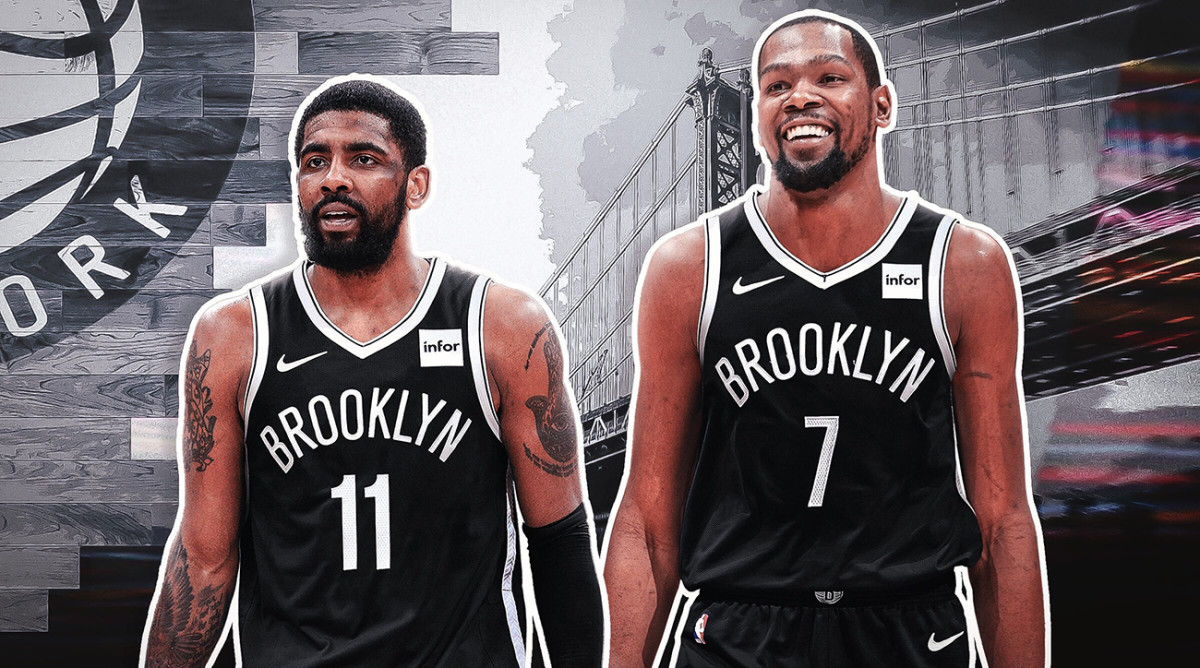
This is Durant’s team, having proven himself to be worthy for the cause in the 2012 tournament (more on that later). Without other top level scoring talent (exception given to Irving) Durant was allowed to go buck wild on all competitors, most notably dropping 30 points on Serbia in the Olympic final. And what a difference four years makes. Concerns abounded at the time about if team chemistry would be effected by Durant’s free agent decision to join the Warriors a mere month before this Olympic tournament, particularly between Durant and Irving. Now he and Irving, who played for the Cavs team that was likely most effected by Durant’s move, are teammates in Brooklyn.

The 2016 version of Team USA was also home to a prolific version of DeAndre Jordan that no longer exists, coming off of 1st Team All-Defense and 1st Team All-NBA honors in the previous season NBA season. More in reference to the context of the NBA coming off that 2015-2016 season, this team was a middle of the road squad in comparison to their fellow Dream Team peers. Their previous season numbers were middling at best but they never ranked last in any of the statistics that I checked. They lose points for having a score-first point guard in Irving as their main distributor of the ball and for having another never-All Star on the team in Harrison Barnes. Durant carrying the load was a bit of a need rather than a luxury for them, particularly in comparison to just four years previous, and that’s how they have ended up sixth.

5. 2000 Olympics in Sydney (The Specialists)

Average Point Differential: +21.6 Outcome: Gold Medal, 85-75 over France

Best Win Share Team (based on Win Shares per 48 minutes from previous NBA season)

Alonzo Mourning

Kevin Garnett

Vince Carter

Steve Smith

Gary Payton

Top Tournament Scorer: Vince Carter (14.8)

Top Tournament Rebounder: Kevin Garnett (9.1)

Top Tournament Assist Man: Jason Kidd (4.4)

Most Minutes: Carter (181)

He Was Really on the Team?!?! Award: Vin Baker (110 minutes played)

This is the first USA Dream Team where you will see a real slip up in the amount of talent after the institution of pros in 1992. Though I will say while their names might underwhelm slightly today in comparison to the 2016 team, I think that is just recency bias.

The 2000 version of Team USA is a bit of a team of specialists with the only one notable exception in Garnett. Carter is a scorer at the peak of his powers. Jason Kidd is handling and distributing, Alonzo Mourning is coming off winning the Defensive Player of the Year award and Ray Allen, Steve Smith and Allan Houston can shoot the lights out. What this team lacks though is the type of interchangeable, multi-talented stars that you will see on teams ranked better than them.

Their biggest strength is around the rim. Between Mourning and Garnett you have two lock-down defenders and a team that blocked more shots in their previous NBA season than any other Dream Team. They could just bludgeon to death their Olympic opponents and it shows, the front-court tandem were the only double-digit average scorers outside of Carter. Their biggest scare came in the semi-final vs. Lithuania, which saw them sneak away with a 2 point victory on the shoulders of Garnett’s 14 & 12 performance that included a crucial steal with 25 seconds left and a 1 point lead. All that being said, I think the close call was more a question of motivation rather than talent, so they place fifth.

4. 2012 Olympics in London (The Re-Deem Team 2.0)

Average Point Differential: +32.1 Outcome: Gold Medal, 107-100 over Spain

Best Win Share Team (based on Win Shares per 48 minutes from previous NBA season)

Kevin Love

LeBron James

Kevin Durant

James Harden

Chris Paul

Top Tournament Scorer: Kevin Durant (19.5)

Top Tournament Rebounder: Kevin Love (7.6)

Top Tournament Assist Man: LeBron James (5.6)

Most Minutes: Durant (209)

He Was Really on the Team?!?! Award: Deron Williams (145 minutes played)

I’m not a huge Durant fan. I’m from Cleveland. He ruined any potential for a continued, fair and balanced rivalry between the Cavs and Warriors, but is he possibly the best Olympic basketball player of all-time? I said before he proved himself in this Olympics, and that he certainly did. Coming off of a Finals loss to James and the Heat this was a statement, and his first successful shot at real glory.

It wasn’t all Durant though. This is the first team we will look at with a real depth of talent. There were five double-digit average scorers on this team in Durant, James, Anthony, Kevin Love and Kobe Bryant. However, those scorers came at the cost of front court depth. Tyson Chandler is coming off a season as Defensive Player of the Year, but he is the only center on the team outside of the fresh outta college Anthony Davis. Its clear the strategy here was to try to be as proficient as possible offensively, and that they were, scoring in triple digits in 6 of 8 games in the tournament. They even dropped an Olympic record 156 points on Nigeria in pool play. Melo had 37 in 14 minutes in that game… I don’t even know how that’s possible. Finally, their previous NBA season ranks 3rd best in terms of Win Shares per 48 when compared to all other Dream Teams.

Perhaps you think I have this group a little low, after all this squad was questioned at the time of its assembly to be able to take a run at the ’92 Dream Team, but its just not quite as good as three of its other brethren. Its definitely missing at least one big piece that might not be obvious, but that one of its immediate predecessors had.

3. 2008 Olympics in Beijing (The Re-deem Team)

Average Point Differential: +27.9 Outcome: Gold Medal, 118-107 over Spain

Best Win Share Team (based on Win Shares per 48 minutes from previous NBA season)

Dwight Howard

Chris Bosh

LeBron James

Kobe Bryant

Chris Paul

Top Tournament Scorer: Dwyane Wade (16.0)

Top Tournament Rebounder: Chris Bosh (6.1)

Top Tournament Assist Man: Chris Paul (4.1)

Most Minutes: LeBron James (198)

He Was Really on the Team?!?! Award: Michael Redd (72 minutes played)

That one missing element is skilled size and Dwight Howard and Chris Bosh provided it for the 2008 team. Howard is a season away from making the Finals as the center-piece of his late ’00s Orlando Magic teams coached by Stan Van Gundy. Bosh is proving himself to be quietly one of the best picks in the highly touted 2003 NBA Draft. He leads this team in rebounding despite getting only the 7th most minutes. Once again, this team has five double-digit scorers on it in Wade, James, Bryant, Anthony and Howard and once again they scored in triple digits as a team in six of eight tournament games.

In comparison, their previous NBA season resume is greater than the 2012 squad as they finished with the 2nd most collective Points per Game of any US Men’s team and also finished 2nd in assists between incredibly capable passers like Paul, James, Kidd and Williams. They had four of the five members of the 1st All-NBA team (Howard, James, Bryant and Paul) as well as the league MVP (Bryant). On top of all this, Spain finishing within 11 points of Team USA in the Final was as close as any opponent would get in a game that saw the steady hand of Kobe Bryant score 20 and lead the team with 6 assists, foreshadowing his final two NBA titles in the two coming years.

Perhaps another rim-protector outside of Howard could have been in order. He was the only player on the team to record more than 1.5 blocks per game in the previous NBA season for this team, but having the rebounding of Howard, Bosh and Carlos Boozer gives them the leg up on the 2012 team. It just doesn’t put them in the stratosphere of our final 2.

2. 1996 Olympics in Atlanta (Dream Team 2.0)

Average Point Differential: +31.7 Outcome: Gold Medal, 95-69 over Serbia and Montenegro

Best Win Share Team (based on Win Shares per 48 minutes from previous NBA season)

David Robinson

Karl Malone

Scottie Pippen

Penny Hardaway

John Stockton

Top Tournament Scorer: Charles Barkley (12.4)

Top Tournament Rebounder: Charles Barkley (6.6)

Top Tournament Assist Man: Gary Payton (4.5)

Most Minutes: Scottie Pippen (176)

He Was Really on the Team?!?! Award: Hakeem Olajuwon (87 minutes played, became a naturalized citizen in such a way that he was eligible in ’96 but not ’92)

Dream Team 2.0 had one very obvious omission, several capable additions and a number of significant hold-overs from the original Dream Team. Obviously, Michael Jordan is nowhere to be found, but Pippen and Karl Malone still rank in the top 5 in minutes for this 1996 team along with one of the best shooters ever in Reggie Miller and a star that burned out far too soon in Penny Hardaway. It was “no Jordan, no problem” in 1996 as Barkley took over the mantle as the team’s best player, leading in most points and rebounds despite finishing 7th in minutes played.

Maybe surprisingly, this team was the most prolific scoring team of any Team USA when counting up their previous season NBA stats, and it comes from a plethora of front court players that all scored more than 20 points per game. Among them, a 23 year old Shaquille O’Neal, a veteran Hakeem Olajuwon and ’92 hold-overs Barkley, Malone and David Robinson. This team also had that previous NBA season’s 2nd, 4th, 5th and 6th place MVP finishers (Robinson, Olajuwon, Pippen and Payton, respectively) and it had 4 of the five first team All-NBAers (Robinson, Malone, Pippen and Hardaway) as well. The only player to not at least have two of the following three accolades for the 1995-1996 season- All-NBA Team, All-Defensive Team, be an MVP vote recipient- was Reggie Miller, and like I said before, he was only one of the best shooters in the history of the game.

Don’t get it confused. They are actually neck and neck with our obvious-by-now first place finisher. You would think this would be an easy decision, but it wasn’t. As great as our 1st place team is, the ’96 Olympic team really was right there in terms of depth of talent. They didn’t finish worse than third in any of the stat categories I compared between these teams previous NBA seasons.

However, neither did number 1.

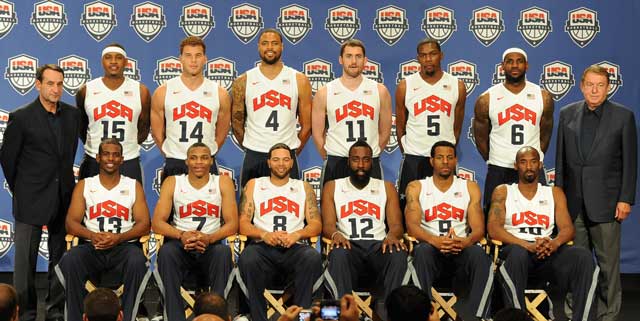
1. 1992 Olympics in Barcelona (The Dream Team)

Average Point Differential: +43.8 Outcome: Gold Medal, 117-85 over Croatia

Best Win Share Team (based on Win Shares per 48 minutes from previous NBA season)

David Robinson

Karl Malone

Clyde Drexler

Michael Jordan

John Stockton

Top Tournament Scorer: Charles Barkley (18.0)

Top Tournament Rebounder: Karl Malone & Patrick Ewing (5.3)

Top Tournament Assist Man: Scottie Pippen (5.9)

Most Minutes: Michael Jordan (185)

He Was Really on the Team?!?! Award: Christian Laettner (61 minutes played)

Jordan was smart, he let a lot of his comrades do a lot of the heavy lifting, a smart move, considering the sizable talent gap between this US National Team and the rest of the world at the time. And they still managed with ease. That point differential is staggering! They scored in triple digits in every…single… game. Barkley once again led the squad in terms of scoring, and is on my short list with Kevin Durant for best US Men’s Olympic basketball players ever. Meanwhile, Pippen handled the ball a lot due to Magic Johnson’s lack of wind (having not played the ’91-92 season) and the fact John Stockton only played in 4 games due to injury.

Barkley, Jordan, Malone, Chris Mullin and Clyde Drexler were double-digit scorers in the tournament. If I include Johnson’s ’90-’91 NBA stats to go with everyone else’s ’91-’92 stats they are the best rebounding and assisting team of any of the US Olympics Men’s Teams. They’re also the best in terms of WS/48 and are second in steals (to 1996) and blocks (to 2000). Without Magic’s numbers they still finish 3rd in assists! He’s one of the most prolific passers in the history of the game, and they are still 3rd without him! All five 1st Team All NBA members are present, four of the five 2nd team members are and the top 6 in MVP voting are all here. Oh, and everyone except Johnson, Larry Bird and college kid Christian Laettner is between the ages of 26 and 29. I could keep going.

And I will. There was no close call. Croatia coming within 32 points in the final would be the closest anyone would come to defeating the Dream Team. Angola losing 116-48 in the pool play opener would be the farthest. There was only domination in between. Besides giving two roster spots to two players who hadn’t played in the previous NBA season, I can’t come up with a criticism (everyone points the finger at Stockton as being the player that got picked over Isiah Thomas, what about Magic? giving him the opportunity was a beautiful gesture given his story, but was he really one of the 12 best players in the world at that moment?).

They are the Dream Team. Now officially the best arrangement of basketball talent that has ever been assembled, at least according to this space.

Crunch-Time Break Down: Classic Edition- Game 6, 2015 ALCS Blue Jays vs. Royals

With no professional team sports being played on the North American continent right now, many have turned to classic games as a refuge to help distract them from the very difficult real world problems that we are dealing with as a sports-loving people. I am no different in this and as the time approaches where I hoped to be able to do either a Crunch-Time Breakdown or a Sports Cliff Notes of something like an NBA Conference Finals or an MLB regular season game, that obviously won’t be happening.

Hopefully a classic game can once again be a good substitute. In my choosing I decided to go with a Game 6 of a fairly recent MLB playoffs and a game that was close throughout, but I didn’t have much memory of. We will be perusing Game 6 of the 2015 American League Championship Series between the Toronto Blue Jays and hosting Kansas City Royals.

The Set-Up

Kansas City arrives home for Game 6 up 3 games to 2 in the series. The Royals had taken an easy 2-0 lead at home in the first two games through the help of adequate starting pitching and an absolutely lock-down bullpen that became the prototype for successful bullpens throughout the league in future seasons. Toronto won Game 3 at home but was absolutely demolished in Game 4, 14-2, behind home runs by RF Alex Rios and 2B Ben Zobrist. The Royals looked ready to take the series after such a Game 4 shellacking. but the Blue Jays re-grouped and scored 5 runs off Royals Game 5 started Edinson Volquez. SS Troy Tulowitzki’s 2 hits and 3 RBI stood out as the Blue Jays sent the series back to KC, 7-1 was the final.

That brings us to the game in question. Game 6. Toronto starts the ace they have rented since the trade deadline, David Price. Kansas City starts the young, fiery, vibrant and sadly no longer with us, Yordano Ventura.

Price looks shaky early. He allows a solo homer in the 1st to former Tampa teammate Zobrist and another to Royals 3B Mike Moustakas in the 2nd. Conversely, Ventura comes out confident and guns blazing. After allowing a double to leadoff man Ben Revere in the first, he sets down ten Blue Jays in a row.

After the Moustakas blast, Price makes an adjustment and begins relying on his curveball more. The move pays off and he strikes out four batters in a row in the 4th and 5th innings and cruises deep into the middle innings, actually outlasting Ventura in this game after seeming unstable early.

Ventura has his streak of ten straight set down snapped by Toronto RF Jose Bautista’s solo home run in the 4th. One of the better sluggers of his time, its Bautista’s first homer of the series. From there, Ventura appears on the brink of unraveling for the rest of his outing. With his emotions on his sleeve, he stares down Tulowitzki after punching him out to end the top of the 4th then walks the first two batters of the 5th before Moustakas bails him out with a diving catch of a Josh Donaldson line drive at 3rd to end the frame.

However, Royals manager Ned Yost felt he needed just 5 innings from his starter and he gets them with a 2-1 lead intact. A 1-out double by Blue Jays DH Edwin Encarnacion chases Ventura from the game in the 6th but the threat doesn’t come to pass as reliever Kelvin Herrera puts out the potential fire before it starts to blaze.

We pick up the action for our crunch-time breakdown in the top of the 7th. I’m embedding the YouTube video of the game below and I will provide timestamps for the action I describe so you can follow along. Feel free to watch the whole game if you are missing baseball and feel the need. It is what I did, and I enjoyed every minute. Being able to skip commercial breaks is a god-send. Without further delay though, enjoy!

7th Inning

  • The Royals stick with Herrera in the 7th (2:13:40). He’s the workhorse of their bullpen in this series, pitching more than any other reliever and doing so without allowing a single run. He sets the Blue Jays down in order, the only notable occurrence being bad body language from Blue Jays catcher Russell Martin as he flies out to start the frame. This act is a carryover from how he reacted when nearly colliding with teammate 3B Josh Donaldson while trying to catch a pop-up to end the previous half inning (2:10:20).
  • Price returns for the bottom of the 7th and allows a lead off single to Moustakas the at bats following the single are a pivotal point in this game (2:26:10).
  • Royals catcher Salvador Perez smashes a deep drive to left that the nifty-fielding Revere leaps for and catches against the wall. He collects himself and rifles the ball back into the cutoff man. They nearly double up Moustakas in the process if only first baseman Chris Colabello is able to squeeze the return throw to the base. The play is quite the swing of emtions. If Revere doesn’t make a phenomenal play then Perez has a double and Moustakas probably scores. If Colabello holds onto the throw at first there would be 2 outs and no one on. Instead the outcome is somewhere in the middle. 1 out, and a man still on first.
  • (2:30:54) Royals LF Alex Gordon then hits a hard grounder to second baseman Ryans Goins’s left that he fields with a dive. His only play is to first. Moustakas advances to second, but there are now 2 outs.
  • Price is removed after this third hard hit balls in the inning. He nearly makes it through the order 3 full times and on the 3rd time through the Royals only go 1 for 8.
  • (2:35:54) Aaron Sanchez enters in relief, one of the few relievers Toronto manager John Gibbons trusts. He hasn’t allowed a run in the playoffs but immediately allows a rocket of a single to left to 9-hitter Alex Rios. For all the defensive effort in the inning, Moustakas still scores. 3-1 Royals. Insurance run acheived.
  • Removing Price is dubious in my eyes. Like I said, the Royals were 1 for 8 the 3rd time through their order and Rios was the 9-hitter. The other side of the coin is that Rios had hit the ball well in his last at bat and according to the broadcast had good historical numbers against Price. Was it the right call? That’s hard to judge, but the truth is that Sanchez immediately allows the inherited runner to score.
  • The inning ends however, without further damage, but during a mound visit the broadcast accidentally shows a graphic promoting Game 1 of the World Series between the Royals and Mets, even though the Royals obviously haven’t won yet (2:40:47). Earlier in the inning, broadcaster Joe Buck had slipped up and said this was going to be soon to be free agent David Price’s last time in a Toronto uniform (2:32:53). Signs that the fix is in?! Hardly. I hate people that claim sports are fixed. Its still funny though.

8th Inning

  • Ryan Madson relieves Herrera in the top of the 8th and immediately allows a slap infield single to the left side against Revere (2:46:55). Sure, its a 3-1 lead, but the tying run now comes to the plate in the forms of Toronto’s top sluggers Donaldson (the AL MVP), Bautista and Encarnacion (the three of them combined for 120 HRs that season) again with no one out. Wade Davis, the Royals lockdown closer is warming in the pen. The broadcast repeatedly suggests going to Davis. Yost sticks with Madson.
  • Madson locks up Donaldson with a 97-mph 2-seamer for strike three (2:48:10). But up comes Bautista who picks out a fastball at the top of the zone and smashes it over the left-field fence for his 2nd homer of the game (2:49:15). We are tied. Bautista hit a heck of a pitch. 96 mph and at the top of the zone, but you can see Perez wanted the ball down and away. No such luck.
  • The broadcast is critical of Yost for sticking with Madson. I think its silly. Madson had allowed a mere infield single and then blew away Donaldson. If you’re that jumpy to get your closer in the game, then just bring him in to start the 8th. If not, then let your qualified set up man try to do his job. It just didn’t work out. Once again, its 3-3.
  • I would have gone away from Madson after the homer though. Yost stays with him to face Encarnacion who walks (2:51:50). THEN Yost brings in Davis.
  • Davis gets Colabello to pop up but a wild pitch with Tulowitzki at the plate sends Encarnacion to 2nd (2:57:40). Davis is behind 2-0 to a very good hitter with the go-ahead run on 2nd and the struggling Russell Martin on deck. Rather than walk Tulo, he battles back from a 3-1 count and strikes him out with heat on the outside corner. Great perseverance by Wade Davis, the tie is at least preserved.
  • Rain had been in the forecast all night, and it finally comes. Between half innings the tarp is laid out and the game is delayed. Its a 40 minute delay in all and the suspense builds. As the tarp comes off it is 3-3 and we are entering the bottom of the 8th. During the delay Toronto manager John Gibbons is interviewed (3:06:10). He’s very straight forward in his answers including his mention of his desperation for bullpen help. He hopes the delay is short so he could allow Sanchez to continue to pitch. It isn’t. Instead he relies on closer Roberto Osuna (insert booing) upon our return.
  • Royals CF Lorenzo Cain leads off and puts up an great at bat (3:46:40). He sees 8 pitches and ultimately works a walk on a full count, laying off a good slider down low. Remember, we are coming right off a rain delay and Osuna is a closer at the top of his game. It would have been all too easy to not be focused enough to put up the at bat that Cain does.
  • The amazing then happens. If you only want to watch one sequence of this game, then pick this one (3:52:00). 1B and clean-up hitter Eric Hosmer singles on a line drive down the line to right. Bautista does a great job of cutting the ball off (with a bum ankle no less, we learn that in the Gibbons interview too) before it gets to the wall and holds Hosmer to a single. He also fires a strike to the infield, but there is confusion. Goins is lined up wrongly for the cutoff throw so Bautista gets the ball into Tulowitzki at 2nd base. This confusion doesn’t just allow the smart and speedy Cain to go from first to third, but he comes all the way around and scores on a single due to incredibly heads-up baserunning. The Royals steal the lead away, 4-3.
  • Let me say that again, Cain scores from first on a freaking single! In the 8th inning of an elimination game! How is this play never mentioned or brought up ever? It was incredibly clutch and I completely forgot that it existed. If Derek Jeter or David Ortiz had done what Lorenzo Cain did, this play would already have its own statue at Cooperstown and national broadcasts would mention it every time any runner ever goes from first to third. Cain manufactured this run all by himself.
  • (3:54:00) Turns out though that Cain would’ve scored anyway. DH Kendrys Morales singles as the next batter and the threat of a rally is on with men on first and second and still no one out, but Osuna settles down and gets Moustakas to pop out (3:57:30) and Perez to hit into a double play (3:59:10). The damage is minimized, but the Blue Jays must score to keep their season alive.

9th Inning

  • Due to the rain delay, Royals closer Wade Davis hasn’t pitched in over an hour, but he’s back out on the mound and facing the bottom third of the Toronto order, looking to clinch a trip to the World Series for Kansas City.
  • I am surprised Gibbons doesn’t pitch hit for Martin, who hasn’t gotten a hit to this point in the series, but it pays off that he bats. Martin singles to center to start the ninth (4:03:00). Dalton Pompey pinch runs for him and not only steals 2nd base (4:04:00) but also 3rd (4:07:05). The usually speedy Royals are suddenly being victimized by their own game. The tying run is on 3rd and there’s no one out.
  • This all happens with Kevin Pillar at the plate, who ultimately walks (4:08:10). It looks like a mistake to bring Davis back out. With men on the corners and no one out, the Blue Jays desperately need to just put the ball in play. They have Dioner Navarro pinch hit for Goins. Navarro’s K rate is 15%, 9 percent better than Goins’s 24%. Pillar steals second and brings the go-ahead run into scoring position, but Navarro strikes out in the process (4:10:58). 1 out.
  • Revere comes up and immediately gets ahead 2-0 in the count. A strike follows and then a VERY questionable fastball up and away that also gets called a strike (you be the judge, 4:13:10). Revere also fails to just put the ball in play. He strikes out on a 2-2 slider. He’s beside himself, probably both for the bad 2-1 strike call and for not executing. 2 down. The tying and go-ahead runs are still in scoring position.
  • Davis still has to face AL MVP Josh Donaldson. Royals legend George Brett checks his heart rate and pulse from one of the suites in the ballpark. But the drama turns out to be no matter (4:16:10). Donaldson grounds one to Moustakas. The opportunity to score by just putting the ball in play has come to pass. Mous fires across the diamond to Hosmer and the Royals are going to the World Series. 4-3 is our final.

Final Thoughts

Toronto goes 0 for 12 with Runners in Scoring Position for the game. That, along with the controversy involved in Moustakas’s homer in the 2nd which was reviewed and upheld, Toronto’s inability to double-up Moustakas on the phenomenal play Revere made at the wall in left, and Cain’s incredible base-running are the keys to this game. The Royals simply executed better than the Blue Jays, despite the great efforts of David Price, who would leave in the off-season for Boston.

Speaking of pitching, the game misses Yordano Ventura. I had forgotten how fun it was to watch his personality play baseball. I loved his competitive spirit in this game, even if he hadn’t entirely harnessed it yet. What a shame that he was never able to have the opportunity to meet his potential.

I only vaguely remembered little parts of this game from back in 2015, and I can’t understand why. In a way I’m thankful now because I was riveted throughout. This game is now an instant classic to me. I consider the Royals a division rival and I still found it great. Why I don’t hear about this game more and especially Cain’s base-running, is beyond me.

I thought for sure the Royals style of play was going to be the wave of the future. With teams resorting to the shift more and more I thought for sure the counter-move would be to put the ball in play and wreak havoc on the shift with speed and good base-running. It turns out I was completely wrong. Teams just try to hit the ball over the fence along with the shift. What did get preserved from this Royals team though was their bullpen, who’s only runs allowed in the series came on the 2-run bomb Madson allowed to Bautista.

This game reminds me of a time not too long ago, but long ago enough for me to be nostalgic. The game was played slightly differently and there were enough names that are now gone or in different places that it made me smile to remember (in fact, I don’t think a single one of the players I mentioned one either side is still with one of these teams). I will leave you with this, take the time some time to pick out a game you wouldn’t normal think about from sports history and give it a shot. If you haven’t done this yet, you might find yourself pleasantly surprised with how much the simple pleasure of the memories might bring.

Breaking News: It’s 1996 and the Indians Have Traded Albert Belle

Mookie Betts may never play for the Los Angeles Dodgers. The 27-year old right-fielder was traded from the Boston Red Sox to the Dodgers this past winter along with David Price for a bevy of young talent, despite being the 2018 American League Most Valuable Player, a four-time Gold Glove and three time Silver Slugger winner. Betts hit .346 in his MVP season and slugged .640, both figures led the league. And yet, the Red Sox shipped him off.

Because free agency is approaching. Betts hits the open market this coming off-season and the Red Sox, with eight of their top ten WAR earners in 2019 gradually reaching arbitration and free agency in the coming years, decided that saving their money to spread it around to many lesser talents was more important than handing most of it to just one talent. So due to that and a lack of interest in getting deeper into the luxury tax, off Betts went. Time will tell if the move was savvy, but this kind of operation out of a Major League front office is becoming less and less of a faux pas.

In 2016, the Red Sox benefited from the other end of one of these trades when they received White Sox ace Chris Sale for a number of prospects including infielder Yoan Moncada. Sale led baseball in innings pitched and strikeouts in 2017 and closed out the final outs of the 2018 World Series for the Red Sox, his 15.1 playoff innings that year helping them reach the baseball summit. Obviously, I’d say the Red Sox did well.

However, sometimes the team receiving prospects really benefits from these deals too. For one, Moncada looks like he could be a potential star for the White Sox. Another example of prospect success is the 2016 trade where the New York Yankees traded closer Aroldis Chapman to the Chicago Cubs for three players including Gleyber Torres, who looks like their shortstop for the next decade. Ironically, Chapman also had a hand in the Cubs first championship in over 100 years. It’s not like they regret sending Torres away, but there is a precedent here. Selling off a valuable player that is about to cash in on his value can be a great way to acquire new young talent.

We know this now, but we only began to become so enlightened about a dozen years ago. I can speak as a Cleveland Indians fan who watched his team trade Cy Young Award winners away in back to back seasons (CC Sabathia and Cliff Lee, ’08 and ’09 respectively) as they were about to hit the open market. The Indians, who have been an inventive and innovative baseball factory since Hank Peters began a baseball tree that has now run through John Hart, Mark Shaprio, Chris Antonneti and Mike Chernoff (just in house, there have been other General Managers that have forged their own path elsewhere that have come from this tree) were absolutely lambasted locally for making both of those deals. Fans hated them and hated Shapiro, the GM of the time, for making them. They were called cheap and gutless. How could they possibly compete while trading Cy Young Award winners away in back to back seasons? The 2008 trade of CC Sabathia ultimately yielded Michael Brantley (among others including bust Matt LaPorta, to be fair), who while no longer an Indian, I would consider to this day one of the best pure hitters in the game. The 2009 trade of Cliff Lee yielded starting pitcher Carlos Carrasco, poised to make his return from cancer this year with five of his previous six seasons for the Indians sporting an ERA of 3.30 or less. Sabathia and Lee were both great after departing the Tribe, but in the long run the moves were justifiable.

At least for the Indians and their fans though, those moves were earth-shattering. They were the an early example of selling high on your biggest stars and making sure you get something for them in case they depart for more lucrative pastures. For much of the decade previous to those trades the Indians learned the hard way, losing Hall of Fame slugger Jim Thome, would-be Hall of Fame slugger if he didn’t use steroids Manny Ramirez and should-be Hall of Fame defensive maestro Omar Vizquel in free agency. However, the Indians did perform a trade like this in 2002. It was the one that really proved this school of thought when they received prospects Lee, Grady Sizemore, and Brandon Phillips for their ace at the time, Bartolo Colon. Before that the only thing resembling a Betts/Sale/Sabathia type deal the Indians performed during their 1990s run of dominance was the 1997 trade of Kenny Lofton where they received not prospects but 2 very qualified Major Leaguers in outfielders David Justice and Marquis Grissom. That ’97 team made the World Series. Justice in particular had multiple productive seasons for the Indians and Lofton even actually ended up returning in free agency in 1998. John Hart made a great trade. He made a trade on the brink of this idea, but not exactly the expiring star for prospects type deals that his disciples would eventually make.

That is why we are here. I want to implant new-school baseball thought into the head of 1990s John Hart. As the 1996 season approached the Indians were coming off of a World Series appearance where they lost in six games to the Atlanta Braves. They came into ’96 with an incredibly deep lineup that included Lofton, Vizquel, Ramirez, Thome, and another Hall of Famer in Eddie Murray among other talents. Their triple-A squad in Buffalo would be home to outfielders Brian Giles and Jeromy Burnitz, both future All-Stars in their own right.

And manning left-field for the 1996 season would be Albert Belle. Intense, studious, relentlessly competitive in the batter’s box and equally vicious to pitchers and fans or reports that rubbed him the wrong way, Belle would hit .317 in 1995 along with 50 dingers in a season that was shortened by 18 games due to the player’s strike. He led the American League in doubles, homers, RBI and slugging percentage. He is the only player to ever hit 50 doubles and 50 home runs in the same season. And he was one year away from free agency, intent to receive the most lucrative contract in baseball history at the time.

What a perfect opportunity to sell high if you’re a GM from 2020 trapped in John Hart’s 1996 body. So that’s right. I am going to try to trade Albert Belle in 1996 for prospects… twenty-four years after the fact.

I obviously have the benefit of hind-sight. I know who will be good in the future and who won’t. I will try not to use that to my advantage. A trade like this was unprecedented in 1996 and even more so when you consider the position the Indians were in. Its hard to find historical comparison for it so I will do my best to cobble together a fair trade. Allow me to walk you through the process.

First, it takes two to tango. I need to find a trade partner. I scoured Baseball-Reference.com’s 1996 transaction log for activity that would suggest interest in a player of Belle’s skill and pay rate. Namely, I looked for trades that were performed before and during that season that included star players or noteworthy power-hitting outfielders. Two deals jumped out at me.

At the 1996 trade deadline the Milwaukee Brewers traded LF Greg Vaughn and a player to be named later to the San Diego Padres for relief pitcher Bryce Florie, outfielder Marc Newfield and left-handed pitcher Ron Villone.

The Padres, looking to make a playoff push, bolstered the middle of their order by adding Vaughn. He hit fourth or fifth 19 times each for the Padres down the stretch while playing left-field replacing the all-time great but aging Rickey Henderson. He would hit only .201 for the Padres in ’96 but would smash 10 homers in 43 games. He played two more seasons for the Padres and finished 4th in MVP voting for them in 1998. He made $5.9 million in 1996 and the Padres were committed for 2 more seasons. Belle was paid $5.7 million in 1996 and later committed to 2 seasons in free agency with the White Sox. Financially, there are similarities there.

In this new world I am creating, rather than sign Henderson to a 2-year deal at about $3.1 million per year before the 1996 season, the Padres have decided to pool that money plus the $5.9 million they would need in order to cover Vaughn and will use it to trade for Belle and pay his salary. In terms of fit, they have an obvious need. They have a recognizable hole in left-field as without signing Henderson they are left with 1995 holdover Melvin Nieves to play the position. He hit .205 in 98 games that previous season. Bip Roberts was another left-field possibility until the speedy utility man was traded in a separate deal to Kansas City on December 21st. Making that deal confirms their need to trade for Belle. It will help put them over the top in the NL West. It will be a feather in the cap of new GM Kevin Towers.

So what does this deal look like?

Padres receive: LF Albert Belle

Indians receive: SP, Marc Kroon OF Marc Newfield, RP Bryce Florie, CF Earl Johnson

The one thing the Indians always lacked in those ’90s playoff runs was a front of the line ace starting pitcher. My goal in this exercise was to trade for one, plus other supplementing young players. Unfortunately I have had to settle a little in this trade. The Padres’ top pitching prospect according to Baseball America in both 1995 and 1996 was Dustin Hermanson, a man who inexplicably only relieved in professional baseball until he exclusively started for the Montreal Expos in 1997. Even as the 3rd overall pick in 1994 and the 18th best prospect in all of baseball in 1995, his lack of starting credentials aren’t what I am looking for.

The next best choice was the number 69 overall prospect in 1995, Marc Kroon. Kroon was a 2nd round pick of the New York Mets in 1991 and traded to the Padres in 1993 in a exclusively minor league deal. His numbers weren’t staggering, but a 3.51 ERA at the AA level in 1995 was a marked improvement and at the age of 22 he still seemed to have time to improve coming into ’96. The Padres however seem to disagree with me as in real life he was relegated to the bullpen in 1996, once again at the AA level. Having fallen out of favor with the San Diego front office would mean he is expendable for our trade.

The next two pieces, Newfield and Florie were part of the Brewers-Padres deal that actually happened and landed Vaughn for the Padres.

Newfield hit .295 with an .812 OPS in 73 games at AAA for the Padres and Mariners (he had been traded to the Padres mid-season) in 1995 and actually earned himself a call-up to the show, spending time in the Majors for both teams. He only hit a combined .236 with 4 homers in the big leagues, but at only 22 there was reason to believe in his talent.

Florie is an example of bullpen depth, something Hart personally always seemed to love to trade for, whether it was Alvin Morman, Steve Reed or Ricardo Rincon. Still, he was a legit relief pitcher for the Padres in 1995 on a team that had depth at that role. Coming off his first full season in, he pitched 68.2 Major League innings and earned a 3.01 ERA in the process, good for a 135 ERA+. A capable sinker-baller, there is reason to believe he could have been plugged into the Indians bullpen in 1996 immediately.

Johnson was a speedy center-fielder who swiped 85 bases in A ball in 1994. While he was a light hitter, with one career professional home run going into the 1996 season, there was reason to consider that the Indians could mold him like they molded the very raw Kenny Lofton from University of Arizona basketball player to Major League All-Star. Further, don’t forget Lofton is 2 seasons from free agency himself. There is a potential void to be filled here. Johnson hit .293 in 81 games at High A in 1995. He wasn’t a complete lost cause and I deem worthy of a look.

The benefit of hind-sight however tells us that this trade is ultimately a lost cause.

Kroon pitched 26.2 Major League innings in his career and none of them ever came in a start. He went five years between big league opportunities between 1998 and 2004, and never caught on in the Majors.

Newfield actually played a lot in ’96 for the Padres and Brewers, scoring an ever-so-slightly better than average 101 OPS+ in 1996 but he never really performed even that well ever again. His baseball career was over by the turn of the millenium.

Florie would never again pitch as well as he did in 1995, but is actually the highlight of the Indians return in this trade. He would pitch six more seasons in the Majors and post an ERA+ of better than 100 in four of them though he would be traded twice more in his career.

Johnson would never get the chance to face big league pitching due to an inability to hit at the AA and AAA level. Both of his batting averages at those levels were below .250 at a time when such a figure just wouldn’t fly, especially for a speedster.

This is however just one of two trade possibilities that I have come up with. I started this exercise by scouring the 1996 transaction log for trades that would seem similar to a deal for Albert Belle. The Padres have created one opportunity, however the baseball’s evil empire, the New York Yankees created the other.

On December 7th, 1995 the New York Yankees, trying to fill a void left by the retiring Don Mattingly, traded third base prospect Russ Davis and left-handed pitcher Sterling Hitchcock to the Seattle Mariners first baseman Tino Martinez as well as relief pitchers Jim Mecir and Jeff Nelson. Martinez would bat 5th, and hit .292 with 25 homers in 1996 for the Bombers. He would collect just $2.3 million that season compared to Belle’s $5.7 million, but that number would graduate into the $4.5 million range over the following five seasons, showing an ability for the Yankees to splurge. This ability to spend is further emphasized by the nearly $10 million the Yankees were willing to commit to starting pitchers David Cone and Kenny Rogers in the same ’96 off-season.

The Yankees also had a need in left-field coming into the 1996 season. Gerald Williams played the most real-life games for the Yankees in left in both 1995 and 1996, but he never played over 100 games in either season due to both injuries and poor performance, especially in the latter year. New York also had a need for a clean-up hitter. Real-life trade deadline addition first baseman/DH Cecil Fielder hit in the clean up spot more than any other Yankees hitter in 1996, suggesting a need for someone to fill the four hole on Opening Day. Who better to fill it than Albert Belle?

So the Yankees, without and every day left-fielder or clean-up batter, and with the backing of the biggest market in the country and money to blow going into the 1996 off-season are a prime candidate to take on Albert Belle. But what do the Indians receive in return?

New York Yankees receive: LF Albert Belle

Cleveland Indians receive: SP Matt Drews, C Jorge Posada, RP Dave Pavlas, IF Kevin Riggs

Now, there is one name in that list of players that will jump out at you, and I promise we will get there. But, once again the main goal of this exercise was to try to bring a future ace to the ’90s Indians. I had considered targeting Ramiro Mendoza, who ended up making 11 starts at the age of 24 for the Yankees in ’96, as the headline prospect here, but decided against it. In order to make this trade I thought it was only fair to alleviate some of the financial burden of bringing Belle to the Yankees by deciding it would mean they would not sign Kenny Rogers. Without Rogers, the Yankee rotation isn’t nearly as deep and Mendoza becomes a much more important cog there aren’t willing to part with.

Drews, on the other hand, was taken 13th overall in the 1993 MLB Draft and by 1996 was the Yankees best pitching prospect, ranked 12th overall by Baseball America. He was a control specialist who posted a 2.27 ERA in high A ball in 1995. In the winter between the 1995 and 1996 seasons he would make an ideal return for the type of trade that I want.

Okay, now let’s get to the name that obviously sticks out twenty-four years later.

Minor league catcher Jorge Posada was a 43rd round pick for the Yankees in 1989 that just kept improving and worked his way into the Majors for a incredibly brief one game cup of coffee in 1995 that didn’t even include an at bat. While not being an overwhelming prospect, Posada showed some ability as an offensive catcher in the minors, nearly skipping AA entirely before playing parts of three seasons at AAA. Additionally, Posada was on the block in real life during the off-season in question, made available in both the trade talks for Martinez as well as Cincinnati pitcher David Wells.

From the Indians’ perspective, catcher Sandy Alomar Jr. was incredibly capable, but often injured, having not played 90 games or more since 1990. His back-up Tony Pena was 39 years old in 1996 and in his last season with the Tribe. Posada, who wouldn’t really take on full-time catching duties for the Yankees until 1999 anyways, could spend most of the 1996 season at AAA for the Indians, much like he did for the Yanks and could become Alomar’s backup in ’97. If a log jam really appeared, he could always be traded.

Pavlas is a lottery-ticket addition based on Hart’s aforementioned penchant for trading for relief pitching. He was a journeyman minor leaguer that actually was out of American professional baseball for several years but pitched well for the Yankees both in AAA and the Majors in 1995. The Indians can always use bullpen depth. I decided to tack him on.

Additionally, Riggs hit .330 (with an OBP of .479!) in 238 plate appearances at AA in 1995 as a utility player. He may be minor league depth, as he was at the advanced age of 27 going into 1996, but might have been worthy of a look in a time where we didn’t know he would never rise above AA. He did however play for the Indians AA affiliate in 1997, suggesting the Indians would have interest in his inclusion.

The outcome of this trade, while ultimately better for the Tribe than my Padres proposal, is ironically acceptable on accident. The main target of the deal, a future ace starting pitcher, never comes to fruition. Drews would go on to post a 5.12 career ERA in AA ball and 7.51 career ERA in AAA. The highly-touted prospect would never make the Majors.

Pavlas would pitch in 16 games for the Yankees in 1996, and pitch quite well actually. He’d throw 23 innings, have an ERA of 2.35 and even collect a save. John Hart would love this guy! Maybe he’d pitch effectively in the Indians pen in ’96 as well, still he this would be his last pro season.

Riggs would be released by the Yankees after hitting .290 for them in 1996 and as I said before, the Indians would give him a look in ’97. There’s is little to believe his career path would change from playing in AA for the Tribe for a year before deciding to play his final year of pro ball in Taiwan in 1998.

That of course leaves Posada. He would go on to play 17 total seasons for the Yankees in real life, peaking in 2003 when he hit .281 with 31 homers and finished 3rd in the American League MVP race. He’d have a career OPS+ of 121 and hit 275 round trippers life-time. He actually would be the steal of this trade, especially if the Indians could lock him up long-term while he was young like the Yankees did.

So here we are, two fairly realistic trade deals that send Albert Belle away from Cleveland in exchange for a package of prospects. One package is a little underwhelming and ultimately rightfully so. The other is accidentally a very intriguing deal for the Tribe with the benefit of hind-sight. I personally think the Padres deal is more likely, but the Yankees deal is obviously more fun while not being outrageous, so let’s dig into that a little more.

Trading Belle in ’96 would have been an unprecedented move by itself, but can you even imagine if John Hart traded Albert Belle to the Yankees?!?! I don’t care that he just engineered a team that brought the Indians to their first World Series in 41 years. The fans would have run him out of town on a rail. The Yankees, while not a divisional rival after the switch to Wildcard play in 1994, were and are still venomously hated in Cleveland to this day. Sports talk radio callers would be comparing Hart to Frank “Trader” Lane in a matter of seconds, the man who traded beloved slugger Rocky Colavito in 1960 (my dad still isn’t over this by the way). Hart would essentially use up all good will that he ever had. This had better work. His job is on the line. Ironically for that reason, he better go with the Yankee trade because that is the one that will work.

Now its time to explain why the Yankees does trade work. Real life statistics would show that while Belle would come into this trade like a lion, he would come out like a lamb. In 1996 he is one of the most feared hitters in baseball, but who is to say he would stay in New York past 1996? In real life he signed the most lucrative contract in baseball with the Chicago White Sox upon reaching free agency before the 1997 season. He played 2 seasons including a year where he had an OPS+ of a staggering 172 in 1998 for Chicago. Belle then opted out and once again signed the most lucrative contract in baseball with Baltimore before the 1999 season. All that was great. He continued to be a monster in the right-handed batters box for three years following the end of his deal with the Indians, but then a degenerative hip condition brought his career to a shocking and premature end. He never played beyond 2000 and collected 18.3 WAR in his career between 1996 and his last game.

On the other side, let’s say the Indians find a way to extend Posada’s contract, much like the Yankees did and much like the Indians did with the likes of Thome, Vizquel and homegrown pitcher Charles Nagy during the early years of their rise. Posada didn’t reach free agency with the Yankees until after the 2007 season at age 35. I will be a little more modest. Let’s say the Indians are able to keep Posada under contract until 2004 instead. That would put him in line with when the remainder of the Indians core (ie: Vizquel) were let loose into free agency. Posada would be worth 26.2 WAR between 1996 and 2004. Even if by some miracle if Belle had decided to remain in Cleveland following 1996 (which was never going to happen anyway), he would not have been as productive in the long-run as Posada. Even with Drews, Pavlas and Riggs all falling on their face, the Indians arguably get the better of this deal.

Now, there is a lot to be said for context. Posada wouldn’t show immediate dividends by spending a year at AAA and then backing up Sandy Alomar Jr. A lot of his production would come in the latter years of ’02, ’03 and ’04 when the Indians began their down-turn. Maybe he would have even been traded at some point for other future players. Meanwhile, its likely the ’96 Yankees, who won the World Series without Belle, would win the World Series with him. But perhaps the bright New York lights, the obnoxious media coverage and Belle’s awful temperament would torpedo the Yankees title run, allowing the Atlanta Braves to be back to back World Series champs. I certainly don’t see Belle remaining lasting in New York beyond ’96 for this reason.

So, what have we learned here? All trades are a crap-shoot. They can be made with the best of intentions. You can do all the due diligence in the world. You can be as theoretically sound as you possibly can, but you never just know who is going to produce, which prospect is going to blossom, or which player’s body is going to break down.

In neither instance that I came up with did I solve the Indians starting pitching problem. One trade was a total bust. In the other I lucked into the secondary prospect I grabbed being an All-Star level player with a long career. As the fine folks at The Ringer would suggest, trading stars for prospects in baseball isn’t the fool-proof plan that it is assumed to be. While at the same time, at least trying to get something for a player that you know won’t be returning is still probably the right decision. This makes me think avoiding the sure-fire “can’t miss” prospect who will eat up all your trade capital in lieu of casting a wider net and grabbing multiple players of potential might be the real moral to the story. The more chances you have to fall into a Brantley, a Torres or even a Posada, the better.

Its part of what makes baseball so wonderfully frustrating.

With Some Teams Allowed to Practice Soon, Here’s An NBA Playoff Plan

Just yesterday NBA Commissioner Adam Silver announced that as states begin to ease restrictions on their “shelter in place” decrees, the league will permit the effected teams to return to their practice facilities if the lifted restrictions allow for it. This means that for instance, there is a chance the Cleveland Cavaliers could return to practice at the Cleveland Clinic Courts as Ohio Governor Mike DeWine is scheduled to announce a pull back of certain restrictions beginning at the turn of the month.

More importantly for the psyche of the country at large, this could be the first small step towards a return to professional sports in the United States. At the very least, its the first time there has been any sort of wind in regards to a return to play and practice in the four major team sports. Still, rather than provide any sort of clarity, confusion and questions abound on what to make of this decision.

Something is curious about Silver’s statement at large. Namely, this is not a planned and organized roll-out of return to business for the NBA and its teams. There are 14 teams in 11 states that are currently under “stay at home” orders that will expire on May 1st or sooner. Certainly, within the states involved there is sure to be differences in what kind of activity will be allowed or disallowed as each governor tries to find his/her way through the gradual process of attempting to return to something resembling normalcy. Of those 14 teams just 8 of them would be considered playoff teams as of today, that’s half of the regular 16 that compete in the first round. The highest seed to begin practicing could be the 3- seeded Miami Heat in the Eastern Conference. In the West it could be the 4-seeded Utah Jazz. As much as its good to hear about any activity for the NBA, as much as it can stoke what little optimism that we have, its clear this announcement today is not a fast track to an NBA playoffs. Further, Silver has said as much.

However, I am not here to be negative, rather the opposite. Many an individual to this point has tried taking a crack at describing what a return might look like for the NBA. Many more have lamented how complicated it is and because we are so seemingly far out from a return haven’t even really bothered with dealing with the details.

What better opportunity than now, with our first inkling of any type of sports optimism since Rudy Gobert was diagnosed with COVID-19, to come up with my own plan on how the NBA should proceed forward.

Before I begin, I absolutely recognize that I am simplifying this process. Its very easy to sit here from my desk and play arm chair commissioner and pretend like I know it all. People’s well-beings are at stake here, and like I have mentioned before, some things are more important than sports. I don’t see the harm in speculating though and I do see a lot of fun in it, so here we go.

My plan is admittedly smaller and less encompassing than some may like. There has been a lot of talk of finishing the regular season in either a full or truncated fashion. There has been talk of playing the playoffs in full among all the qualified teams. I have even seen one suggestion floated by The Ringer’s Bill Simmons that the NBA should have a 12-team playoff. My plan is unfortunately smaller than all of these, but for good reason.

The NBA should not only scrap any remaining regular season games, but should also get rid of the first round of the playoffs as well.

That’s right. Go with the top four seeds from each conference only. Why? For a number of reasons.

First, re-starting all thirty franchises is entirely impractical. My proposition is that the remainder of the season will be played within the City of Las Vegas. Vegas, which obviously doesn’t have its own NBA franchise, but is the unofficial home of USA Basketball and the NBA Summer League will easily have the facilities for 8 teams and will also have the built in amenities available to house players, staff and the like for as long as needed considering the dearth of empty hotel rooms the city is currently home to. Naturally, social distancing and even quarantine will still need apply. Players, staff and possibly their families will need to remain among themselves only as much as possible. Its easy for me to say, but its a small price to pay for helping the spirit of our nation (not to mention allowing everyone involved to get paid).

Packing up and sending eight teams to a potential NBA bubble in Las Vegas will be considerably easier than sending thirty teams, or even sixteen. The less teams, the less logistical headache and the less potential risk involved.

Additionally, with a sudden and abrupt end to the NBA season I think cutting the number of NBA teams that qualify for the playoffs is more fair when you consider how a potential playoff race could have altered the lower seeds entering the playoffs. For instance, would any of the Portland Trail Blazers, New Orleans Pelicans or Sacramento Kings have caught the Memphis Grizzlies for the 8th seed in the West? We will never know. They were all just 3.5 games behind Grizzlies at the time the season suspended, and the Kings in particular were hot, having won 7 of their last 10. The Pelicans were riding the wave of healthy rookie Zion Williamson. In a situation where the bottom seeds of the playoffs are essentially murky, and in a league where there’s probably one too many playoff rounds anyway when you consider that a team with a .462 winning percentage in the East was probably going to make the playoffs, why not eliminate the ambiguity and just go with the cream of the crop?

Yes, a team that exceeded expectations like the Oklahoma City Thunder will not be rewarded. The same can be said for the star-studded Philadelphia 76ers. Its a shame, but if those teams wanted to make the playoffs, they had their opportunity to work themselves to a 4-seed or higher in the 60+ games that were played.

Lastly, only one team ever ranked lower than the 4th seed has ever won the NBA Finals. That was the 1995 Houston Rockets, who were the defending champs. That’s it. The possibility of us missing out on the potential Finals winner by eliminating the bottom four seeds in each conference is extremely low. The benefits here outweigh the drawbacks.

With all this in mind, when May 1st approaches and governors begin to announce their plans, the league should take a comprehensive look at where each state falls. From there, even if your state is beginning to open up, if you aren’t a 4-seed or better in either conference your players and staff can pack it up. We will hopefully see you for training camp in November.

On the bright side, based upon the research I have done, there is the potential for two teams- the Miami Heat and Utah Jazz to begin practice depending on what their respective governors announce on May 1st. Those teams should put together a health and safety plan in order to protect their players and essential employees to be submitted to the league office. In fact, no team has to wait until their governor lifts restrictions to submit this plan. Its actually better to have it in place in advance. Once approved and permitted by law they can begin practice in anticipation of more and more teams coming to the opportunity to resume their operations.

Moving on, a lot has been made about what the quality of play will be when the teams will return. It will be hard for players who have been inactive for months to just jump right into the playoffs, let alone a shortened playoffs that is missing the first round. In this case, I would recommend taking a page out of the book of the Korean Baseball Organization. Teams in the Korean major baseball league played upwards of a month’s worth of inter-squad scrimmages in preparation for the regular season, that is now set to begin on May 5th. A gradual roll-out where teams play inter-squad games against themselves can provide them the opportunity to play themselves back into shape, and if done for a significant length of time, I think it could prove effective. The goal then would be to gradually let these teams play against themselves while they wait for all the remaining teams to become available. From their, the last team(s) allowed to begin operations will be given three weeks in order to get into form.

However, this plan is admittedly not fool-proof. One concern at this point would be California. Home of the two best teams in the Western Conference, Governor Gavin Newsom’s stay-at-home order is indefinite, unlike many other states. In contrast to Wisconsin, whose order is set to expire as of May 26th, its hard to even speculate on when the Lakers and Clippers would be capable to begin practicing. One other wrench is the Toronto Raptors, who are under the domain of an entirely different country. Lastly, while Las Vegas mayor Carolyn Goodman is pushing to re-open, Nevada Governor Steve Sisolak doesn’t think the state is near ready. Knowing when our neutral playoff site will be ready is problematic.

Nevada’s stay-at-home order is scheduled to expire on April 30th. Let’s assume that gets extended one more time to May 31st. Let’s then say they will need two weeks to prepare for the arrival of NBA personnel. We will start slow. Come June 15th, if any combination of the Lakers, Clippers and Raptors (or whoever else for that matter) are unable to begin practice in their home states, they can entire the Las Vegas NBA bubble and begin their three week inter-squad preparation period.

Throughout that three weeks, the other qualifying teams will gradually begin to enter the bubble and get acclimated to their new surroundings. That preparation period will be capped off with each team getting to play one exhibition game against an opponent from the other conference on Tuesday July 7th. On the 9th, the playoffs will begin.

From there, things are a bit simplified. For games only one court will be needed and naturally, there will be no fans allowed. I do think that if there is some way for the home team to control artificial crowd noise, that would do well to help the atmosphere. Perhaps the NBA can contact the New Orleans Saints…

Moving on, since so few teams are being used, games can be played in prime-time each night and as few as two referee teams could be necessary. That first night of July 9th would begin with a 7:30 PM Eastern tip off between the Miami Heat and the Milwaukee Bucks, and would be followed by the 10:30 tip off of the Utah Jazz and Los Angeles Lakers. The next night the Celtics play the Raptors and the Nuggets play the Clippers in the same time slots. From there, the match-ups can alternate back and forth. There’s no need for travel days and likely no need to have an extra off day to avoid a bad ratings night. When you consider the number of sports-starved eyeballs have consumed The Last Dance and the NFL Draft this week its hard to see how such a set-up for actual games wouldn’t be a huge hit even on the most inopportune of nights.

Factor in an extra day off at the conclusion of each playoff series and you are looking at the Conference Finals beginning on July 24th at the latest. From there, the conferences can just alternate nights and have prime-time to themselves. Perhaps 7 PM and 9:30 PM Eastern time starts would be in order.

By August 7th we would be staring the NBA Finals in the face and would have a champion crowned by August 19th, setting the league calendar back about 2 months, but leading to a reasonable Christmas Day start to the 2020-2021 NBA season.

Allowing for the other thousand variables that could possibly go wrong between now and then, of course…

A Baseball Debate: Do Today’s Pitchers Throw Harder Than They Used To?

One continual debate that I enjoy having with people that love baseball is about the idea of how hard pitchers have thrown throughout history. Recently, I’ve seen a lot of posts online about great baseball documentaries, and this conversation re-inspired a debate in my mind because of the Netflix documentary simply titled Fastball. For those unfamiliar, this film is about the evolution and origins of baseball’s most basic pitch, and even more about how we measure its speed effectively.

The cornerstone of this argument, and one baseball hill that I am absolutely willing to die on, is the question: Would pitchers from previous eras compete from a velocity standpoint with the greats of today?

My answer to this is an emphatic YES, but with one large caveat. I openly admit that the wonders of modern medicine and our improved knowledge of strength training and nutrition allow for more pitchers to throw hard today than ever before. However, I find it very hard to believe fireballers from decades past, like Walter Johnson, Bob Feller, Sandy Koufax didn’t throw just as hard. Today I am here to enter my plea on why.

We will start with the dubious, which is Johnson. I say he is dubious not because of his own merits, but because of the merits of the technology that was around to track him in his day. Arguably the greatest pitcher ever, the all-time leader in shutouts, a two-time MVP and a 417 game winner through 21 seasons for the lowly Washington Senators, Johnson was once clocked against a motorcycle while wearing street clothes and a mere few warmup pitches. Mathematics suggests that he threw a baseball at 97 mph that day. More anecdotally, Ty Cobb, 2nd all-time in hits, called him “the most powerful arm ever turned loose in a ball park”. Johnson himself spoke to his own velocity, claiming that the later pitching star Bob Feller didn’t quite throw as fast as he. Which I would tend to believe, when you consider Johnson’s own even-handedness when he also claimed one of his contemporaries, Smoky Joe Wood, threw even harder.

Moving forward, we look at Feller. Many know the 18-year Cleveland Indians veteran as one of the best pitchers of baseball’s golden age. A look at his Baseball-Reference page suggests he had an admittedly early peak. Feller was an absolute workhorse early in his career, leading baseball in innings pitched 5 times by the time he was 28, and doing so while also missing three seasons due to military service. By the time the Indians had won their last World Series in 1948 Feller was 29 (the same age as pitchers Mike Clevinger and Alex Wood today, for reference) and had led baseball in strikeouts 8 times.

He did this with an absolutely blazing fastball. Ted Williams had hand-eye coordination not only great enough to be the last man to hit .400, but also be called “one of the best pilots I know” by future astronaut John Glenn. Williams in turn, called Feller “the best and fastest pitcher I ever saw”. In an effort to find out exactly how fast Feller, while still in his prime in 1946, was clocked by the US Army at 98.6 mph. That figure however came from the point that the ball would cross home plate. Today, the radar gun readings taken on television and by Statcast come from the time the ball leaves the pitcher’s hand. Computations on how much gravity and wind resistance would slow Feller’s ball down suggest that at the point of release the ball was likely at a velocity anywhere between 101 and 107 mph.

Bob Feller’s fastball being measured by the US Army, 1946. The device pictured, a Lumiline Chronograph measured the speed of the ball at home plate as shown.

I don’t care what year it was. Feller threw straight gas.

Skeptics will call both this and Johnson’s story old wives’ tales. They will point to the lack of reliable equipment used to measure speed or the potential faults in the calculations done by the Army. They will claim that the legend is bigger than the truth and that there’s no way without modern means that either man could possibly throw that hard. They will claim Williams and Cobb didn’t know any better in their day and age than to think these men threw fast. The reason Williams hit .400 was that pitching was so much easier to hit then. Cobb is a relic of the dead-ball era where bunts were more common than bombs. Meanwhile, the number of 95+ mph fastballs thrown nearly doubled between 2007 and 2015.

But let’s move forward, to another Indians fireballer just a couple decades later. In 1965 “Sudden” Sam McDowell led the American League in ERA and made his first All-Star team. This was a decade where the average baseball player was 20 pounds (at least partially of muscle) lighter than today. It was a time where ballplayers still needed winter jobs in order to live and couldn’t focus on training year-round. Specifically, McDowell himself weighed in at 190 lbs and therefore was 17 lbs lighter than today’s average player when he pitched 273 innings that season. For reference, no one in baseball has thrown as many as 250 innings since Justin Verlander did it in 2011. McDowell had all these factors stacked against him, yet struck out 10.7 batters per 9 innings in 1965. That’s essentially equivalent to Yankees’ ace Luis Severino who matched that figure in the much more strikeout-friendly 2017 season. Further, Severino is also considered by many the hardest throwing starting pitcher in baseball. McDowell’s sky high strikeout rate can be attributed to his fastball which was questioned to be just as fast, if not faster, than the great Sandy Koufax, another legendary pitcher with a cannon for a left arm.

Yes, I am once again making inferences. There can be flaws in my reasoning and my evidence isn’t entirely concrete. However, if McDowell wasn’t throwing just as hard as Severino, he sure was throwing just as effectively with the same showcase pitch.

For those doubters that may still be out there, perhaps a more scientific approach is necessary.

I can’t remember if it was a gym teacher, a baseball coach or some other adult of authority during my formative life, but I remember an individual of that stature in my teen years announcing very confidently to a group of young people including myself that “Throwing a baseball overhand is a completely unnatural motion. That’s why baseball pitchers always have arm pain and softball pitchers don’t.’

I cannot speak about softball pitching, but it turns out that the above statement about baseball is completely and utterly factually inaccurate. Not only is throwing overhand a natural action that humans have been performing since the dawn of our existence, but its actually a trait that is identifiably human. There isn’t a living creature known on this planet that is able to throw overhand with the same effectiveness or efficiency that a human being does. Not one. A common chimpanzee is anywhere from three to five times stronger than Aroldis Chapman is, but that chimp’s fastball wouldn’t get ticketed in a school zone.

A 2013 Harvard study concludes this and further reinforces the notion by stating that the human shoulder is specially built with elongated muscles that store energy and release it much in the way a slingshot or a catapult does. For another anatomical comparison, our shoulders are the equivalent of a kangaroo’s legs, that allow them to sour through the air in a way that is immediately identifiable as one of their main traits as a species. Throwing prowess, born possibly out of natural selection and the need to be able to throw a rock or a spear in order to hunt for dinner, is equally an attribute of humanity.

Not only does this mean that if aliens come down and allow us to choose the contest that will determine the future of our planet that we better well choose baseball, but it sets the precedent that humans have been predisposed to being able to throw heat for ages. Yes, modern techniques mean that more guys are reaching their peak velocity than ever before. You are able to build more better baseball pitchers today due to strength training, better mechanics and nutrition, but the premise that Feller, McDowell or Koufax really were firing bullets out there seems reasonable when you consider human anatomy.

Officially, the aforementioned Chapman has been clocked at 105 mph. The Army would claim that Feller was comparable in 1946, but if my premise that modern processes and equipment are helpful then something needs to be reconciled. If Chapman and Feller have the same amount of predisposition for throwing hard, and Chapman has the benefits of modern society while Feller doesn’t, then what gives? Why doesn’t Chapman throw harder?

Well first, he might. If Feller was more on the low end of the 101-107 range, then there’s your answer right there. If not though, then there too might be a precedent already that while humans are the best throwers on the planet, we might have already peaked in terms of our ability regardless of all the additional training that we can do.

Radar guns first came en vogue in the 1970s as they were proliferated into the MLB at the suggestion and encouragement of Michigan State coach Danny Litwhiler. While there reliability has improved over the years, Nolan Ryan‘s 103 mph fastball clocked in the 1978 All-Star Game is a reading to be reckoned with.

In that same year, the World Record for the 100 meter dash was held by American Jim Hines who set the record in 1968 (making him a contemporary of Ryan, Koufax and McDowell) at a time of 9.95 seconds. Today the record is 9.58 seconds, set in 2009 and held by Jamaican Usain Bolt, nearly 4 percent faster than Hines. Chapman’s 105 mph fastball is just 2 percent faster than Ryan by comparison. Human foot speed has improved at a rate double throwing speed, and we are assuming that Ryan just happened to throw his fastest pitch ever at the 1978 All-Star Game (plausible, but maybe not likely). In truth, the precedent is there that the peak of human throwing performance has been set.

If that can be the case for the time between Ryan and Chapman, than what makes that time period different than from Johnson to McDowell? What reason do we have to believe that our human biology alone isn’t enough to be able to bring the cheese?

I suggest we have none. Walter Johnson threw hard. Just like McDowell. Just like Ryan. Just like Chapman. And just like our prehistoric ancestors, throwing four-seamers to knock dinner out of the sky.

One Last (Imperfect) Statistical Analysis: 2020 vs 2009 Naismith HOF Class

Here we are. The final foe. I have tested the players of this year’s Naismith Basketball Hall of Fame against three classes of greats originating from similar inductions in 1980, 1987 and 2006, and each time this year’s recipients have held up to the challenge. So far, this does truly look like the greatest class of Basketball Hall of Famers ever.

For those of you who haven’t followed, this test has been performed through their collective award resumes, and a statistic I made up for our purposes called Accolades per Player, or APP. As a reminder one last time, here is that award resume for Kobe Bryant, Tim Duncan, Kevin Garnett and Tamika Catchings.

58 All-Star Appearances (Bryant with the most, 18)

51 All-NBA/All-WNBA appearances (Bryant and Duncan tied at 15 total appearances, but Bryant had 11 1st teams to Duncan’s 10)

51 All-Defensive Teams (Duncan with 15, but Bryant and Garnett were first team 9 times, meanwhile the WNBA only has one team, so all 12 of Catchings All-Defense awards are essentially first team)

6 Defensive Player of the Year Awards (Catchings had 5 of these, I don’t care that she’s a woman, she might be the best defender out of this whole group)

6 All-Star MVPs (Bryant had 4)

6 Finals MVPs (Duncan had 3 of these)

5 season MVPs (Duncan had 2)

4 rebounding championships (all Garnett)

1 scoring title (Bryant)

12 Championship rings (5 for Bryant and Duncan each)

Beyond that, I have also aggregated their traditional statistics to compare and contrast against the previous classes in question. I have taken these four legendary NBAers and melded them into one super-player with the following per game career stats:

20.1 Points Per Game

8.6 Rebounds per Game

3.8 Assists Per Game

1.3 Steals Per Game

1.3 Blocks per Game

0.218 Wins Shares Per 48 Minutes

Today we will do the same, but this test is special. Today, they will go up against an incredibly formidable class that includes three greats from the late 80s and 90s, including arguably the best basketball player of all-time.

2009: wing Michael Jordan, center David Robinson, point guard John Stockton

The 2009 HOF Class, all member of the Dream Team.

34 All-Star Appearances (11.3 APP vs 14.5 APP) (Jordan led with 14)

32 All-NBA Appearances (10.7 APP vs. 12.75) (Jordan and Stockton each had 11)

22 All-Defensive Team Appearances (7.3 APP vs. 12.75) (Jordan, 9)

2 Defensive Player of the Year Awards (0.7 APP vs.1.5) (Jordan & Robinson)

4 All-Star MVPs (1.3 APP vs. 1.5) (Jordan, 3)

6 Finals MVPs (2 APP vs. 1.5) (all Jordan)

6 regular season MVPs (2 APP vs. 1.25) (Jordan, 5)

11 scoring championships (3.7 APP vs. 0.5) (Jordan led the league in scoring 10 times! Ten!)

1 rebounding championship (0.3 APP vs. 1) (Robinson)

9 assist championships (3 APP vs. 0) (Stockton had all 9)

5 steals championships (1.7 APP vs. 0) (Jordan, 3)

1 block championship (0.3 APP vs. 0) (Robinson)

This group may finally give the 2020 Hall of Famers a run for their money. Look at that resume! Yes, our newest Hall of Famers take most of the actual trophies, but thanks to Jordan alone the 2009 group have as many Finals MVPs awards to their name as the 2020 inductees, and have done so without the benefit of a fourth player. Six regular season MVPs compared to the Kobe/Duncan/KG/Catchings’ five also gets the better of the newcomers whether or not you take APP into account. In reality, even with all the folklore, its easy to forget how incredible Jordan was. Not only was he the home of all six Finals MVPs himself, as well as five of the regular season ones, but his 10 scoring titles dwarf anything the 2020 Hall of Famers did, and that’s without even counting the token scoring championship that the Admiral won in 1993-1994. Statistical championships at large are really where this group shines as they also brought in nine assist championships (all Stockton), five steal titles (MJ and Stockton combined) and 1 block championship (Robinson). All of these conversely counteract the fact that they only had one rebound title compared to the 2020 groups four. Really, if you wanted to bet on one of these groups being the league leader in something in a given season, you should pick Jordan, Robinson and Stockton. They also, if nothing else, would likely make an incredibly devastatingly good three-on-three squad. That is a post for another day, but I really think I’d take Stockton, Jordan & Robinson in a game of three-on-three with any combination of Bryant, Duncan, Garnett and Catchings.

Moving on though, let’s look at this 2009 group in the statistical aggregate. Jordan, Robinson and Stockton averaged:

20.4 Points Per Game

6.0 Rebounds Per Game

6.6 Assists Per Game

2.0 Steals Per Game

1.2 Blocks Per Game

0.236 Win Shares Per 48 Minutes

For the first time, the pacing statistics of their median season, which is 1994-1995, were nearly the same as 2006-2007. Teams averaged one more possession in ’94-’95 with their PACE figure being 92.9, just a 1% increase over ’06-’07. This change merely bumps their statistics down marginally:

20.2 Points Per Game

5.9 Rebounds Per Game

6.6 Assists Per Game

2.0 Steals Per Game

1.2 Blocks per Game

0.236 Win Shares Per 48 Minutes (not altered)

Naturally, the two big men of the 2020 inductees propelled them to a higher rebound and rate and the 2009 squad is pushed to better assist numbers by Stockton. But with points being essentially the same its stark to realize that the group with 12.75 APP in terms of All-Defense honors didn’t accumulate nearly as many steals as less decorated defensive group from 2009. The less-awarded squad also blocked shots at nearly the same rate as the 2020 group despite having only one big men in their presence. Finally, the cherry on top of this statistical sundae is that the 2009 Hall of Famers average 0.236 WS/48, which bests the 2020 Hall of Famers.

In all, this is darn close. Bryant, Duncan, Garnett and Catchings are more highly decorated in terms of traditional awards like All-Stars, All-NBAs and so on, and a lot of that can be attributed to the great longevity that all four of those players possessed. They won awards in the late stages of their careers, not just their primes. They had to play at a high level throughout. Statistically though, the edge goes to Jordan, Robinson and Stockton. They actually led the league in different stat categories more often. Jordan alone had more scoring titles than the 2020 inductees had of any type of statistical title. Additionally, their per game averages are comparable to the 2020 squad in a lot of ways and I think its most impressive that they generated steals with such frequency. Lastly, the WS/48 analytic would also fall in the 2009 Hall of Famers favor.

Objectively, this is way too close to call and not worthy of splitting the hair. The 2009 Class was more statistically dominant, the 2020 Class was more highly decorated. Both are the best we have ever seen, that much this exercise has made me sure of, but to call one better than the other at some point is just a matter of preference.

My preference then is to side with the 2020 group on the premise of sheer individual talent. Unequivocally, Jordan is better than Bryant, that much can’t be argued against. However, Duncan is probably the best power forward of all-time which leads me to prefer him to Robinson. That resolution leaves me with the strange choice of comparing Stockton to either Garnett or Catchings. In their merits as a total basketball player and in comparison to their own peers, I think I’d pick both Garnett and Catchings. Both scored at a more elite level, won championships and were the best players in the history of a given franchise (Timberwolves for Garnett; Fever for Catchings) teams. Stockton cannot boast any of those things.

Ironically, I spent this entire time on a statistical analysis that led me to an anecdotal answer, but so be it. Ultimately, narrative and opinion does play a factor, particularly when the numbers get so close that you can barely tell the difference. I strongly believe this is our situation. Ultimately, no matter what your preference, each and every one of these Hall of Famers is deserving of a recognition that I desperately hope that they all receive.

Are They the Best Class Ever? An (Imperfect) Statistical Analysis of the 2020 NBA Hall Inductees- Part 2

At the time of my last entry, I spoke to the prowess of the players of the 2020 Naismith Basketball Hall of Fame class and how quite possibly, this is the prominent class in the history of the institution. To test that theory, I have put together the four classes that I think would be challenge the 2020 class and am testing the group’s against each other in terms of how many awards that had been adorned and their statistical abilities on the court as a collective.

As a reminder, that 2020 class consists of four players that are planned to be inducted this summer: Lakers legendary guard Kobe Bryant, iconic Spurs power forward Tim Duncan, passionate Timberwolves/Celtics/Nets power forward Kevin Garnett, and Indiana Fever forward Tamika Catchings of the WNBA. Where I had last left off, I had to the conclusion that my first test against the 1980 class of Oscar Robertson, Jerry Lucas and Jerry West went in favor of the newest entries in to the Hall of Fame. That brings us to their next challenge. You can look back in my original post if you like, but for the lazy, here are the main credentials for Bryant/Duncan/Garnett/Catchings.

58 All-Star Appearances (Bryant with the most, 18)

51 All-NBA/All-WNBA appearances (Bryant and Duncan tied at 15 total appearances, but Bryant had 11 1st teams to Duncan’s 10)

51 All-Defensive Teams (Duncan with 15, but Bryant and Garnett were first team 9 times, meanwhile the WNBA only has one team, so all 12 of Catchings All-Defense awards are essentially first team)

6 Defensive Player of the Year Awards (Catchings had 5 of these, I don’t care that she’s a woman, she might be the best defender out of this whole group)

6 All-Star MVPs (Bryant had 4)

6 Finals MVPs (Duncan had 3 of these)

5 season MVPs (Duncan had 2)

4 rebounding championships (all Garnett)

2 scoring titles (Bryant) (I erroneously credited them with only 1 in my first post)

12 Championship rings (5 for Bryant and Duncan each)

Career Stats Combined/Aggregated Together

20.1 Points Per Game

8.6 Rebounds per Game

3.8 Assists Per Game

1.3 Steals Per Game

1.3 Blocks per Game

0.218 Wins Shares Per 48 Minutes

And now, for our next candidates.

1987: forward Rick Barry, guard Walt Frazier and shooting guard Pete Maravich

24 All-Star Appearances (8 Accolades Per Player vs. 14.5 APP from the 2020 squad) (Barry led with 12)

28 All-League Appearances (6.7 APP vs. 12.75 APP) (Barry led with 10, including times he was named All-ABA)

7 All-Defensive Teams (2.3 APP vs. 12.75) (all Frazier)

0 Defensive Players of the Year

2 All-Star MVPs (.7 APP vs. 1.5) (Barry & Frazier)

1 Finals MVP (0.3 APP vs. 1.5 ) (Barry)

0 regular season MVPs

2 scoring championships (.7 APP vs. 0.5) (Barry & Maravich)

1 steals championship (0.3 APP vs. 0) (Barry)

3 Championship Rings (1 APP vs. 2.75) (Frazier won twice)

The only thing this group has on the 2020 Hall of Famers are statistical titles. They hold 2 scoring championships between Barry (’66-’67) and Pistol Pete (’76-’77) along with Barry also leading the NBA in steals for a single season (’74-’75). This tops Bryant’s two years as the top scorer based on APP and a complete lack of being the best in the league at thievery by any of the four newest members of the Hall of Fame. In every other listed accolade though Bryant, Duncan, Garnett and Catchings best the 1987 group. The easiest way to make a succinct distinction here is that to notice that the 2020 squad had 12.75 APP in terms of All-League awards while the 1987 group has just 6.7 in comparison. That 6.7 also includes Barry’s All-ABA awards from his time in the now long-defunct alternative basketball league where he was easily one of the top stars.

Meanwhile, steals and blocks are once again not available for all the seasons that the ’87 Hall of Famers played so those will once again be omitted from our aggregation of their stats. However, their basic averages suggests that this group is formidable, particularly in terms of scoring. They averaged:

22.7 Points Per Game

5.8 Rebounds Per Game

5.4 Assists per Game

0.143 Win Shares Per 48 Minutes

Luckily, their median season is the 1974-1975 NBA season and we are now far enough into history that the PACE statistic is available to describe how many possessions occurred in games relative to today. I will not need to Jerry-rig an answer based on shot attempts like I did for the 1980 Hall of Fame class. To that end, in the 1974-1975 NBA season teams averaged 104.5 possessions per game, compared to just 91.9 in the ’06-’07 median season of the 2020 Hall of Famers. That comes to 14% more possessions in ’74-’75 and with this in mind, if I normalize Barry, Frazier and Maravich’s stats to ’06-’07 standards they average:

20.0 Points Per Game

5.1 Rebounds Per Game

4.7 Assists per Game

I think makes them comparable to our 1980 group, but even the ’80 Hall players top this class when you consider their accolades. For that reason alone, 1987 Hall of Fame class is not one to consider better than this year’s class. We must move along.

2006: forward Charles Barkley, guard Joe Dumars, small forward Dominique Wilkins

26 All-Star Appearances (8.7 APP vs. 14.25) (Barkley led with 11)

21 All-NBA Appearances (7 APP vs. 12.75) (Barkley, also 11)

5 All-Defensive Teams (1.7 APP vs. 12.75) (all Dumars)

1 All-Star MVP (0.3 APP vs. 1.5) (Barkley)

1 Finals MVP (0.3 APP vs. 1.5) (Dumars)

1 regular season MVP (0.3 APP vs. 1.25) (Barkley)

1 scoring championship (0.3 APP vs. 0.5) (Wilkins)

1 rebounding championship (0.3 APP vs. 1) (Barkley)

For all the name recognition, this group just doesn’t compare in terms of accolades to the 2020 Hall of Famers. They just don’t have the ammunition to keep up with the hardware that Kobe/Duncan/KG/Catchings have, point blank.

But not so fast, my friend…

There may be a good reason for that lack of APP. This group of inductees just happened to play in the era of Jordan. As such, His Royal Airness piled up awards and accomplishments as arguably the best player of all-time. In doing this, he took a lot of those awards from some of his also very worthy adversaries. Players like Barkley and ‘Nique likely lost awards in this era much like how teams like the Knicks and SuperSonics missed out on potential championships. With that in mind, we let’s look at the stats. Even better, we also now have steal and block numbers to help complete the picture. This group averages:

21.1 Points Per Game

7.0 Rebounds Per Game

3.6 Assists Per Game

1.2 Steals Per Game

0.5 Blocks Per Game

0.161 Win Shares Per 48 Minutes

Their median season is the 1991-1992 campaign, which would suggest that what I said about living in Jordan’s era is correct. This season was the year of his second of six rings. I won’t take you through all the numbers again, but just know that PACE statistics suggest that the ’91-’92 season was 5% faster than the ’06-’07 season. The Class of 2006 normalized statistics then are:

20.1 Points Per Game

6.7 Rebounds Per Game

3.4 Assists Per Game

1.1 Steals Per Game

0.5 Blocks Per Game

0.161 Win Shares Per 48 Minutes (not altered)

It turns out they are statistically actually pretty darn comparable to the 2020 Hall of Famers. Their shortcomings come from not rebounding or blocking shots as well despite having The Round Mound to propel them in those categories. Taking it one more step analytically though, this group averages 0.161 Win Shares per 48 Minutes, not nearly as good as the 2020 group that clocks in at 0.218 WS/48. That analytic doesn’t make it look nearly as close the the traditional statistics did. Depending on how much you trust new-fangled statistics there could be an argument here, but when you combine their lack of Win Shares with their lack of hardware, I think we need to turn down the idea that the 2006 Hall of Famers match the 2020 class.

But there is one more challenger. What about the aforementioned Jordan, arguably the greatest player of all-time? Better yet, he is paired up with two other greats from his era. Arguments already about about their greatness, but next time we will pair up the great 2009 Hall of Fame class against this one.

Coming soon…