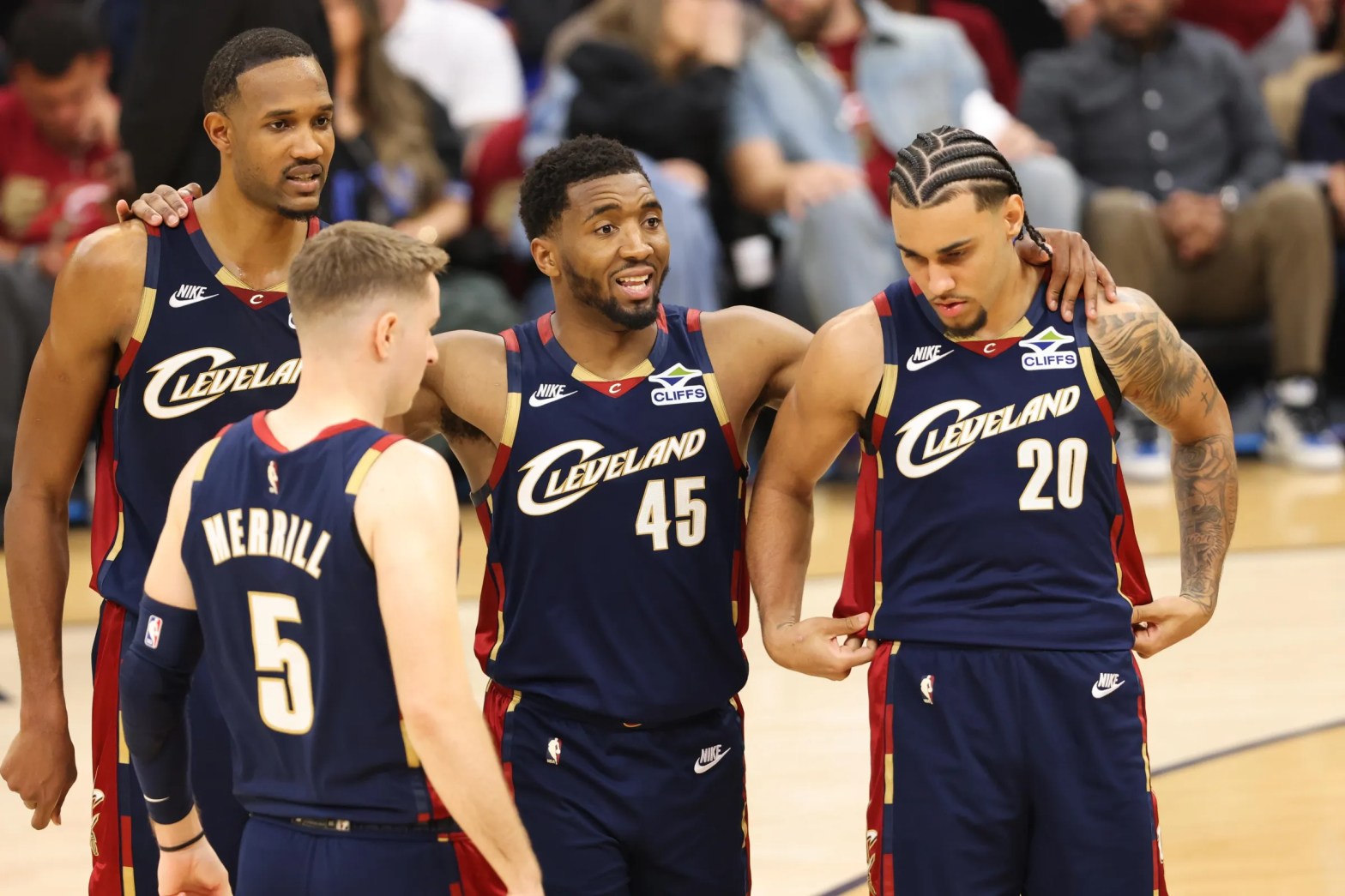
First, let’s get the elephant out of the room right away. I was obviously completely off with my Eastern Conference Finals prediction of Cavs in 7. You can’t get much further away from Cavs in 7 than the Cavs being swept in four. Maybe if the team bus hadn’t shown up for one of the games. That’s about the only way possible. Even in a world where the Cavaliers hang on to win Game 1 rather than squander a 22-point deficit, that probably makes a difference in the series (perhaps Knicks in 6 then?), but it certainly wasn’t the difference between a series win and a series loss.
No, Cleveland was outpaced by a noticeable margin by the Knicks, to say the least. The outcomes weren’t close. The Cavaliers were defeated by double-digits in all games of the series with their median margin of defeat being 14.5 points (which is more forgiving than their average margin of 19 points, but also, a 37-point deficit in Game 4 does a lot to skew that average).
Some of that margin can obviously be attributed to New York being a better team. Alternatively, Cavs’ star guard Donovan Mitchell is on record with the media saying that the Cavs did this to themselves, and I cannot help but agree. The Cavaliers struggled to put away their first round foe in the Toronto Raptors despite being the better team, having home-court advantage and Toronto being at a significant health deficit. The Raptors did not have their starting point guard for the entire series and had one of their best scorers hobbled for part of the series, missing the end of it entirely. The Raptors should have been ended in 5 games. Instead it took seven.
Admittedly, there is less shame in Cleveland allowing their second round opponent to make it to seven games as well. The Detroit Pistons were the top regular season team in the Eastern Conference, carried by a player in guard Cade Cunningham that received first place Most Valuable Player votes. They were also a great defensive team that wasn’t going to make it easy. Still, the Cavs laid a complete and total egg in a closeout game at home in Game 6 of that series, again making life harder on themselves.
Due to their inability to put teams away, the Cavaliers played a game every other day for nearly a month- from April 29th until they stopped playing entirely after May 25th. Meanwhile, the Knicks had nine days of rest before playing Game 1 of the Eastern Conference Finals. That context makes a Game 1 collapse make a lot more sense. Same for the continued lethargy that followed. I’m not excusing it. This was the pinnacle of basketball. There are only so many opportunities to achieve what the Cavs were trying to achieve and they failed to live up to the challenge. I’m just giving reason to it. And again, like Mitchell said, Cleveland did it to themselves.
That brings us to what might be next. There have been a number of potential roster and organizational decisions that have been speculated on and publicized. Unfortunately, I feel like the Cavaliers only have so many levers they can pull to improve, but the intrigue does continue.
What we know for certain is that both head coach Kenny Atkinson and team president Koby Altman will be staying. I feel both ways about Atkinson. He was a breath of fresh air when was he was hired going into the 2024-2025 season. Cleveland took off like a rocket in that first campaign, having arguably one of the best offenses in the history of the sport. In piloting the Cavaliers to the Eastern Conference Finals this most recent season, Atkinson is the first Cleveland coach to so without LeBron James on the roster since Lenny Wilkins in 1992. In fact, Atkinson and Wilkins are the only Cavs coaches to make the ECF when the playoffs have contained eight teams in each conference and LeBron was not on the roster.
On the other hand, Atkinson’s teams have found ways to underwhelm in the post-season despite their achievements. The 2024-2025 version of the Cavaliers might have been this era’s best opportunity do something special. They were ravaged by injuries, but also noticeably overwhelmed by the physicality, intensity and pace of the impending Eastern Conference Champion Indiana Pacers. Perhaps Atkinson simply didn’t have the talented he needed on the floor. All-Star level players in power forward Evan Mobley and point guard Darius Garland missed games in the series. Trade deadline acquisition and forward Deandre Hunter also missed time. Mitchell played through a sprained ankle. All of these players were hobbled even when they were on the floor. On the other hand, Atkinson didn’t do much to scheme Cleveland out of these issues and Indiana coach Rick Carlisle’s team philosophies propelled the Pacers to the series victory.
How much Atkinson should be blamed for the Cavs’ inability to put both the Raptors and Pistons away in shorter order this spring is up to interpretation, but he definitely deserves some blame. Every team the Cavaliers faced along the way was able to exploit Atkinson’s squad’s inability to take care of the basketball. Atkinson is on the record with the media stating that he doesn’t emphasize minimizing turnovers, thinking they are a necessary evil that comes with the creativity that great players bring to the game.
The Cavs continue to struggle with physical defenses that pressure the ball and disrupt plays in the half-court, the same issue that the Pacers exploited last season. To be fair, there is a reason why this style is trendy right now (it works at large, not just against the Cavs), but any counters, whether they be changes to personnel on the floor or scheme have been lack-luster on Atkinson’s part. Some of that must fall on him, but probably not enough to send him packing given the achievements that have also occurred under his tenure.
I’m more secure in Altman, in part because I appreciate the stability he has provided following the executive-level musical chairs that owner Dan Gilbert had been playing before Altman’s promotion. Altman’s continued leadership does have deeper merit though. The current crop of talent on the Cavaliers’ roster, for better and worse, is Altman’s vision. The rebuild that started upon James’s second departure has all happened under Altman and while there have been issues regarding the core of players that he has accumulated and their ability to “take the next step”, Altman has gone from a team that went 19-63 with Collin Sexton, Cedi Osman and Jordan Clarkson leading the team in minutes in 2018-2019 to making the Eastern Conference Finals. He’s earned the right to see this thing through.
That being said, there is ample evidence given the way in which Cleveland won playoff series this year, and the way they were so comprehensively dumped by the Knicks, that Altman’s roster does require improvement. He has been a creative architect to this point, unafraid to take risks both that have succeeded (trading for Mitchell), failed (trading for Hunter) and are yet to be determined (trading for James Harden) while also winning on the margins (acquiring Jarrett Allen as a footnote of a larger deal, developing Dean Wade into a strong complimentary piece) and sometimes following conventional wisdom (drafting Mobley, presiding over a youth movement).
Unfortunately, I think he also may have painted himself into somewhat of a corner. Since LeBron’s return in 2014, when the Cavs have contended, money has been no object for Gilbert.He has signed off on some of the largest luxury tax bills and payrolls in league history in order to keep core talent together on the Cavs’ roster. To that point, the Cavaliers’ most recent roster was the most expensive in the league.
The NBA’s most recent Collective Bargaining Agreement combats against an owner like Gilbert’s strategic generosity. Teams above certain spending thresholds (or “aprons”) have privileges taken away from them when constructing their rosters. These restrictions also compound as teams spend multiple years over the aprons. Cleveland was above the “second apron” last season, which means they are not able to use the mid-level exception to sign a player to an additional mid-level contract above the salary cap. They also aren’t able to trade for a player with a large contract by trading multiple smaller contract players away, among other restrictions.
I personally find that apron rules hard to follow, annoying and a bridge too far (perhaps I am just biased), but these are the rules we live under and those, I believe, are the two main restrictions that could make life hard for Altman.
They are also a major part of why Altman traded Garland for Harden. Along with Garland’s injury history, Harden is seemingly willing to play ball on opting out of his contract this summer and taking a pay-cut in order to receive multiple years of guaranteed money. The bad news is Harden is 10 years older than Garland. The good news is his willingness to adjust his contract could open up additional possibilities for Cleveland.
The biggest and most buzz-worthy possibility for the Cavs would be to trade with the Milwaukee Bucks to receive former MVP and star power forward Giannis Antetokounmpo. This is the type of move that jumps off the page and at face value would automatically put the Cavaliers on a shortlist of favorites in the East next season.
However, I am more lukewarm on the idea. Giannis missed playoff games due to injury in all but one season between 2020 and 2024. His team didn’t make the playoffs at all in 2025 as a calf injury limited him to less than 40 games. He will be entering his age 32 season, which doesn’t make him excessively old by any stretch, but Giannis plays a physical style of game offensively that is predicated on his physical tools. Will his game age gracefully? He likely has a high defensive floor due to his size and length, but he could regress some with a slower first step.
What bothers me more than potential on the court regression though is that for a player who has largely been portrayed in the media as humble over the course of his career, I personally feel like he has been a bit of a diva over the last 18 months. I don’t love how he has handled his relationship with the Bucks, where it seems like he is playing nice in front of the media talking about how he is committed to Milwaukee while he has clearly been asking to be traded behind close doors. Giannis has made it seem like its all his agent that is causing problems with the organization, making ultimatums and asking out when they don’t come to fruition. Giannis, we all know your agent works for you, not the other way around.
Antetokounmpo obviously isn’t the first player to ever use the leverage that his high-level skills create, but I don’t think his behavior rings out as someone that would embrace and be committed to winning in Cleveland. I think the cold truth is that in this market, when you get stars, they need to be players that either truly commit to the city and organization or can compartmentalize and lock in for a set period of time. I have nothing to back this, but I think Giannis is done with small markets, otherwise he wouldn’t be looking to jump ship in the first place.
That’s all without mentioning that Giannis is in the last year of his contract, so bringing him in is a massive gamble. There is a counter-example that makes me sound like an idiot, that being when the Raptors traded for Kawhi Leonard in surprisingly similar circumstances. That worked. The Raptors have the hardware to prove it. At the same time, I don’t think that experience is repeatable.
Fans are also hoping that perhaps LeBron would return to Cleveland this summer, and it genuinely pains me to say it, but my thoughts are also negative on James making a third stay in our fair city. This one is rather simple. I do think that LeBron has qualities to offer the Cavaliers on the floor. He would have to be willing to play a smaller role, and I question if he respects Mitchell enough to defer to him in the same ways that he has been willing to when Luka Doncic is on the floor in Los Angeles. However, my skepticism in this case is more about the finances.
Again, the Cavaliers are above the league’s financial aprons. As stated earlier, the Cavs could get under the second apron in their negotiations with Harden. They could also get under the first apron, but doing so would require not returning any of their free agents. Then, if the Cavaliers wanted to pay LeBron say, $30 million, for his services they would need to clear nearly all of that money by removing more players still on their roster. All told, we are looking at something like dumping Max Strus, Dennis Schroder, Dean Wade, Larry Nance Jr., Craig Porter Jr and Keon Ellis.
I understand I’m not talking about marquee names here, but that is a lot of depth to lose in order to have your starting lineup include a 42-year old and a 37-year old. All of that depth would need to be replaced with players making the minimum. Take this with a grain of salt, I have a heck of a time managing the cap in MyLeague in NBA 2K. But… I have a heck of a time managing the cap in 2K and even I think this isn’t a great idea.
There may be other moves the Cavs could pursue via trade though that could be worthwhile. Getting under the second apron is imperative for all of them, but any of Timberwolves’ power forward Julius Randle, Pelicans’ forward Trey Murphy or Celtics’ wing Jaylen Brown would be fascinating additions to Cleveland’s starting lineup.
Acquiring any of these three players would likely require the Cavaliers parting with one of their two key big men in Mobley or center Jarrett Allen. Unfortunately, Minnesota is more likely looking for guards to pair with Anthony Edwards rather than gumming up their offense with another big next to Rudy Gobert. As for New Orleans and Boston, those conversations would likely start with Altman offering Allen and his counterparts then asking for the more highly thought of Mobley.
Mobley was arguably the Cavs best player this post-season. He scored 17 points per game while leading the team in rebounding, providing more assists than anyone but Harden and continuing his elite level defense. He also blocked nearly 2 shots per game and led the team in Player Impact Estimate. On the one hand, this could be the time to sell high on Mobley, whose offensive game has yet to round out in a way that you can depend on him to create his own shot now five full years into his NBA career. On the other, do you really want to part ways with him after he finally proved himself in the post-season?
Brown is a highly decorated proven winner. He could provide the kind of leadership that the Cavs lack because they are a roster that devoid of players that have successfully climbed the mountain before. He’s also a 5-time All-Star, 2-time All-NBA and a former Finals MVP all while still being technically south of 30 years old. It would pain me to send Mobley to a team we might see down the line in the playoffs, but for Brown it would be worth it. From Boston’s perspective, Brown has always been somewhat redundant sharing the offensive load with star forward Jayson Tatum. The Celtics have been trying to find proficient big men ever since the Al Horford renaissance ended. The deal could make sense to both sides as long as Cleveland can get the finances to work.
All that is to say, while Murphy will be just 26, has shown an ability to create on the wing, and shoot it at a high-level and it would be fascinating to see Mobley play next to Zion Williamson, Murphy lacks the intangibles to put the Cavs over the top. His youth also doesn’t match the timeline that Altman forced this roster into by hitching his wagon to Harden.
Meanwhile, Brown would be committed for three years, longer than anyone we have talked about, but still just a year longer than Mitchell. He is one of few players that would make it okay to part with Mobley, and I just don’t think the Cavs end up acquiring the type of transcendent talent they need by trading Allen.
There is the chance as well that the Cavaliers could just work on improving on the margins. There is an argument to be made that any scheming Atkinson did once Harden was brought in the fold needed to be done on the fly. This group only had about three months together. A full training camp and 82 games playing together could cause improvement on its own. Whether or not that alone would be enough to overtake what should be an improved Eastern Conference in 2027 is yet to be seen.
Due to the increasingly restrictive nature of the NBA’s current cap rules, the Cavaliers’ pathways to improving on what was both a season of achievement and disappointment are restricted, but they certainly aren’t entirely eliminated. The road that Altman, Atkinson and company face is challenging, but they have both done enough at times to allow fans to keep an open mind. Altman has been creative and willing to take risks before and I am curious what he may have up his sleeve this off-season. Atkinson did lead one of the best offenses in league history just two seasons ago. This is a roster with four different All-Stars on it.
The Cavs hit another roadblock, but this group has found ways to maneuver and progress all while making a splash. I wouldn’t put it past them to do it again.
 Pick-Up Sports Talk: Cleveland