Crunch Time Break Down: What’s Kevin Love so Mad About?

Yesterday was a tumultuous day for Kevin Love. Subject to trade rumors since at least Dec. 6th, Love has grown increasingly frustrated recently with his status on the Cleveland Cavaliers. For background, Love signed a 4 year, $120 extension in the wake of of LeBron departing Cleveland in the summer of 2018. That extension started this year and will carry out through the spring of 2023. He inked that deal with the understanding that the Cavaliers were going to try to continue to field a competitive team, capable of reaching the playoffs. This notion didn’t come out of thin air, but rather from the statements that were made to him by General Manager Koby Altman.

Obviously, that hasn’t happened whatsoever. A little over a year later the Cavs are now 10-25 and look like a top-half lottery team for the second year in a row, and are still in the beginning stages of a complete rebuild. As such, Love is the subject of continual trade rumors and even though he hasn’t formally asked for a trade, would likely welcome one. How do I know this? Well for one, there are reports that say so. But also, things appear to be hitting a boiling point between Love, his teammates and the Cavaliers’ staff.

Saturday afternoon following shoot-around, Love had an emotional “outburst” that was directed at Altman. One of his claims during that outburst was that the Cavs have “no feel”. Further, in the waning seconds of the 2nd quarter in Saturday night’s contest vs. the Oklahoma City Thunder Love appeared visibly frustrated and threw up his hands at ball-handling guard Collin Sexton mid-play. Love stood in front of him until Sexton passed him the ball. This led to Love firing a pass to forward Cedi Osman (who ended up being fouled on a 3 point attempt).

Bad body language, outbursts, a desire to be traded, and alleged complaints about head coach John Beilein. Love doesn’t sounds like a good teammate right now.

I think his frustration to a point is understandable though. The sticking point is the actual on the court actions of himself and his teammates. All that I laid out above is obvious. Its’ all macro-level considerations of the situation that Love finds himself in. If you take a look at the nuts and bolts of a game situation that Love finds himself in though, it could be perceived as pretty maddening.

I’ll provide an example. I will call this a “crunch time break down”. I might do more of these in the future, where I lay out a close game and explain what I saw as an avid basketball fan. Forgive me. Its going to be wordy. I could just as easily throw up a video and say “see for yourself”, but there are specific points I want to lay out. Without further delay:

This past Thursday night the Cavaliers took on the Charlotte Hornets from Rocket Mortgage Fieldhouse (gag).

With about 5 minutes left in the game the Cavaliers led 100-93 and Love, forward Cedi Osman and center Tristan Thompson have all just re-entered the game after rest. The following possessions occur (this is going to be fairly Love-centric, but I plan to be even-handed):

Right off the free throws that allowed the trio to come into the game Love received the ball in the post and travels. Its his only turnover of the night, the Cavaliers had 14 as a team. 4:58 remains in the game. Cavs still by 7.

Charlotte point guard Terry Rozier makes a three and Charlotte now trails by 4. On the next Cavs’ possession the ball never leaves Sexton’s hands. He drives into the crowded paint and puts up a contested layup with 3 seconds left on the shot clock. He held the ball for the entire 21 seconds. Not only is it a miss, Love is open at the 3 point line. 4:13 remains. Cavs lead 100-96.

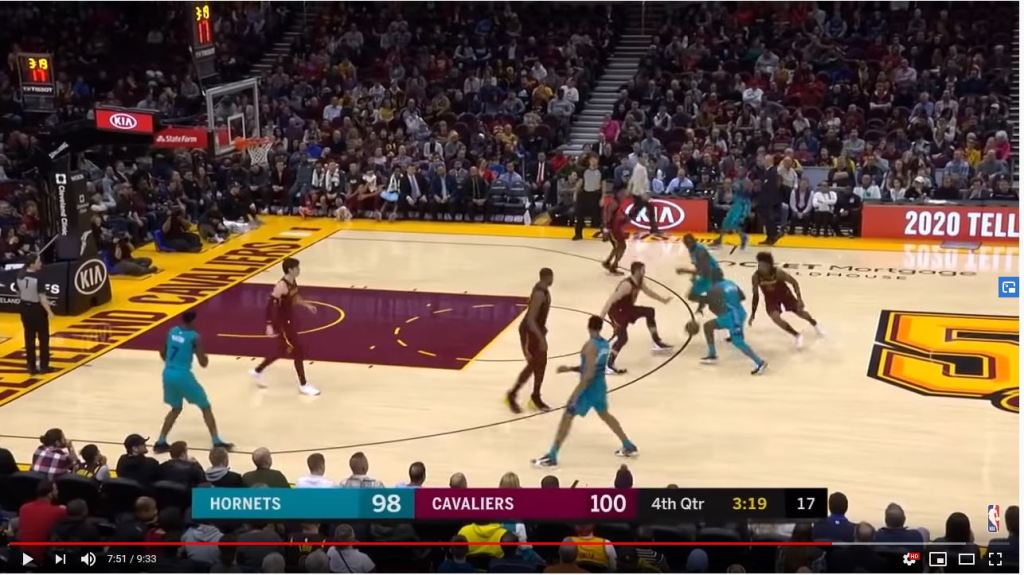
Charlotte forward PJ Washington’s layup makes it a 2 point game. On the Cavs possession they run a set play. After the ball comes up the forecourt, Love receives the ball at the top of the key and immediately gives it up on a dribble hand-off to wingman Kevin Porter Jr. Porter dribbles around the perimeter into traffic and takes a bad contested layup. The shot is no good. Love isn’t as open this time, but is still uncovered on the left wing. Osman and Sexton are also open on the left side of the floor. Two bad, contested layups in a row. Cavs lead 100-98. 3:27 remains.

Porter putting it up, surrounded by 3 Hornets. Love, Osman and Sexton, all open to his left.

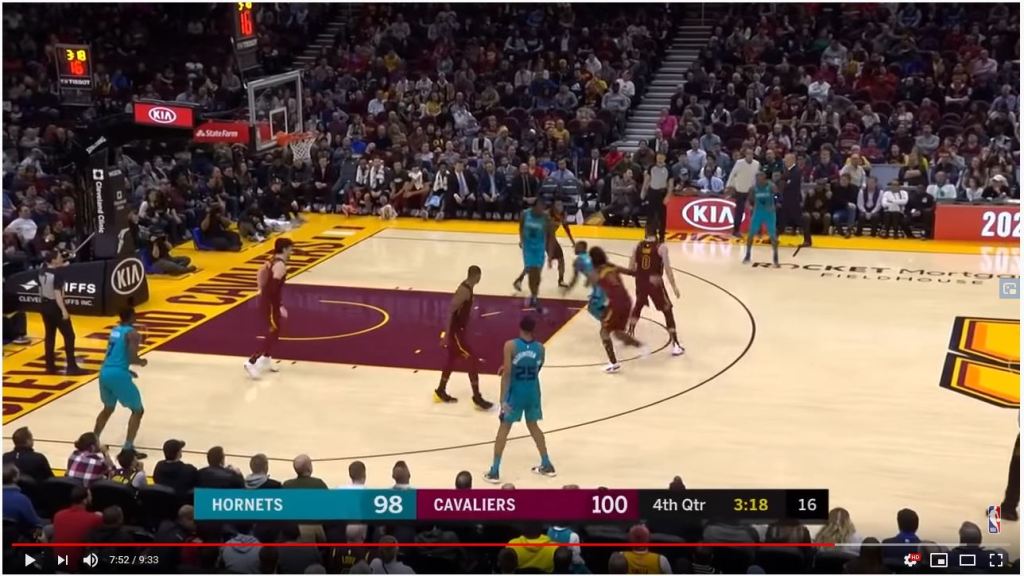
On the ensuing Charlotte possession Rozier comes right down the floor off the rebound, and receives a screen from center Bismack Biyombo. Love had been guarding Biyombo and shows hard on Rozier. To Rozier’s credit and the slow-footed Love’s detriment, Rozier crosses Love, who fails to impede his progress. Porter was Rozier’s man, but he went over the top of screen and now can’t recover since Love failed to keep Rozier in front. This means the man guarding the weak-side corner- Osman, should come to help. He doesn’t. Tie game. 3:16 left. Cavs call timeout.

Love tries to keep Rozier in front
Love is too slow. Osman appears ready to help.
Osman is still standing there. Easy layup.

Coming out of the timeout Beilein draws up a play for Love off of a Thompson off-ball screen at the top of the key. Love takes an open three in rhythm but misses. 3:06 left. Still tied at 100.

Charlotte guard Devonte Graham throws a pass into the stands and the Cavs get the ball back. A Darius Garland-Love screen and pop leads to penetration by Garland down the right side of the lane. Garland kicks to Sexton in the left corner. 3 ball… got it! This is the best play you will see throughout this entire exercise. Cavs lead 103-100. 2:30 left.

Hornets come right back down and Graham answers with a 3 of his own. We are tied again. The ensuing Cavs possession has Garland bring the ball up the floor on the right side of the key. Osman comes out, slips a screen and dashes to the left wing behind the 3 line. Osman briefly flashes open but by the time he receives the pass and puts up the shot he is contested. 1 pass was made, the shot was contested, Love never touched the ball and 11 seconds were on the shot clock when Osman hoisted. Bad possession. Still tied. 1:58 remains.

Look who is open on the other side of the floor.

Sexton plays sparkling defense that leads to a Garland steal of Rozier. Garland is fouled in the open floor which leads to a review to check for a clear path foul and an unofficial timeout. No clear path foul occurred, but its Cavs’ ball and we are still tied.

Beilein uses the extra time to draw up a set play for Love coming off another screen. He takes a good shot, but misses the three pointer at the top of the key. We are still tied and there’s 1:30 left.

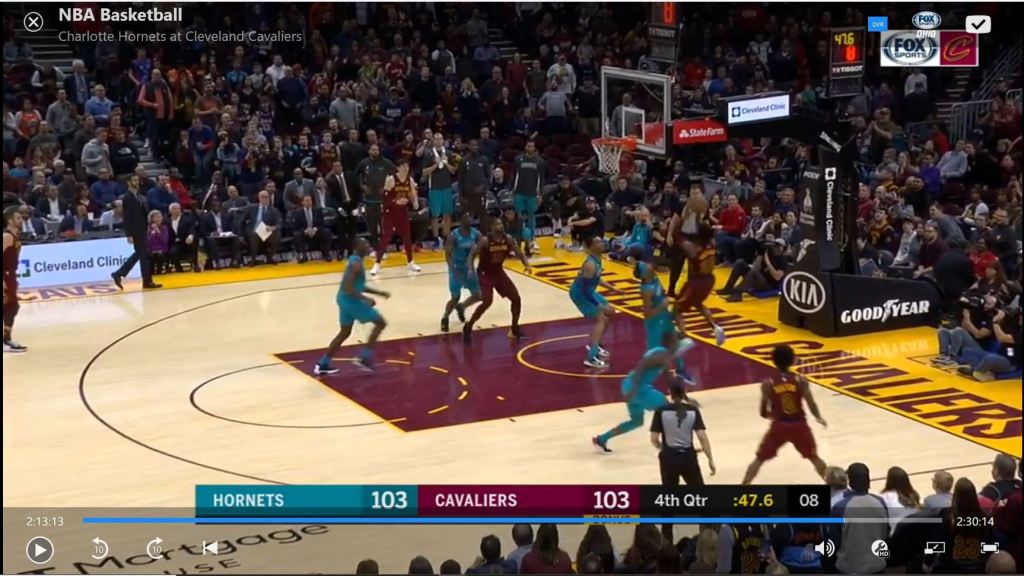
More good team defense in crunch time leads to a missed three by Rozier. We are really getting into crunch time now as Thompson pulls down the rebound and gets it to Garland as we get under the minute mark. Garland and Love run screen and pop again. It looks a lot like the play Sexton made a 3 on instead this time Garland takes a layup in traffic with 7 seconds still on the shot clock. Biyombo should be guarding Love at the 3 point line but he has completely abandoned his post and has come down to the key to help on the drive and ensure he retrieves the rebound. This is the most open Love has been yet, naked on the left wing at the 3 point line. We are still tied and 45 seconds remain.

Love is barely in frame, but open. Osman is open too.

On their possession Charlotte runs a screen slip that leads to a bad, contested three that Graham makes even though he had no business taking it. Basketball-reference.com describes it as a “36-footer”. I give credit to Sexton for contesting. 106-103 Charlotte. 23 ticks remain.

Beilein calls timeout and the Cavs inbound at half court. Austin Carr directly says on the broadcast “You can (afford to) go to your second or third option here and get a 3 point shot.”. John Michael makes mention that a quick 2 pointer wouldn’t be bad either. We either want to work for a 3 pointer to tie or find a quick, easy 2 pointer and allow time to still come back.

Love comes to the ball at the left wing and receives the inbound. Its a screen hand-off to Sexton at the top of the key. Sexton’s initial drive is shut down, but he tries again and dribbles into the paint. Biyombo completely leaves Love this time. You can see it down below. He knows there is absolutely no chance Sexton is going to pass the ball back out. Its another missed layup in traffic. The Cavs were down 3, Sexton took 8 seconds and only got a contested layup out of the possession. That was neither a couple passes that led to a three, nor a quick, easy 2 pointer.

Biyombo pulls down the rebound because he has nothing better to be doing; the Cavs foul twice and send Graham to the line. He makes both and Charlotte leads 108-103. 9 seconds remain. Looks like checkmate.

Beilein calls his last timeout and the Cavs take the ball out from half-court again. This time the play is a direct pass to Love in the post off the inbound. Instead of guarding Love, Biyombo is guarding Osman, but hedges inside to help on Love. Love actually notices and fires the ball out to the perimeter to Osman. 3 ball… got it! Holy cow! Someone passed to an open player, and a shot was made?! The Cavs still trail by 2 and there’s only 4 seconds left.

Actual court vision.
Cedi for 3!

The Cavs foul again and the door kinda, sorta swings open. Rozier misses one of two free throws and its a 3 point game again, but the Cavs are out of timeouts and have to inbound in the back-court. Sexton gets freed up 40 feet from the rim and fires a decent looking shot, but its no good at the buzzer. Love comes over and rubs Sexton’s shoulders. I’m not a lip-reader, but he appears to tell him “good shot!”. The Cavs lose by 2 after leading by as many as 10 in the fourth quarter.

So what do we have here? 11 possessions in the final 5 minutes for the Cavaliers. Love touched the ball on 6 of them but two of those were quick give-ups for a dribble hand-off and a screen hand-off. Three different times he was left wide open on the perimeter and four different times a young Cavaliers’ ball-handler took a bad, contested layup at the rim. That’s just as many attempts as legitimate touches that Love got in the final five minutes.

I would be frustrated too. I am not saying that Love should be taking every shot down the stretch of a close game. Absolutely not. But at the same time, each possession that didn’t involve him was absolutely poor. The only one where he didn’t touch the ball and it went well was Sexton’s corner three. Yes, Love missed 2 threes of his own. They were good, open shots. They weren’t contested layups with two or more defenders draped over the shooter while the best player on the team stood wide-open for three. That’s how you lose games. That’s not how you build any type of winning culture. That’s the type of thing that leads to this:

A good friend of mine texted me and said he thinks Sexton lost track of the shot clock. Could be, but it seems more like Sexton just doesn’t have any real vision. He isn’t really a ball-handler. He couldn’t see Love standing near the paint with the 6 foot tall Chris Paul on him. Love literally has 9 inches on him! I think that’s what Love might have meant on Saturday when he blew up at Altman and said the Cavs have “no feel”. These young guys have no feel for how to operate a professional level offense. What is Coach Beilein teaching these guys anyway? The crazy part is that with the shot clock running down, Love found a half decent look for Osman for three, and they got foul shots out of it. That would not have occurred unless Love did what he did.

Yes, Love is being surly, but I think he has good reason. Quite genuinely, if placed in this position I think a certain former Cavaliers’ star would act very similarly as well. In fact, this on-court attitude is somewhat reminiscent of LeBron taking himself out of plays while Kyrie Irving and Dion Waiters fought over the ball in 2014, or the month long pout-job he did in January of 2018 to force Altman to re-form the Cavs roster at the trade deadline.

I don’t think Love means anything ill by what he is doing, but he is frustrated. I can’t blame him for that. Unfortunately for him, he might have to ride out the storm for this season. A Love trade still seems like a rigorous endeavor at this point.

More on that to come…

MLB’s Negotiating Terms With Minor Leagues Are Dirty, and Hurt the Game

In an effort to cut costs earlier this off-season, Major League Baseball created a proposition to cut affiliations with up to 42 Minor League Baseball teams. That’s right. The same billionaires that are comfortable shelling out $324 million to Gerrit Cole over 9 years and $245 million over 7 years to Anthony Rendon are worried about their ability to cover the expenses of the Staten Island Yankees and the Burlington Bees (Angels affiliation).

They have brought this proposal to the negotiating table against the Minor League Baseball, as the agreement between the two parties is set to expire after the 2020 season. Eliminating the current affiliations would make the 42 teams independent, meaning they would no longer have a league or players. They would still exist as businesses, but they would be be fending for themselves and would have to find new independent leagues and their own rosters. MLB has taken what is usually a formality of negotiation and renewal and turned it on its head.

So why is this happening? Really, this began in 2014 when a lawsuit was filed in the State of California by minor league players alleging that their wages, which can run from $1000 a month to $3,000 a month depending on the level they play, were unfair and violated minimum wage laws. Major League Baseball is responsible for these wages and has benefited since 1938 from a government ruling that stated that minor league baseball players are seasonal employees, and therefore not protected under the minimum wage. This ruling was renewed in the US Government’s March 2018 spending bill, that was passed specifically with a statement that excluded minor league baseball players from federal labor laws.

Backing up though, that 2014 lawsuit was established as class action in 2017 at the Federal level. A US Magistrate Judge ruled that a collection of players who played in the California League could continue as plaintiffs. However, similar players playing in Arizona and Florida were ruled out until this past August when the US Circuit Court of Appeals in California ruled 2-1 in favor of including the players from additional states in the class action. This also means that even more players can join and ultimately, maybe be entitled to not just improved wages in the future, but damages resulting from their lack of pay in the past. While it has not been a huge story, this definitely has not been a great public relations situation for MLB and they have to figure that in the long run, this lawsuit might not turn out in their favor.

To their credit earlier this year, the Toronto Blue Jays (run by former Cleveland Indians President Mark Shapiro) announced they would be raising their minor league wages by 50 percent. However, they are the only organization to get out ahead of this issue and improve wages for their minor leaguers.

I’m sure the other owners can see this controversy brewing though. Its ultimately not a good look for the teams to be paying their farm hands so very little. Unfortunately, the solution they have come up with doesn’t seem very even handed either. It appears that they all aim to follow the example of the Houston Astros organization (since they’ve just been so classy lately) and cut minor league affiliates while banking on improved player development technology to account for the smaller talent pool. One aspect to not be neglected here is that technology. If teams can use Rapsodo to better measure spin rate or SwingTracker to better judge and correct flaws in a hitters swing they don’t have to play as much of a numbers game when hoping to find talent.

Are you with me so far? Because its about to get worse.

With all of this in mind, and the above mentioned Major League/Minor League negotiations going on, Manfred took it a step farther last Friday, publicly threatening to cut ties with Minor League Baseball as an organization entirely. The statement comes it seems from a point of frustration in negotiations. Manfred has been vocal recently about Minor League Baseball’s inability to be flexible in talks and further, how he did not care for how public the Minors organization has been with the press about the removal of 42 teams. The commissioner apparently decided the best way to take out his frustrations about his counterparts playing the press as a negotiating tactic… was to also play the press as a negotiating tactic. And he sure did swing for the fences.

To be clear, cutting ties would not mean the abolition of minor league baseball, but rather, Minor League Baseball. It would mean that MLB would be negotiating with the individual teams instead of all of them together in one organized entity. This set up with provide MLB with a huge amount of leverage to do whatever it wants in the talks, being able to throw its proverbial weight around since it would be working from such a great place of financial power.

So here we are. The billionaires club that is the MLB owners have grievances about having to make sure their employees are paid the minimum wage. So much so that they want to eliminate 42 teams worth of roster spots. Never mind that five full months of pay at $1700 a month for a first year AA player comes to $8,500. Add a little extra cash for how the season extends into September and that player is getting compensated about $9000 for their talents. For those of you keeping score at home, the poverty threshold for a single American under 65 years old is $11,770. It sure is a darned shame those poor billionaires can’t even muster up the extra $2770 just to get their AA players (never mind players below that level) to the poverty line without cutting teams out of the equation.

Additionally, minor leagues as an institution are a gambit that the largest growing sports league in America, the NBA, only recently has gotten into, but now nearly every NBA team has a G League Affiliate. Baseball has over a one hundred years of infrastructure working in its favor. Yet, the NBA is able to pay its G-Leaguers $35,000 salaries.

This all goes without mentioning each team of course has its own season ticket salespeople, game-day operations managers, and concessions workers among other occupations. With the fate of their teams in jeopardy, so are all of those jobs. Those jobs are in danger today based solely off of association.

And yet even further, not only would all these people be hurt, but the owners would likely be hurting the welfare of the game. One of the best marketing benefits that baseball has is its established network of minor league teams. If you just live in or around a small city there is likely inexpensive, professional baseball near you. There are 261 teams worth in America. You might not be able to afford lower level seats in the big city, but you’re likely to be able to watch the stars of tomorrow in that town nearby, all up close and personal. Maybe one or two of them will even make it to the show and that will encourage you to start watching their Major League club on television (queue baseball’s biggest money maker: the television contract).

To be fair, yes. Minor League Baseball should likely be willing to negotiate on some things. Maybe they can take on a greater portion of overhead costs or be less dependent on the Majors for improving their facilities. They could even take on a part of player salaries. But, there are 4 countries recognized by the United Nations that make less money in GDP than the New York Yankees just committed to Gerrit Cole (I keep mentioning Cole. This isn’t about MLB players. They are the product. They have earned their payday from the owners). The $209 million each team received in revenue sharing in 2018 would pay for nearly six-thousand $35,000 NBA G-League sized salaries.

For the MLB owners to work for the removal of 42 teams and all the jobs and economic impact that come with them though is dirty business. Dirty business that seems to be a positive for them and them only, with even the game itself possibly taking a hit.

And now they’re threatening to take their (probably juiced) ball and go home if they don’t get what they want.

If even the purveyors themselves aren’t looking out for the game, who is?

If Indians Were Looking to Improve By Trading Corey Kluber, Now Wasn’t the Time to Do It

When I started writing in this space I promised Cleveland baseball content, which to this point, has actually been conspicuously absent. I had another post all punched out and ready for editing today, but then I started getting the alerts early this afternoon on my phone. Truthfully, I was hoping to not have to start Indians content this way:

The Cleveland Indians have traded two-time former Cy Young Award winning ace starting pitcher Corey Kluber to the Texas Rangers for outfielder Delino DeShields Jr and rookie relief pitcher Emmanuel Clase.

The acquisition concludes over a year of trade discussion about Kluber, that dates back to talks from before baseball’s 2018 Winter Meetings. Talks about Kluber continued all last winter, but the Indians could never come to terms with any team and decided to begin the season with Kluber and his $17 million contract on their books in a continued attempt to compete for the World Series.

Ultimately, that move might have proved costly. Kluber was not good in April at all, posting a 5.80 ERA in 7 starts. This sample size was small, but not promising before a line drive come-backer by Marlins outfielder Brian Anderson nailed Kluber in the pitching arm on May 2nd and ended not only his night, but his season. It likely also diminished his trade value. Kluber was injured through the July 31st trade deadline and a return in August proved impossible after he suffered an oblique stain while rehabbing his arm in the minors.

The Indians came into this off-season with all that baggage around Kluber. Still, with a clean bill of health given trade talks commenced again about the dominant right-hander. This is the part that I just don’t understand.

A lot of fans like to lament the Dolan family. I, for one, usually don’t. I applaud them for the fact that as an ownership group they have largely hired incredibly competent people to run their baseball business and not meddle in affairs. I genuinely believe the Indians are run as one of the 5 best organizations in all of baseball and a lot of this has to do with the steady hand of ownership.

Everything I can think of would suggest that wasn’t the case with this Kluber trade. Let me be clear on why.

Kluber’s value was high coming off of the 2018 season. He finished third in Cy Young voting, posted the best ERA of his career besides years that he won that award and led the AL in innings pitched and walks per 9 innings. The $17 million he was slotted to make in 2019 was a considerable amount of money, but a relative steal compared to the $23.3 million AAV a lesser pitcher like Patrick Corbin received on the open market that winter. Names included in trade talks at the time included legitimate prospects like Padres outfielder Hunter Renfroe, who would crush 33 home runs in San Diego this past season.

A combination of the poor April and the injury that followed likely zapped a lot of that trade value. Teams were able to come into talks this winter with the Indians using Kluber’s poor performance and injury to negotiate a better deal. What is puzzling to me though is why the Indians front office would still go through with it.

This is a staff that largely loves to sell high. They did not do this whatsoever with Kluber. If I was in their position I would have to question an offer like the one that was ultimately accepted. Kluber may be coming off of an injury, but it was a freak one, not based on stress or miles on his arm, but by an accident. There was no structural damage to his elbow or shoulder. There should be no reason to expect the injury to linger. Further, his poor month to begin the 2019 season was just that: a month. What are you more apt to trust? The one month of ineffectiveness he struggled through in 2019, or the six seasons of dominance that came before it? This was the perfect opportunity for the Indians to shelf the trade talks and let Kluber return to form. A likely better performance and a clean bill of health could either lead to the dominant ace you know helping propel your ballclub to 2020 playoff hopes, or at least a better value at the trade deadline. To be clear, my beef is not with trading Kluber at all, but for trading him now and for what was received in return.

Instead, Kluber was traded- when his value probably couldn’t have been any lower than its been since talks commenced. Why? As stated before, the Indians front office deserves a lot of credit under the Dolan’s ownership. With the exception of the Manny Acta years they have provided competitive baseball consistently while at the helm. If I can see the flaws in the trade they just performed, I’m sure they are aware of them as well. So what’s the deal?

Remember how I congratulated the Dolans on not meddling? Well, maybe they have started. Its likely not a coincidence that Kluber’s $17 million is coming off the books in return for a paltry rookie contract and the projected 2nd year of arbitration contract of $2.4 million for DeShields. We already know that the marching orders last winter were to cut payroll, and cut payroll the Indians did in the removal of Lonnie Chisenhall, Michael Brantley, Andrew Miller, and Cody Allen among others from the roster via free agency. Maybe this is all step 2 in that process, but it couldn’t come at a worse time.

The Minnesota Twins won the AL Central last year. It was the first time since 2015 that the Indians didn’t carry that pennant. The Chicago White Sox have amassed a strong lineup of hitters that appear ready to break out. With the right smattering of pitching, that becomes a very talented ballclub also looking to usurp the Tribe in the standings.

The Indians answer to all of this so far? Trade their somewhat expensive, but relatively reasonably priced ace pitcher when his value is lowest.

Speaking of… what have the Indians gotten in return? To be frank, there actually is at least a little good news here.

DeShields is a light-hitting right-handed outfielder that played exclusively in centerfield last year but can play leftfield as well. He hit .249 in 2019 with just 4 home runs and a fairly average .325 OBP, but did steal 24 bases. His weighted Runs Created plus (wRC+) was just 72, and is just 76 over his 4 year career (100 would be average, higher is better). Defensively, he held the 4th best Range Runs for any centerfielder in baseball, while being a middle of the pack quality centerfielder otherwise. Oddly though, he hasn’t played any other position than centerfield since 2017, an area likely to be patrolled by Oscar Mercado in 2020 and beyond for the Tribe. Ultimately, DeShields was worth 0.8 Fangraph’s WAR in 2019. His career high is 2.1 in 2017 when he hit .269, scored 75 times and had 29 stolen bases. Basically, he’s a fast, athletic outfielder that was taken 3rd overall in the 2014 draft, but few other tools ever developed.

Clase is a right-handed rookie relief pitcher with a fastball that scouts absolutely adore for both its velocity and movement. He only pitched 23.1 Major League innings in 2019, but posted an ERA of 2.31 in those innings. He has shown an ability to limit walks, both in the minors and with a walk rate of just 6.4% for the Rangers last season. His combination of a blazing fastball, able to regularly hit 99 MPH, while not walking many hitters is a talent beyond his years. He also incorporates a slider, but will likely automatically be the biggest “power arm” in an Indians bullpen that often got by with only finesse in 2019. Ben Clemens at Fangraphs claimed he could be one of the best relievers in baseball just this past August. (If you don’t click any other link in this post, click that one. It will give you hope.) He is a legitimate solid pick-up.

Clase is the real chip here that the Indians got in return, but he projects as a (possibly even dominant) set-up man for their bullpen. Someone you hope will pitch 70 innings a year but nothing more. I truly feel the Indians could have gotten more for Kluber if they had played this right, and they likely know this too, either kicking themselves for not trading him last winter or wishing they could give it one more go this summer.

That was not be though, and it makes me wonder if the walls are closing in around the Tribe front office when all it would take is the money the Dolans had already committed in order to keep the team’s competitive aspirations afloat. It makes me really wonder what’s next.

It makes me not so confident in a front office that has given me every reason to be.

Doncic and the Mavs Are Great… Maybe Even Historically Great

We are now about a quarter of the way through this NBA campaign and four teams that didn’t find themselves with a playoff spot last season are currently in the top eight in their respective conference. Of those teams, there were a couple you could expect a leap from. The Miami Heat and Los Angeles Lakers added star power in Jimmy Butler and Anthony Davis, respectively. Those 2 squads were poised for the leaps that they have taken. On the other end of the spectrum, the Phoenix Suns find themselves as an 8th seed today after having the worst record in the West just last year.

The team that has made the biggest leap in the standings though is the Dallas Mavericks. And news-flash: they have been really good. After finishing 14th in the West last season, just above the Suns, they are currently cemented into 2nd place, 3.5 games behind the Lakers. That’s a 12 position jump in the standings. The Mavs also have the 2nd best point differential in the Association and have won 5 games in a row including a 46-point thrashing of the New Orleans Pelicans yesterday that saw star forward Luka Doncic score 28 points in just 26 minutes.

(Full disclosure, as I have edited this post they have come back from a 20-point deficit vs. the Kings tonight and are now wrapped up in a close game. All that appears above and below does not include data from that game… I hope I didn’t jinx them. I already look silly because Kyrie still hasn’t returned to action).

Doncic in particular has been incredible. The internet has been buzzing just in the last couple of weeks about his superb play. Last year’s Rookie of the Year has already taken another step forward at just 20 years old.

At 20, the Slovenian-born former Euroleague MVP is leading the NBA in Basketball-Reference’s VORP statistic, a stat very similar to the WAR stat that is used in baseball. Let me be perfectly clear on how good Doncic has been. Doncic’s VORP of 3.0 puts him on pace to finish the season at a VORP of 11.2. Only 2 men have ever had a rating that high for a season. You might have heard of them. Their names are James and Jordan. Did I happen to mention that this guy is 20 years old?!

For those of you not as enamored with new-fangled stats, he’s also nearly averaging a triple-double with 30.1 points per game (good for 3rd in the NBA), 10 rebounds per game as a 6 foot 7 guard and 9.2 assists per game. There are 7 players in the league this year that are shooting 73% or better at the rim while taking at least 5 such attempts per game. Doncic is the only one listed under 6 foot 9 and is also the only one that has logged all his minutes as a guard, according to Basketball-Reference. All of this is coming from a guy that a lot of basketball talking heads didn’t think would have the athleticism to be a star in the NBA. He’s not perfect. He’s taking the 3rd most 3-point shots in the league while only making about 32% of them… but did I mention he’s 20 years old?!

Beyond Doncic, this team has been incredibly sound. They’re first in the NBA in Offensive Rating and have the fewest turnovers per game. Sixth-man Tim Hardaway Jr. has the best turnover percentage in the league while being one of three double-digit scorers on the squad alongside Doncic and power forward Kristaps Porzingis.

The X-Factor here though is Porzingis. Last year’s big name acquisition before the trade deadline is only 20 games into his return from a torn ACL that caused him to miss all of last season. The Mavericks gambled when they traded for him and to be fair he isn’t a sure thing. His scoring numbers are down. This has been the least efficient shooting season of his career by True Shooting Percentage (.499) and he’s averaged fewer points per game than any season other than his rookie year. However, he’s rebounding at a better clip than he ever has (15.0%) and is 5th in the league in blocks per game (2.0). I would say this signifies that he is playing hard. His offense is going to come. This is already the league’s best offense and Rick Carlisle knows a little bit about how to showcase an over-sized power forward who can shoot from anywhere on the floor.

For perspective on this team’s brilliance with the ball, last year’s Golden State Warriors have the best Offensive Rating in NBA history at 115.9 for a full season. Right now, this year’s Mavericks are at rating of 117.9. I know we are only 22 games in and I am getting ahead of myself, but they are on a record pace and Porzingis is likely only going to get better. If he can become the more adept scorer that he was while playing for the Knicks this team could even find another gear. This could be a historically proficient offense.

Outside of Doncic and Porzingis they have had real professional efforts from the rest of their roster. Hardaway has scored 12.5 points per game off the bench, Dwight Powell’s defensive field goal percentage (57.7) puts him in the company of other respected big man defenders like Marc Gasol and Mitchell Robinson. Bench guard Delon Wright is 10th in the league in Offensive Rating.

Yes, this team seems somewhat devoid of star power outside of their two top guys, and really Doncic is head and shoulders above Porzingis at this moment. It isn’t all positives. Their performance bares similarities to LeBron in his first go-round with the Cavaliers, although to this point Doncic has even out-paced LeBron’s age 20 season.

This is only the beginning though. Porzingis is just 24 and I think I remembered to mention that Doncic is 20. ESPN’s Zach Lowe calls the Mavericks quite possibly the next team to have a roster with a “Big Three” a la LeBron, Kyrie Irving and Kevin Love or Ray Allen, Paul Pierce and Kevin Garnett. Even if they don’t add a big piece, Dallas has become an organization of great stability and infrastructure under Mark Cuban, Donnie Nelson and Carlisle. They should be poised to be a real problem in the West for years.

The Dirk Nowitzki story might have just ended in Dallas, but a new and possibly even bigger tale may just be beginning.

Kyrie Irving Will Not Be Returning for Games in Cleveland or Boston. A Conspiracy Theory?

The Brooklyn Nets have announced that star point guard Kyrie Irving will miss the next three games with a shoulder impingement, however this is not new news. Cavalier fans should be familiar by now with Irving’s injury woes throughout his career. Beyond that, this particular shoulder injury has ailed him for over a week now. He was last seen on the hardwood on November 14th in a 101-93 loss in Denver and if he misses the next three games as scheduled he will have missed seven in total.

What is really newsworthy here though is who those next three games he will miss entail. The Nets are hitting the road right now and are headed on a three game trip that will take them first to New York (okay, so in that case maybe they aren’t hitting the road quite yet), and then to Cleveland and Boston next week.

For those of you who might have been hit on the head or just don’t pay close attention, Cleveland and Boston are the last two cities that Irving played for. Not only did he play in them and depart, but neither departure was exactly… amicable.

After three straight finals runs with the Cavs Irving requested a trade, likely tanking any legitimate chance at a second NBA title in the LeBron era, and being the first domino to fall in what ended up making the King himself pack his bag and head for the sunnier pastures of Los Angeles.

Starting with the 2017-2018 season, Irving then spent the next two campaigns in Boston after an abysmally executed trade sent him to the Celtics. Irving’s problem has never been his play on the floor, and he continued to be one of the prime scoring guards in the league for Boston in 2017-2018, averaging 24.4 points per game on a career high True Shooting Percentage. Fortunes turned though as an injury late in the year caused him to miss the playoffs. Young stars like forward Jason Tatum and guard Jaylen Brown thrived without Irving on the floor and really came into their own, making it all the way to Game 7 of the Eastern Conference Finals. When Irving returned in 2018-2019 it proved too difficult for the team to mesh both personalities and play styles between Tatum and Brown’s emergence, Gordon Hayward’s return from injury and Irving’s desire to remain top commander of both the ball and attention. Irving departed unceremoniously in free agency, but not before an ugly playoff performance that saw him shoot the worst percentages of his playoff career and put up negative values for Offensive Win Shares.

For both the friction he caused and the false promise of his skill in the playoffs, many Boston fans were happy to see Irving go. They were likely only happy to see him return next week in a Brooklyn uniform so that they can boo the pants off of him. Boston is an opinionated city. They are going to let you know where you stand, and Irving very well might be basketball public enemy #1 right now. Needless to say, Irving seems to have drummed up some ill will on his way out of both of his previous situations.

Further, this would have been Irving’s first return to the TD Garden. He has also only played in Cleveland one time in four opportunities since leaving the Cavaliers, and that was the very first game of the 2017-2018 season, his very first as a Celtic and first as a non-Cavalier. He has not played in this town since. Even with the Celtics in the playoff chase last year he skipped both late season opportunities to play against the Cavs in February and March. Both times he ended up playing the game both before and afterward indicating no injury kept him out of the lineup. Maybe we ought to be paying closer attention to when some of these guys take their “Load Management” days off.

What am I trying to say? Shoulder injury or not, Irving might be ducking these games in Cleveland and Boston. I’m not the only one saying it either. The Athletic’s Joe Vardon reports that two sources tell him Irving flat out will not travel to either city. Further, ESPN’s Kendrick Perkins has stated he thinks Irving was never planning on playing in either city for these upcoming games.

I’m not willing to go to a full conspiracy theory like Perkins and say Irving is currently sitting out to make missing these two games believable. Even in this era of player empowerment I don’t think a team is going to be receptive to a player on a contending team disappearing for that long as an… emotional precaution (think about that box score note… “DNP- Emotional Precaution”). However, it is an awfully convenient coincidence for him to take his time recovering his shoulder and then maybe come back when the Nets return to Brooklyn after their game in Boston.

You would think then that Irving is trying to dodge the same kind of venom in Cleveland that he is likely to receive in Boston. What is strange though is that in that one return he actually received a fairly mixed reception. And of course he did. You must remember after all that he was the man that hit the game-winning shot in Game 7 of the Finals. Really, even with the his messy departure there is good reason to revere him in Cleveland.

It seems to be Irving’s own attitude though that gets in the way now. He truly is a perplexing individual, and frankly I think its all ego. Its almost like those old memories are beneath him. This is the man who decided he didn’t want to live the basketball version of the good life. He didn’t want to play second fiddle to LeBron and be able to gobble up the victories and Finals runs that came with that experience. He wanted to go out on his own and prove himself. Honestly, I really think there is something to respect there but at some point he is working against his own best interest. Sure, he wanted to win. I have no doubt about that, but he also wanted to be the man at the same time. Nothing less would suffice. Here we are two years later, and Irving is now in Brooklyn, with Kevin Durant in tow. Maybe Irving has convinced himself Durant will never be the top 3 player he was in Oklahoma City and Golden State and that he is still primed to be the man in Brooklyn for years to come. Or perhaps Irving realized he could really use the help after all. Its all too hard to tell.

What I can tell is that its likely that same ego that is telling him to not bother to return to Cleveland or Boston. Its funny. I’m not even sure he harbors any malice for the fans or the city of Cleveland in particular. I literally think that for him the victory of the 2016 Finals wasn’t good enough because LeBron was the team leader and best player. Even though Irving made the Finals-clinching shot. Even though he scored 41 points in Game 6. Some how, some way, in that mind of his that was still a hollow victory. LeBron was running the show and he wasn’t. It doesn’t count, and not only does it not count, but he doesn’t want to re-live it.

The Boston stuff? That’s a LITTLE more understandable. Naturally, I think we would all rather he soak in the boo birds and then go out and silence them with his play. That would likely be the impressive way to perform, but if the Nets are okay with it then its totally his prerogative to avoid them. You know, to take the easy way out.

What a contradiction, and really such a shame. Irving truly harbors a ton of talent. He’s even put it to great use in his career already. I just hope some day he’s able to get over his own ego and find a new perspective. Maybe one day he will enjoy it. Maybe one day he will even play against the Cavs in Cleveland again.

It Was All Good Just a Week Ago: 5 Reasons for the Cavaliers Recent Struggles

Just last Tuesday the Cleveland Cavaliers were up five points, on the road against Eastern Conference favorite Philadelphia with 2:30 left in regulation. They sat at a record of 4-5 at the time, technically in an Eastern Conference playoff spot, albeit only 9 games into the season. They would go on to squander that lead and lose the game 98-97 in the Wells Fargo Center.

Since then they have dropped 4 more games in a row including yesterday’s 124-100 loss to the Miami Heat. They have been out scored in these games by an average score of 117-99. Even more startling, the average score after 3 quarters has been 95.5-73. The final quarters in each game have been 20/20 club garbage time.

So what happened? This team was showing promise not but 9 days ago and looked like they would be more competitive than we (or at least I) originally imagined. Now it seems like the bottom is dropping out. Coach John Beilein went as far as to scrap his starting lineup after halftime yesterday, playing a different rotation to begin the 3rd quarter.

Of course, understanding problems is the first step in solving them. Below I have 5 big reasons I think are tantamount to the Cavaliers’ recent struggles. All statistics referenced either come from basketball-reference.com or NBA’s tracking data and stats.

  • The Cavaliers average 7.2 of their shots being blocked per game. Only the Atlanta Hawks are worse at 8 shots blocked.

The league’s best teams at avoiding blocks average about half of this. Two of the last four losses have included double digit blocked shots against. There are 11 Cavaliers that have had a shot blocked during their most recent losing steak, and the only regular to not have been rejected is Larry Nance Jr. I think a lot of this can be attributed to a lack of flow in the offense. In their last four games, the Cavaliers are just one of three teams in the league to assist on less than half of their made baskets. They aren’t moving the ball effectively and are putting up predictable and often difficult shots. The chief culprits in this have been Tristan Thompson, who has gotten blocked 5 times in 3 games and Collin Sexton who has been blocked 6 times in the last 4 games.

Sexton in particular appears to be desperately, and ineffectively trying to create offense- mostly for himself. During this losing streak, the majority of his shots are coming after 3 dribbles or more. His second most popular location to shoot from during this span has been the area inside the paint but outside of the restricted area. This has also been his least efficient shot according to effective field goal percentage (35%). This would dictate he is forcing his way into the paint to take contested shots near, but not at the rim and he is missing a lot of them. Naturally, he is getting blocked on others. When placed in this situation it seems like it would be a perfect time to draw the defense’s attention and then kick out to an open player. Unfortunately, Sexton is still averaging just 2 assists per game this season. His offense hasn’t been the only individual struggle though.

  • Cedi Osman hasn’t been good, especially defensively

I wrote in my Cavaliers preview that this was going to be a key year for Osman. The 3rd year forward was headed into a contract year with a full season of starting under his belt at the age of 24. This was the make or break year for the Cavs to commit to this high-potential 2nd round draft choice. They took that pressure away though by signing Osman to a 4-year extension just one game into this season.

Osman has not re-paid the Cavaliers for their faith as of yet.

Opposing teams have feasted on him on the defensive end of the floor. They are shooting 69.2% on field goals within 10 feet of the rim when Osman is the primary defender. This would dictate that size is killing him, especially when he is forced to play the power forward position. Miami power forward Julius Randle scored 30 points in the Cavs’ match-up with the Heat last Thursday in Cleveland. While Osman wasn’t always defending Randle, he was primarily. Osman would also be the main defender against Philly’s Tobias Harris when Harris scored 27 points on just 14 shots this past Sunday and for Duncan Robinson’s 9 for 12 on 3 pointers night that occurred yesterday in Miami.

Meanwhile, Osman’s Offensive Rating for the season is 99, with a rating of 100 being average. So for all his trouble on the defensive end, Osman hasn’t been proficient offensively either. His offensive ratings of 94, 66 and 76 in three of the last four losses are even worse to boot. But he isn’t the lone player to struggle on offense.

  • Tristan Thompson has been shut off offensively.

Thompson had been a rather large focal point of the Cavaliers’ offense in their first 9 games. He was effective enough that ESPN’s Zach Lowe wrote about how pleasantly surprised he was with how capable Thompson had been on the floor this year. Thompson didn’t play yesterday for rest reasons and perhaps the break was appropriate as for the season he is averaging 11.6 field goals a night. Over the last 3 losses before yesterday however, he had put up just 6.7 shots per game and was shooting just 45% from the field., compared to 53% for the season. Most notably, he only shot 3 times last Wednesday against the Heat in 23 minutes. Perhaps Beilein was right to keep him off the floor yesterday. I hope this means his minutes will be able to go back up in the coming games as Thompson hadn’t played under 30 minutes in a game before this now 5-game skid. He hasn’t played more than 28 since the streak started.

  • Wear and tear is starting to set in already.

Thompson isn’t the only regular Cavalier to miss time lately. Both Kevin Love and Larry Nance missed Monday night’s game against the Knicks in New York and I think the team paid dearly for their absence. Truly, some of the problems I am listing here are inter-connected. A lack of Love and Nance led Osman to more minutes at the power forward position, where Randle was able to take advantage Monday night. Additionally, the Knicks had 19 offensive rebounds in that game, a clear indicator of the lack of effective big men for Cleveland.

The Cavaliers also appeared lost on offense without the ability to run plays through Love, further worsening Sexton’s previously mentioned shot selection problems. They also turned the ball over 19 times to New York’s 7, leading to an assist-turnover ratio of less than 1. Absolutely brutal.

Additionally, the schedule hasn’t done the Cavaliers any favors. This week includes two back-to-backs, including a trip from Dallas to Cleveland with consecutive games on those trip days. This comes at the end of a 3 game road-stand that started with a home game followed by a game in New York also on consecutive nights. This schedule dictates that these current woes could get worse before they get any better. Which is bad, because defense requires effort and…

  • The Cavaliers are having trouble guarding anyone

For example, Cleveland has played Miami twice during this losing steak. The Heat have shot 54.4% and 52.6% in those games. The scoring is coming from stars and non-stars alike. In the first Miami game on the 14th rookie guard Kendrick Nunn scored 23 points with 8 assists. Another rookie, Tyler Herro had 16 off the bench. Journeyman center Meyers Leonard was 5 of 6 from the field and 2 of 2 from three.

In the next game in Philly, Tobias Harris killed the Cavs for 27 points on 14 shots leading to a phenomenal True Shooting Percentage of 90.7% (aided by Osman, as I mentioned earlier) . The Sixers shot 54.8% as a team for the game, aided by 11 Ben Simmons assists. Randle then ran wild in the following contest scoring 30 points on 17 shots and a 70.6% field goal percentage. Yesterday, it was the Duncan Robinson show as Miami shot 51.4% from three point land as a team. Probably the best stat to depict how horrible the defensive effort has been during this losing streak though is the 95.5 points per game the Cavaliers have averaged allowing through 3 quarters each game. For comparison, Cleveland has scored 97 or less for full games in 3 of their 5 recent losses.

The Cavaliers will have to clean up at least some of these issues if they want to get back to their winnings ways. This is a season of growth and their is a lot for Beilein and company to work on. To be fair, they are only 1 loss worse than I predicted as this point, but early flashes of competence have turned into the issues we see now.

There isn’t a lot of time to snap out of this. Five more games are to come in the next eight nights, but if Thompson can play effectively coming off of rest and young players like Osman and Sexton can show up in multiple facets, the Cavs have the ability to have wins ahead of them.

A Re-visit: Astros and Warriors Both Dealing with Their Very Different Demises

Both foreshadowed on this very site in the past month, the Houston Astros and Golden State Warriors are both former champions of their realms that are now being disgraced in current times.

During the Astros-Yankees ALCS this year I wrote about the rumors surrounding the Astros illegal sign-stealing. Well, just in this past week The Athletic’s Ken Rosenthal broke an official story that the Astros’ antics aren’t just a rumor. The article is behind a paywall, but includes corroboration by former Astros (and current Athletics) pitcher Mike Fiers. Allegedly, the Astros were using at least one camera in center field to relay what pitch was coming to their batter through a series of sounds, often including banging on a dugout trash can.

In recent days, former pitcher Danny Farquhar also spoke about his experience facing the Astros. A breakdown video of Farquhar’s appearance on September 21st, 2017 as a member of the White Sox highlights evidence of the tactics that the Astros used. The video is shown below. Viewer discretion is advised, the gentleman who put up the video does use foul language.

I also wrote about how while its was pretty apparent that the Astros were doing this, it wasn’t very helpful to them in their endeavors to win baseball games. Minute Maid Park may have more spy cameras than a Mission Impossible film, but the Astros have been just as good of a hitting team on the road during their 3 year run of dominance as they have been when their abilities have been… technologically enhanced… at home.

Meanwhile, other teams are livid. They want to drag the Astros through the mud for this. Houston General Manager Jeff Luhnow was met very coldly this past week at the annual off-season GM meetings. Players have gone on to mocking the Astros on social media and the like, including Cleveland’s own Mike Clevinger (also notice that the first 4 replies to the tweet belong to Logan Allen, Shane Bieber, Zach Plesac and Marcus Stroman).

My concern though is that Rosenthal alluded that the Astros weren’t the only team using illegal means to steal signs. Everyone is ignoring the “Part of a Much Broader Issue” portion of the headline. The Boston Red Sox have already been punished in 2017 for illegally using Apple Watches. There are now rumors about other teams as well. What are the chances that some of these players and executives will be eating crow when their own organizations get popped for doing similarly? Major League Baseball is investigating the entire situation, including interviews with Houston staff, Red Sox manager Alex Cora and former Astro and newly-named Mets manager Carlos Beltran.

Punishments are coming. We just don’t know how severe they will be yet or who will face them. I would not be surprised to see the Astros face a hefty fine, as well as a loss draft picks and international free agent pool money. However, will Luhnow face suspension? What about manager AJ Hinch? Both have been presiding over this farce. It is yet to be seen if player participants will be punished as well. The Astros could be absolutely decimated by this act that really didn’t statistically seem to help them. Sometimes winning at all costs really can be to your detriment.

All-New NBA Instant Replay, and That Pesky Human Element

So… something weird happened Thursday night in the Miami Heat’s victory over the Phoenix Suns from Talking Stick Resort Arena in Phoenix . However, I want to describe it before you see it. Don’t scroll to the bottom of this entry until you’ve finished reading.

Its the 3rd Quarter and the Heat lead by 5 with about 4 minutes left. Suns guard Jevon Carter plays a passing lane and intercepts a pass on the defensive end of the floor. He charges down the left wing to the other end, draws in the defense as he gets to the rim and flips a quick pass to the cutting forward Cameron Johnson on his right. Johnson leaves the ground attempting to finish a lay up and gets bumped on the play by Miami star Jimmy Butler. Johnson misses the lay up, the whistle blows and Johnson is set to head to the free throw line.

There’s just one thing… Butler is adamant that he didn’t foul Johnson. Luckily, this is the first year in NBA history where his team has recourse. Not only does Butler believe he didn’t foul, but head coach Erik Spoelstra confidently calls a timeout, followed by a wave of his right hand in a circular motion. Indeed, he’s calling for a coach’s challenge.

The coach’s challenge is newly implemented this year in the NBA, after years of being a part of other major American sports. Adam Silver and company are following suit in an effort to clean up officiating decisions. And who can blame them? Instant replay is there to make sure the call is absolutely, positively correct.

In case you don’t know the new rule and didn’t click the link, each team gets one challenge per game. Coaches can challenge a personal foul call against one of their own players, an out of bounds call or a basket violation, such as a goal-tending. Personal fouls can be challenged at any time; out of bounds and basket violations cannot be challenged in the final 2 minutes of regulation or overtime. The league office can also request a review of any such similar play, including in the final 2 minutes.

Sounds good, right? So Spoeltra knows exactly what he is doing. He calls a timeout as required, followed by signaling for a home run (you’ll see what I mean when you see the vid), which is the signal required by rule to challenge a call. He struts confidently onto the floor, certain of himself. Butler looks incredulous. In his mind, there is no way on God’s green Earth that what just transpired was a foul. A green light flashes on the scorer’s table and the referees head to the monitor.

For the next 2 minutes everyone sits around and waits. Any discernible momentum for the game is gone. Players, coaches and fans stand by idly. At home we can see the replays on television.

Its clear. Johnson makes an offering at the rim, expecting one of the better defenders in the league in Butler to challenge his shot. Butler does something funny though. He keeps his arms down and rotates his body completely away from the play. He does the opposite of fouling. Really, he does the exact opposite of defending. Contact is minimal to negligible. Lots of us who have even just played pick up games can empathize with Johnson. He didn’t miss the layup because of contact. He missed the layup because he was anticipating contact that never came. No wonder Spolestra and Butler look cool as cucumbers.

This call should be a snap. The referees spend nearly 2 minutes at the monitors. They must be trying to go over how to reverse a foul call into a non-call. This is a new concept after all.

Having come to their conclusion the purveyors of basketball justice return to the floor and…THE CALL STANDS?!?!?!

There is no justice.

And ladies and gentlemen, this is why I hate instant replay in sports. We all just wasted our lives, killed the momentum of the game, blew a Miami timeout and brought a lot of attention to a questionable call. All of that, just to still get the call wrong.

Now take a look for yourself and tell me that I’m wrong.

Instant replay was supposed to promise us the right call every time just by its existence. The mere fact that officials can go back and look at the play again and correct themselves itself theoretically now means we should expect perfection. Unfortunately, its just not that simple.

Plays like this one are subjective. There is no cut and dry answer. There is no clear and present boundary between a blocking foul, a charge call and a non-foul. It is all subject to the interpretation of a human. A flawed human, who can either rightfully agree or disagree with the thousands of wannabe referees in the crowd. He can also just be too proud of himself to change the call, want to cover for his fellow referee colleague, or any other number of reasons that he or she might interpret a call a certain way.

On the other hand, some calls really are cut and dry. Out of bounds calls. Goal-tending or not. Is the ball-handlers foot on the line or not? No judgment there. Just facts.

But even these calls aren’t always that simple. There are times where we want the spirit of a rule, but not the actual rule to the letter of the law. Baseball has these. Think of all the base runners called out by replay because when the runner slid his body came off the bag for a millisecond.

Think of Game 6 of just this past World Series this year where the umpires rightfully called runners interference on Trea Turner. Thousands of fans were in an uproar. The rule was implemented to the letter, but its practicality is questionable. Replay isn’t about practicality. Its about black and white where sometimes it doesn’t or shouldn’t exist.

But those aren’t basketball examples! Try the 4th Quarter of Game 1 of the 2018 finals. Kevin Durant was called for an offensive foul late in the game when he bowled over LeBron James on his way to the rim. Referees declared they were using replay to judge if James was in the restricted area when making contact with Durant. This is legal. They could use replay to see where LeBron was clearly positioned. Strangely, the rulesalso allowed for referees to then reverse any judgment made on the foul. In the end, the charge call on Durant was reversed, but not even because LeBron was in the restricted area. He wasn’t, but the refs used the review as an opportunity to reinterpret their original judgment into a blocking foul. Two different views, two different decisions and in a pivotal moment the referees changed a judgment call- a call contradicted by the referee expert on the broadcast (see below).

Replay often is time consuming, impractical and doesn’t work as intended. And really, its no one’s fault. Even in the most crystal clear of times it can be wrong. Which is why I say that if leagues want to use it on cut and dry calls, then more power to them. Be aware though that plays viewed in the replay lens may not always be as clear as they appear. Its only ever going to work to the best of the ability of the people being employed to interpret it.

Its harder than you think to get rid of the human element.

Baseball Cliff Notes: World Series Game 7 Edition

I have a lot of thoughts about last night. I’m just going to give them, start to finish. Consider this like Cliff Notes.

Early Innings

  • Zack Grienke was absolutely masterful. His second pitch of the night was an absolute bullet hit by Trea Turner that Alex Bregman snared out of the air at 3rd base. Other than that, he was untouchable. He had allowed 1 base runner in his last 16 batters faced before Rendon’s homer in the 7th threw AJ Hinch into a panic.
  • On the other end, Max Scherzer was solid. This is a guy who wasn’t able dress himself just days before pitching because he was in so much pain. Gutsy performance. Houston did a really good job early of being selective and making him work. They also hit some good pitches.
  • Yuli Gurriel’s homer in the 2nd in particular, was off a good pitch. It was a slider down, Gurriel was out on his front foot but got it in the air and got some help from the short porch.
  • In that same inning, there was a chance for this game to get away from Scherzer early. He gave up the homer to Gurriel, then left a fastball right down the middle to Yordan Alvarez for a laser of a line drive single. Carlos Correa then also hit a good pitch for a single. He waited back on a fastball on the outer half of the plate and beat the shift.
  • Robinson Chirinos then tried to bunt and I don’t know if that call came from Hinch or if he was doing it on his own, but it was a bad call. Why is your 8 hitter bunting for your 9 hitter, who is hitting .137 in the playoffs? Chirinos popped up the bunt. Man, was that a gift. Wasted at bat with men on 1st and 2nd and no outs.
  • .137 hitting Josh Reddick then grounded out for the 2nd out but Scherzer still almost botched the inning. He fell behind in the count 3-0 on George Springer. Springer swung on 3-0 and smashed a sinking line drive to left that Juan Soto had to catch off his shoe tops. A couple inches there and its 3-0 Houston, instead its 1-0 after 2 innings.
  • Houston was putting another good inning together in the 3rd. Jose Altuve hit a good slider for a single. Bregman put together a good at bat that led to a walk. Scherzer was really letting it fly against Alvarez a couple batters later. He hit 96 on the radar gun multiple times in the at bat. Alvarez still got on top of a 96 mph fastball above the zone and hit it to the track in center. If they are using the juiced baseballs its probably 4-0 Houston at that point. Instead it remained 1-0.

Middle Innings

  • Even with the low scoring, 1-0 game going into the 4th and with how good Greinke had been, neither pitcher recorded a strikeout until the 4th inning. Can you imagine that in today’s game? There were 2 former Cy Young winners pitching, by the way. I don’t know this, but I think the hitters were trying harder to put the ball in play given the weight of the game.
  • To that point, this is such a game of inches. Soto catches a ball off his shoe tops to end the 2nd inning and end a threat. Correa’s RBI single in the 5th bounced off Rendon’s glove at third base while he was in a full dive. He really almost had it, instead its a run scored and Alvarez went from 1st to 3rd.
  • Then there was the requisite asinine umpire review. Alvarez slid into 3rd on the play and Washington challenged that he came off the bag for a millisecond while being tagged. Luckily common sense prevailed and he was called safe. It just turned into a waste of a minute and 52 seconds of our lives.
  • In case my bullet points aren’t an indication, I was taking notes. After the 6th inning I specifically wrote in my notes “By no means should Greinke be removed. Pitching like a man on fire.” Foreshadowing.

Late Innings

  • Then to start the 7th he just leaves a fastball in the middle of the plate to Anthony Rendon. John Smoltz called it a changeup in the broadcast booth, but it was 89 mph, which is on the low end for a fastball for Greinke at this point in his career. I think he just mislocated. One mistake, the lead is cut in half to 2-1, and AJ Hinch begins pooping himself in the dugout.
  • Greinke then walked Soto. The 2-1 pitch was called a ball, but it looked like a strike to me. Its a shame, because the walk led to Hinch pulling Greinke. Too early!
  • Obviously, I would have stuck with Greinke. He made one mistake and then walked a guy with an iffy call involved. I think you have to trust you’re highly regarded starter there. Its become so en vogue to pull starters in playoff games that I think that Hinch managed the game in a way to try to avoid criticism. It didn’t work out for him.
  • But, a lot of people have made something of Hinch going to Will Harris instead of Gerrit Cole. I really didn’t mind that. Harris had not given up a run in the playoffs before entering the game last night. Yes, he’d pitched a lot, but he had pitched a lot because he had been incredibly effective.
  • It was also not the beginning of an inning, not a prime time to go to Gerrit Cole, who has one relief appearance in his entire career going back to college.
  • Harris immediately gives up the 2-run dinger, and the lead to Howie Kendrick. Hinch panics even more and goes to Roberto Osuna, his closer in the 7th. It works for the time being, but its 3-2 Washington now at stretch time.
  • Its still 3-2 in the top of the 8th. Osuna is still in. Adam Eaton walks with 1 out. Closers typically aren’t used to having to control the running game. Eaton steals second, mostly due to a lack of attention from Osuna.
  • So now, 2 outs, a man on second, Soto is up with first base open. He’s a lefty. Right-handed Kendrick is on deck with right-handed Osuna pitching. The Astros didn’t intentionally walk any batter all season long. They should’ve broken that rule for Soto. Instead, he singles in Eaton, now its 4-2 Washington going to the middle of the 8th.
  • I wonder if Dave Martinez would have stuck with Patrick Corbin in the 8th if Washington hadn’t gotten that insurance run. Corbin was fantastic himself though. 3 innings, 2 hits, no walks.
  • Specifically, Corbin’s bottom of the 8th was huge. One of the biggest pitches of the night was him striking out Jake Marisnick on a 3-2 count to end the inning. It was still a 4-2 game at the time.
  • That out allowed Washington to let Daniel Hudson go for a traditional 3-out save in the 9th. No need for him to get an out to end the 8th, sit back down and then come back in the game. It also kept the Astros from getting Springer to the plate with a chance to tie with one swing.
  • Hudson didn’t shy away from the moment in the 9th. He blew away Altuve with a fastball and then got Brantley with nasty offspeed. It was 6-2 at the point, but those were still the biggest pitches of his life.

Post-Game Thoughts

  • Not a very classy move by Gerrit Cole to only speak to the media as an agent of himself and not as an Astro. I get being upset at the outcome and not getting a chance to be a part of the game, but that’s not exactly the type of leadership and attitude I’d be thrilled with if I’m thinking of giving him a boatload of money this offseason. Ability talks though. He’s definitely going to get paid.
  • Congrats to the Nationals, man. They earned this. They won 5 games will facing elimination this postseason.
  • I’m happy for them and for DC. They hadn’t won a World Series in that town since 1924. The Great Depression and the second World War hadn’t happened yet. Absolutely incredible! Good for them.
  • Ken Rosenthal is a tiny man. He looked so little in that sea of Nationals.
  • Shoutout to Walgreens
  • Shout out to Bryce Harper
  • And lastly, and most importantly… Just 145 days until Opening Day!

Warriors Win! Everything is Back to Normal… Right?

I was about to look really silly.

That’s right, after Sunday night’s brutal 120-92 loss to the Oklahoma City Thunder, I was ready to proclaim this year’s version of the Golden State Warriors to be an absolute shell of their former selves. And for good reason! They had lost their first two games of the year by a combined 47 points, given up 141 in their opener vs. the Paul George-less Clippers, and failed to score 100 against the similarly Paul George-less Thunder. In neither game did the ever lead. I was ready to get onto this space, and start talking about how Golden State hadn’t just lost Kevin Durant to both injury and free agency, or how it sounds more and more like we won’t see Klay Thompson at all this year. I was also going to talk about how much the losses of Andre Iguodala and Shaun Livingston really meant to their play on the floor and their locker room. I was going to write about the lack of suitable replacements for all the players they have seen leave their roster and how once the injuries start rolling in, they don’t seem to stop. It was quite the story of doom and gloom.

This was all before Monday night’s match-up with the New Orleans Pelicans. And lo and behold, all those stories of a down-trodden former champion were thrown to the wayside. Following a tweak to their starting lineup and subsequent rotation changes, the Warriors played some inspired basketball. Despite shooting an incredibly startling 13.6% from the field in their first two games, Jordan Poole was thrust into the starting lineup tonight by Steve Kerr. The rookie used this as an opportunity to score more points in this one game (13) than his first two in the league combined (11). The Warriors hit some of the old, traditional hallmarks of their brand of play as well. An 11-0 run in the 2nd quarter stretched their 4 point lead to 15. They had 72 points at half-time and 103 by the end of the 3rd quarter. Draymond Green grinded and facilitated his way to a 16-17-10 triple double. The lead peaked at about 10:30 remaining in the 4th quarter. Warriors 108, Pelicans 79.

And for all of that. For Steph Curry’s 26 points and 11 assists. For the +36 that Draymond Green provided when on the floor. For the move by Kerr to ditch Marquese Chriss in the starting lineup and go straight to a small ball lineup with Green and Glenn Robinson III as the largest starters on the floor I just have one thing to say.

I still don’t think this Warriors team is very good.

Sure, they were on the 2nd night of a back-to-back. This much is true. However, they came into town to play an also win-less Pelicans team without its 1st overall pick in the draft (Zion Williamson), nor its best veteran player (Jrue Holiday).

From the very get-go it was clear the Pelicans were flat. The first four minutes of the game included a 1 of 7 start from the floor for the Pels, and 4 turnovers. The lack of focus and desire was palpable.

Twice the Pelicans had passes stolen off the inbound in this game. They shot 54.5% from the free throw line.

Golden State out-rebounded New Orleans by 20 rebounds, 61-41. 19 of those rebounds were the offensive variety, 8 more than the Pelicans.

With the Warriors sheer lack of size, there is absolutely no excuse to be out-rebounded like that. This team is playing Draymond Green, Marquese Chriss and Eric Paschall as its biggest men on the floor. Green is great, but he is 6 foot 6. Chriss is tall, but had already played himself out of the starting lineup. Eric Paschall is a 6 foot 7 rookie that Bob Myers took in the second round just a few months ago.

And while we are on the subject of size, New Orleans shot 47 threes. Forty-seven! I don’t understand the lack of interest in getting to the rim– getting outscored in points in the paint when you have the bigger players. Yes, threes are a big part of the game today, but so is getting shots around the rim.

I watched this game myself. I saw the play on the court. This was more of a game that New Orleans lost than Golden State won. It was absolutely gift-wrapped.

And that would mean that in a certain way, the Warriors remain win-less. The nervousness about this season still remains with some of their fans, and I totally can understand where that comes from. In that linked article, they are excited about the energy provided by Omari Spellman…

Yes, inevitably they will get some of their size back and contribution from guys like Spellman will be less necessary. Center Willie Cauley-Stein will make his Warriors debut after he returns from injury, and Kevon Looney will return soon as well to fill out their center rotation. Green and Curry will look great on certain nights. Kerr will mix and match new, young players. He will give them chances to learn and grow and they very well may be better for it. And to be completely fair, we really are still just three games in. I am sincerely teetering on the line for this being a hot-take.

Ultimately though, Curry is 31. That’s nothing in LeBron-Years, but for a point guard that’s going to be leaned on more this year than any other year of his career, that can be troubling. D’Angelo Russell may play the same position as Klay Thompson, but he isn’t Thompson. He isn’t even half the defender that Thompson is (well, technically he is: 4.5 Defensive Wins Shares over the last 3 years to Thompson’s 7, but you get the point). Really, he is more KD-lite, getting all the isolation possessions on a team that doesn’t really need isolation possessions unless they are coming from the most prolific scorer in a generation. Green needs to put up a Defensive Player of the Year caliber of a year, and that will mean doing more of what he did tonight and less of the -23 effort he put together Sunday. It will mean providing more for a squad that exited Monday night with the league’s worst Defensive Rating despite the victory. All the other guys? They just have to play replacement-level basketball and hope the above three stay healthy. With that, and only that will the Warriors make the playoffs in a dastardly deep Western Conference.

And what a far cry that sentiment is from one year ago today. 4 non-playoff teams in the West last year appear to have improved their rosters and are looking to vie for playoff spots that don’t really exist for that taking. Can the Warriors lose so much talent and really maintain a playoff-level of basketball both physically and mentally? Does the hangover over 5 straight Finals appearances get to them if they continue to slog out of the gates? At what point do they just punt the season because they are without Thompson and could really stand to benefit from pairing his return with a high draft pick in 2020?

Most importantly, could you imagine having all these questions about the Warriors last season? I sure couldn’t. But here we are.

The mighty have fallen despite last night’s easy indications. They are going to take their time to get their barrings, and perhaps a draft pick, before they stand back up.