Digging Slightly Deeper on What’s the “Right Thing” for Francisco Lindor: Part 1

Its been the biggest story of the Cleveland Indians off-season and really one of the biggest in the entirety of Major League Baseball. Indians All-Star shortstop Francisco Lindor will come into his fifth full Major League season this year and will do so without a long-term contract.

This past January, Lindor agreed to a $17.5 million dollar contract for his second year within the arbitration system. That leaves just one more season in 2021 before he will become a free agent on the open market.

The consensus is that Lindor, arguably the best player on the roster and the face of this generation of Indians teams, and the Indians front office have tried to work out an extension for his contract in the past, but simply haven’t come to terms. The Indians have a pattern of taking risks on young talent, buying out their arbitration years and even sometimes a free agent year or two, but Lindor has resisted. As he gets closer and closer to the open market it will likely just become that much harder to find an agreement. To his credit, Lindor has bet on himself, and more power to him for it. He stands to potentially make a huge payday in the 2021-2022 off-season.

While there isn’t absolutely no hope at all that a new extension could still happen, for some it seems a foregone conclusion that Lindor will not be on the roster beyond 2021. Even Indians owner Paul Dolan made a remark last winter that Indians fans should “enjoy” Lindor while they can. Meanwhile, just this weekend Lindor himself stated that he wants to bring a championship to Cleveland and that the most important thing to him is winning. He also specifically mentioned that the Indians just need to provide “the right thing”, but they haven’t offered it.

Very cryptic, but a lot of people assume the obvious. He is saying that he wants the Dolan family to show him the money, Cuba Gooding Jr. style. Now, this is merely just speculation, but I think everyone is just slightly off with this assumption. Sure, Lindor wants more cash, but there is one more detail here that isn’t quite as obvious that I really think Lindor is referencing.

Years. Years and years of commitment. Allow me to explain how I got here.

In 2019, the now 26 year-old Lindor had the 6th highest Wins Above Replacement of any shortstop in baseball. Among the five shortstops that performed better were four that are right around his age. The Cubs’ Javier Baez and Colorado’s Trevor Story are 27. Much like Lindor, Boston’s Xander Bogaerts and Minnesota’s Jorge Polanco are 26. All of them except Baez have signed some sort of contract extension with their current team. Bogaerts received the best deal at at $132 million (over 7 years).

Now, I do believe that Lindor is set slightly apart from this pack. He is the most prolific of this bunch of players, accumulating the most WAR over his career to this point. Further, this accumulation isn’t due to playing more games. He actually averages about .04 WAR per game, the rest of the bunch. Beyond this, he is a four-time All-Star, two-time Gold Glove Award winner, two-time Silver Slugger, led baseball in runs scored in 2018 and has finished as high as fifth in MVP voting (2017). Bogaerts (3 Silver Sluggers, 2 All-Stars) and Baez (2 All-Stars, 1 Silver Slugger, 2nd in MVP voting in 2018, led league in RBI that year) are almost as well decorated, but not quite.

What is my point here? I’m trying to establish a barometer for what a Francisco Lindor extension might look like. Lindor is the best player of this group and will want to be paid as such. Further, he will also want a slight bump in salary just because more time has passed since all these other shortstops’ deals have come to fruition.

However, I have heard a lot of talk thrown around in regards to $300 million or more… and I’m not sure Lindor’s market value is quite there yet. Once again, allow me to explain.

If you were to take the very best of the other shortstops’ deals you would end up with a 7 year contract at $19 million per year, equating to $133 million. That’s not anywhere near the type of numbers that Bryce Harper, Mike Trout or Gerrit Cole are getting, but this is what precedent suggests. It could also be proof positive that there is absolutely no chance of Lindor signing an extension. Players like Harper and Trout that hit the open market stand to make even more than when signing an extension. You can make the argument that the likes of Bogaerts and Polanco settled when they signed long-term without testing the waters.

Moving on with the precedent that we have though, Lindor is the best player of this group, and he will want more money for both inflation and in order to make the Players’ Union happy. For that reason, let’s change his terms to 8 years and $24 million per year for a total of $192 million.

I want to focus first on that $24 million figure though, because for the Indians, that really may not be an insurmountable number. Current 1st baseman Carlos Santana will make $20.8 million this year and that money stands to come off the Indians’ books following the season, barring the approval of his team option. Further, although it was the largest contract in team history, the Indians committed $20 million per year when they signed Edwin Encarnacion in 2017. If the Indians front office is able to account for that extra $3 million or so, I do think that there is an Annual Average Value out there that is manageable for both Lindor and the Tribe, particularly when you are talking about a star of Lindor’s magnitude.

However.

A long-term commitment is also essential to this deal. Of the other five shortstops that I mentioned before, only Trevor Story signed an extension that was less than five years (also excluding Baez, of course), and once again Lindor is the best of the best. He is going to want the best of the best, and herein lies the problem.

In March of 2017 the Indians signed IF Jose Ramirez to a 5-year contract extension worth $26 million. And that is the longest contract that the Cleveland Indians front office has ever agreed to. Beyond that, the Indians have only committed to one 4-year deal in team history, given to Travis Hafner in 2007. To top it off, notice that the AAV on that Ramirez deal is still only $5.2 million, making it relatively low-risk.

There is absolutely no way, no how that Francisco Lindor is going to receive anything near an eight year commitment from the Cleveland Indians, particularly at over $20 million per year. It just wouldn’t be in the nature of this front office or ownership group to extend themselves to those reaches. So to say its the amount of money that the Indians won’t pay to Lindor that is the problem is only half of the truth. I actually believe the Indians could meet Lindor’s monetary wants in the short-term. They nearly do right now. Lindor will make $17.5 million this coming season. They just don’t have the stomach to commit to him for the extended length of time that will be required. I think this is the “right thing” that Lindor is requiring.

We can and will discuss whether that is a good thing or a bad thing on another day soon.

9 Possible Kevin Love Destinations- A Ranking

The trade deadline now fast approaches following a Cavaliers’ victory on Monday night against the Detroit Pistons from Little Caesar’s Arena in Detroit. The Cavaliers move to 13-34 following the win and sit tied for 13th in the Eastern Conference with the New York Knicks. They are well on their way to second consecutive year in the draft lottery, and I have already written about their continually frustrating play despite this specific victory. Concerns continue to brew as reports come out that some of the players on the roster are frustrated that more progress hasn’t been made on the court.

Kevin Love is likely one of those critics. He has already let it be known that he would prefer to be traded to a contending team, while not directly demanding so. It is well-documented that he is frustrated though, showing it both on and off the court. Hard decisions are going to have to be made as February 6th approaches.

I came into this season thinking Love would likely remain on the roster through April, but with how this season has progressed and how detrimental keeping Love could possibly be to every party involved, its now a definite that a trade to ship Love elsewhere should at least be explored. Beyond that, we know for a fact that Cavaliers General Manager Koby Altman is listening to offers.

And the rumor mill spins. I’ve taken some considerable time to comb through that rumor mill and devise a list of suitors for Love. The teams I am about to list have had their names strewn about the inter-webs in regards to a potential attachment to a trade. I will put them in three categories and rank them, from least likely to most.

Before we get there though, we need to have some criteria for these rankings. Teams obviously have to financially be capable of taking on Love and his 4-year extended contract in a trade that makes sense for both sides. The money has to match up under NBA rules, and the trade must make sense. Beyond the basic financials of the situation, I will be mindful that most teams are also trying to save their cap space for the summer of 2021 when a monumental free agent class headlined by Milwaukee Bucks star Giannis Antetokounmpo will be available. Therefore, a team that can handle Love’s contract, and still have additional cap space is a better option. One possible exception to this element though would be a team that isn’t located in a big market or glamorous, free agent destination. That type of team would be much more likely to pull the trigger on a trade for a star of Love’s ilk, even with the flaws his contract perpetuates .

Further, Love must be a fit for that prospective team. This likely means its a team with a star or two on it already where Love would slide in as the 2nd or 3rd best player. The team would have to be able to swallow the fact that Love has statistically been one of the worst defenders in the league this year (299th out of a qualifying 311 in NBA.com’s Defensive Rating!!!). Lastly, a team currently in playoff position that isn’t considered head and shoulders above everyone else (so basically any team in either conference’s top 8 that isn’t the Lakers, Clippers, or Bucks) or a fringe playoff team looking to gain some cachet would be a better fit. I personally think the best bet to trade Love comes from a team looking to cause a stir by jumping itself from 9th thru 11th in this conference right now and into the playoffs.

Additionally, wherever it isn’t already mentioned, there is also the opportunity for draft picks to be included in these trades. I will talk a lot about the Cavs receiving players that often just fill salary cap rule obligations. Ultimately, most of the value back that the Cavs will ever receive will be in dollar-less draft pick selections.

There might be one or two more elements to this, but those would be specific to the teams we are talking about, and we will get to that. Without further delay, let’s get to it! Here are your nine ranked teams that have been rumored to Kevin Love trades.

I Can’t Believe Writers Thought These Were Good Ideas

9. Golden State Warriors

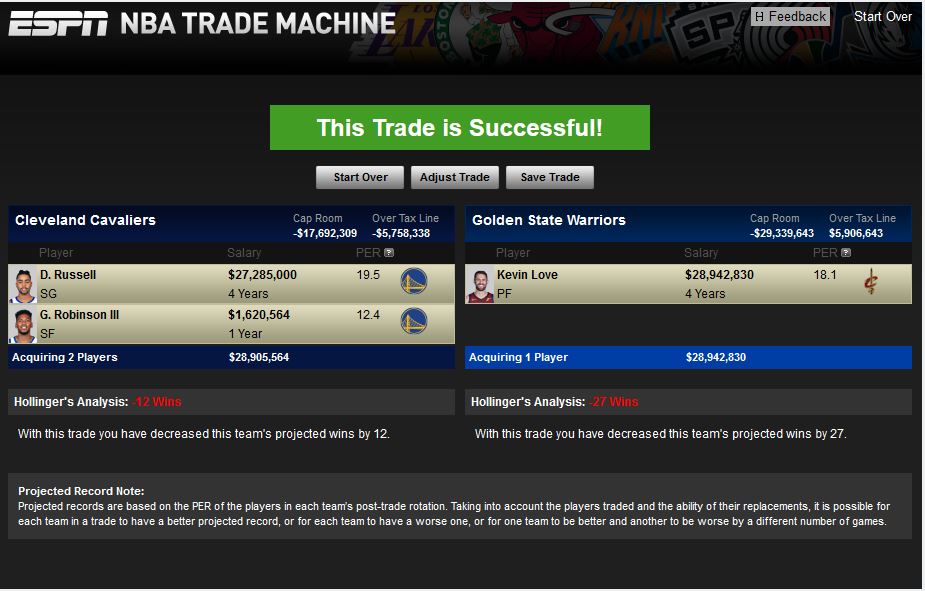
  • The premise behind this is that the Warriors are itching to get rid of guard D’Angelo Russell so much that they would be willing to take on Love in an effort to re-tool next season.
  • What’s more likely is that the Warriors will continue to tank out this season, try to come back with a fully healthy squad next year, plus a high draft choice and be nearly as scary as they were in 2016 all over again.
  • Yes, Russell becomes redundant next year when Klay Thompson returns and he is the only player financially that makes the money work here. MAYBE this is a consideration in the summer if Love hasn’t been dealt, but I suspect the Warriors are in no hurry to use their assets.
This trade is also bad because analysis shows it makes both teams actually worse.

8. Boston Celtics

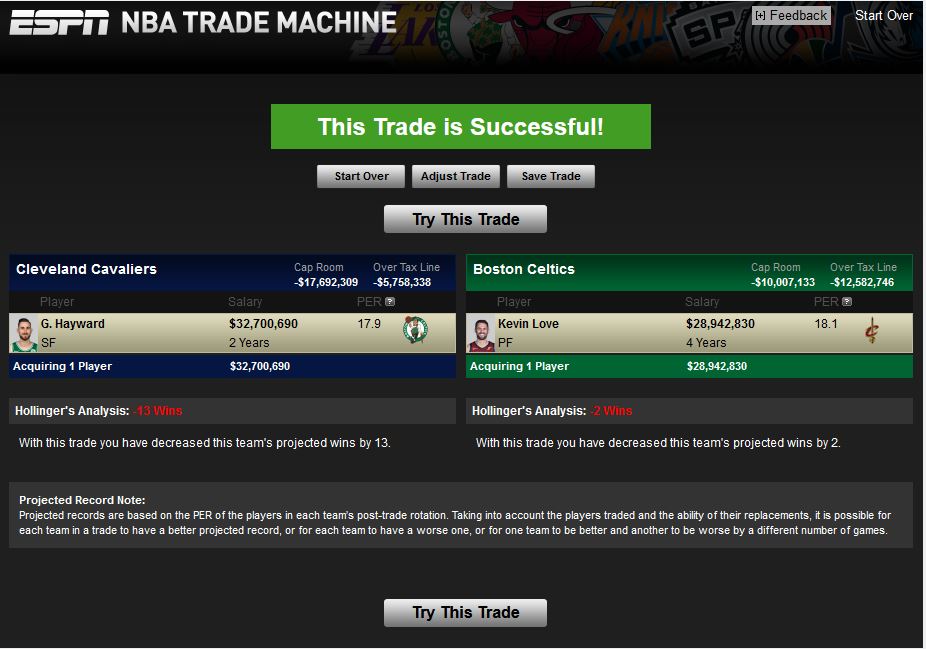
Love for Hayward straight-up is possible but unlikely.

7. Dallas Mavericks

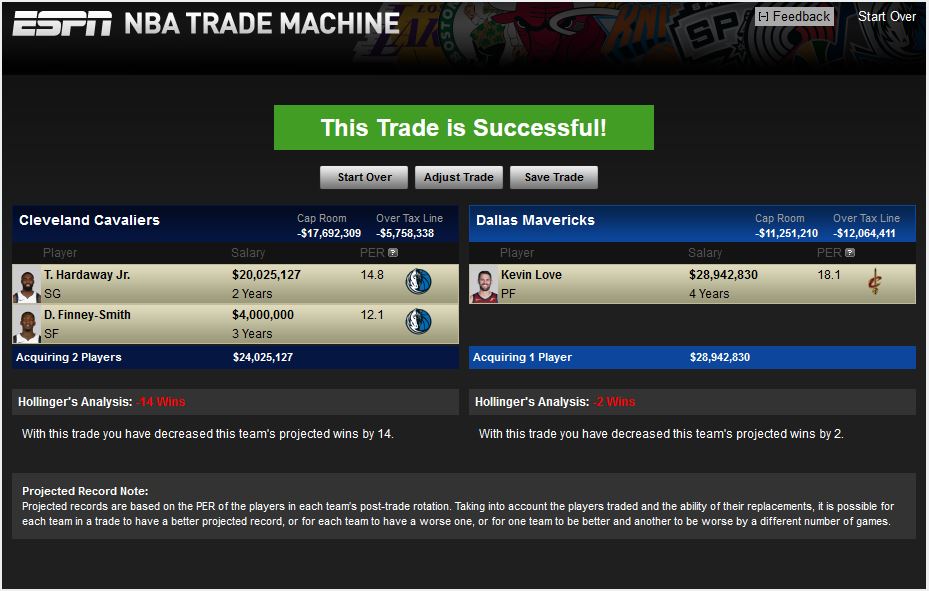
  • Another team where contracts lead to trade inflexibility, this one requires the Mavericks to deal sixth-man Tim Hardaway Jr. I fear he might be too difficult of a loss for a team with true aspirations to go deep into the playoffs. They’d be trading their 3rd best scorer for a guy averaging only about 3 points more a game if this trade were in the offing.
  • Love would slot in well with current stars Luka Doncic and Kristaps Porzingis, but he would fill their 2021 cap room. Doncic will be 22 in 2021. Porzingis will be 26. They are perfectly equipped to continue to progress for now and add another star when that summer comes. They have the possibility to be the next super-team in a couple years, but only if they don’t trade for Love.

Teams Where I Can Start to See It

6. Portland Trail Blazers

  • This seemed fairly likely at one point. Portland is Love’s hometown team and he has expressed interested in returning. I’d even call it his preference.
  • Also, stat-stuffing but often not-winning center Hassan Whiteside would be a likely centerpiece to any trade. I could see the Cavs being excited about giving Whiteside a 4th chance for his career to flourish.
  • Portland is a fringe playoff team, currently 10th in the West as they have disappointed all season. Love would be a good fit to go with star guards Damian Lillard and CJ McCollum.
  • However, Portland traded wing-man Kent Bazemore earlier this month and his contract was likely needed for flexibility in any such Kevin Love trade.
  • They are also 25th in the Association in defense, a likely explanation for their woes this year and something Love would far from remedy.
  • He’d also fill their cap for the 2021 off-season. Portland might be a little too underwhelming right at this moment to sacrifice their future. This trade seems a little ill-conceived.
A Blazers trade would likely include Whiteside, and a young prospect like Little or a pick. Either would be legal.

5. Miami Heat

  • Miami is an ambitious playoff team that could really stand to add to the star power it has with forward Jimmy Butler. They’re 14th in defense and Butler along with coach Erik Spolestra preach a style that could bolster Love’s abilities on the defensive end.
  • A trade would likely include some combination of veteran forward James Johnson’s bad contract and wing-man Justise Winslow, who has been oft-injured this season and played poorly when healthy.
  • However, due to previous moves the Heat are unable to include their first round pick in 2020 or 2022 in any trade, making sweetening the pot much more difficult and likely requiring them to trade one of the young, talented prospects that they have been depending on for production this season (my recommendation would be shooter Duncan Robinson). I doubt they will be willing to make that sacrifice.
  • Miami is a big-market, destination for free agents and the Heat are currently positioned well to bring in a big name player in 2021. They still could do so if they trade for Love, they currently would have that much space, but after relenting on trading for Thunder guard Chris Paul all summer for cap reasons, it sure seems more likely that Pat Riley would rather hold onto that money for another year and a half.
Duncan Robinson is just one prospect that Miami could trade in lieu of draft picks. Others include guard Kendrick Nunn and shooter Tyler Herro.

The Real Deal Ideas

4. Indiana Pacers

  • Indiana has a cavalcade of players that could possibly be included in a deal that would likely be headlined by center Myles Turner. The Olympian is expendable for a perceived inability to co-exist on the floor with other fellow big man Domatas Sabonis, who the Pacers are committed to.
  • The Pacers would fill their 2021 cap money if they trade for Love, but are a small market team not likely to pull in a big fish in free agency.
  • They already have players like guard Victor Oladipo and Sabonis to slot around Love and are the 10th best Defensive team in the NBA.
  • Concerns come from how serious are the Pacers about their playoff aspirations and the fact that this trade would occur within the Central Division. Indiana is 5th in the East and still doesn’t have Oladipo back from injury, but does a trade for Love really make them competitive with the Bucks? Will the Cavs trade Love within the Central? Still, there is potential here. This deal would check a lot of boxes for both teams.
Turner is valuable enough to potentially do this deal without picks involved, and Love could fit better with Sabonis.

3. Orlando Magic

  • The Magic are the 7th seed in the East right now and could really bolster themselves by adding a playoff tested star like Love who can provide offense to go with the 7th best defense in the league.
  • They are a smaller market, but do have some Florida appeal to free agents, which is handy because currently they could handle Love and an additional 2021 free agent on their books.
  • Aaron Gordon is likely the big contract to be traded back to the Cavs and he’s the closest thing Orlando has to a face for their franchise right now. That might be a price slightly too steep, or the Magic front office could think their potential has peaked with Gordon as their leader.
  • An interesting note: teams are also interested in Magic guard DJ Augustin. Augustin’s steady hand was crucial to Orlando’s playoff appearance last season, but they might also be willing to part with him in exchange for Love. A team like the Clippers though is much more likely to have use for Augustin, so a 3-team deal might be a possibility. This would likely require the Cavs to also acquire Mo Harkless from the Clippers.
  • A simpler 2-way deal such as Gordon and forward Al-Farouq Aminu for Love is more likely.
Wiry center prospect Mo Bamba can also be swapped out for Aminu in this deal, but Gordon is likely the best return player in any of these suggested trades (with exception to the unrealistic Celtics and Warriors deals).

2. Memphis Grizzlies

  • Memphis had the 2nd pick in the most recent NBA Draft. As of today, they are the 8th seed in the West at 22-24.
  • They are a small market with a young team and a ton of cap space. They don’t have other stars to pair with Love outside of rookie guard Ja Morant, but would automatically get a bump for adding a play of Love’s caliber offensively. It would also signal that their front office is serious about competing.
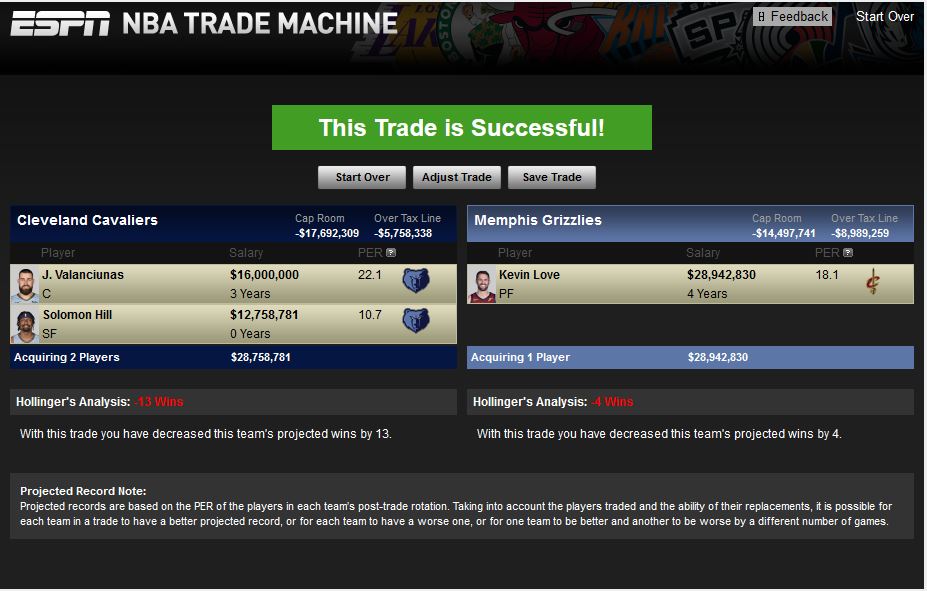
  • A deal will likely include center Jonas Valanciunas and the miserable contract of forward Solomon Hill. There’s not a lot of value there but with a pick or two included, there is a trade that makes a lot of sense.
  • The only other drawback I see if that Memphis is 22nd in Defensive Rating, but I think they could compromise that to solidify their present and to provide a running man for the young Morant.
This one would require picks. Valanciunas has some talent, but as constructed this is mostly a salary dump trade.
  1. Phoenix Suns
  • This is the most likely destination if only based off all the non-hypothetical smoke that exists around a Kevin Love to Phoenix trade.
  • The Suns are 11th in the West, and although Memphis is in the playoffs as of today and Phoenix isn’t the Suns have a considerable amount more star power to pair Love with in one of the top scoring guards in the league in Devin Booker and former 1st overall pick center DeAndre Ayton.
  • Phoenix isn’t a traditional small market team but they are an organization with a bit of a reputation for a bad owner, making then not a great free agent destination. A Love trade might be their chance to bring in an established star.
  • Beyond all this, they could have 2021 cap room even with Love added to their roster and he could help change the reputation of the organization.
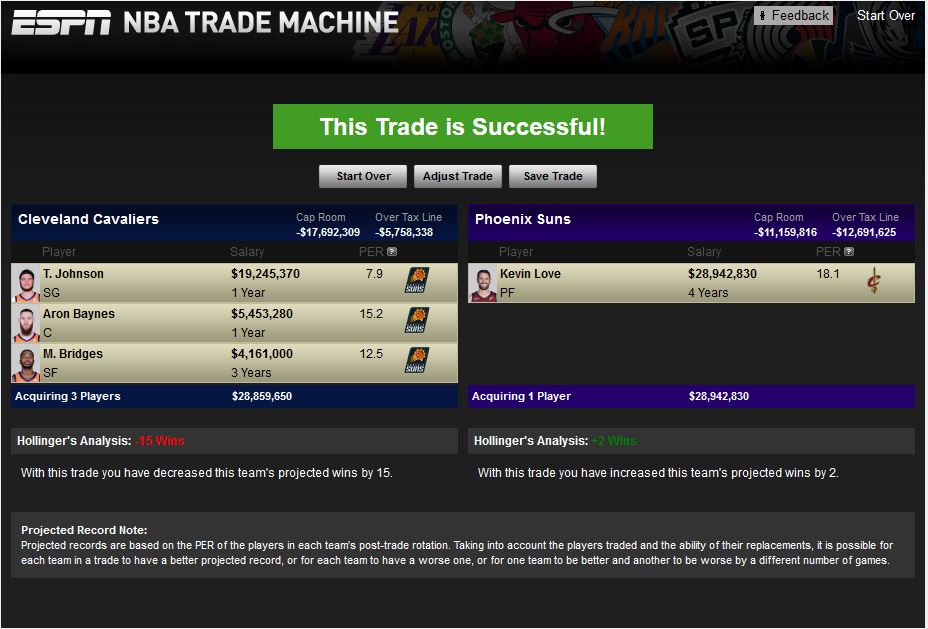
  • The Suns also have the biggest arsenal of trade-able contracts to send back to Cleveland. Guard Tyler Johnson is likely part of the deal, but beyond that names could include Cam Johnson, Aaron Baynes, Frank Kominsky, Mikal Bridges along with various picks. Variety and flexibility more likely means a better chance at a deal.
Just one of the ways a Suns trade could go down since Phoenix has so many trade-able assets.

Will a trade happen? That is yet to be seen. There is still the pull and tug of the fact teams don’t want to take on Love’s 4-year max contract. He’s on the wrong end of 30 years old and has an injury history. There aren’t a lot of long-term contracts in the league right now and having all that money tied up is a real liability. Teams will feel like they are doing the Cavs a favor by taking him off their hands, but the Cavs are still going to want value for him.

I do know that after finishing this exercise a trade feels more possible than I thought it could be before. There’s a real possibility a team like Indiana, Memphis or Phoenix will want to make a statement and make a slightly rash judgment to compete now. We only have another week or so to wait and see, so an answer is coming shortly.

For now, it wouldn’t be a Cavs season without Kevin Love trade rumors.

A Post About Kobe Bryant’s Death from the Perspective of a Shocked and Devastated Sports Fan

I’ve been prepping a post about trade possibilities for Kevin Love as the trade deadline approaches… forgive me. I don’t feel like writing it anymore right now.

Kobe Bryant is dead today at age 41. He and his 13 year old daughter Gianna were in a helicopter crash this morning. Tragically, Gianna has passed away as well.

I feel selfish for focusing on Kobe. Four other people including his own daughter passed away, but Bryant will get all the press and all the publicity. Maybe that is better. Others can grieve in peace. Maybe its worse. What about recognition? We as a people only care about tragedy when it happens to us or to someone with a high profile. I’m guilty of it as well. I know I am. That’s why I feel the way I feel now. Just stunned. Absolutely, positively stunned. My reaction from the moment I got the notification on my phone has just been “Wait, what?!”.

I was never even that big of a Kobe fan. I’m from Cleveland. To this day, with the exception of four years we as a city would rather forget about, this is LeBron’s town. Even today. Its strangely bizarre then that last night LeBron passed Kobe in all-time scoring for 3rd on the list. What a strange set of circumstances. Bryant’s own last tweet is a show of class at being usurped by James.

Regardless of all that, this death matters to me, and I know it matters to so many more. I might not always have preferred Kobe’s style of play; I’d make jokes about his reluctance to pass and how his overly serious nature helped cause the rift between himself and more jovial former teammate Shaquille O’Neal, but I always recognized Kobe as an undeniable force.

A fierce scorer who would use a deft combination of skill and will to get buckets on one end and smother his opponents on the other. He grew into a leadership role as his career progressed. His second set of Finals runs with the Phil Jackson led Lakers showed an older, wiser Bryant still at the top of his game, but more capable to reach his teammates and work inside a framework to make everyone exceptional. He became a well oiled winning machine, willing to raise his teammates and himself in favor of greatness on the floor. He became the undisputed 2nd best shooting guard in the history of the game. He became an invincible force of basketball nature, even sinking 2 free throws before retreating to the locker room after tearing his Achilles in 2013. He became the Black Mamba.

And I think that, for those of us fortunate enough to have been able to follow Bryant’s career, that is why this hurts and why it is so shocking. Every previous memory we have of Bryant is of him willing his Lakers squads to 5 rings, slashing through every last Toronto Raptors on his way to 81 points or even those aforementioned one-legged free throws. We never consider these athletes that we cheer or boo just as fragile as the rest of us, especially when they hit the type of peaks that Kobe hit. It is absolutely devastating when we end up getting reminded that despite all those feats they are exactly what we are: human. It hurts.

Now for a disclaimer: I don’t want this next part to be taken wrongly. Family and friends are important- one of the most important things this world has to offer, period. What I am about to say is in no way a replacement for that, if anything it should re-affirm it.

For someone who has been an avid American sports fan for as long as I can remember, these teams and these individuals become a part of our lives. I can turn the television six days a week in the summer and watch the Cleveland Indians play baseball. Often times I do exactly that. These athletes become part of our routine. We watch their professional lives progress sometimes from their dismissal from college until their middle age. They become part of our lives. For better or for worse, they create a connection with us through a common interest. They just happen to be the ones blessed enough to perform it on a daily basis. Bryant may have been a villain to me more often than not, but he was a respected one for all the reasons I have mentioned. Having “lived with him” for the last 20+ years is what makes this so harrowing.

He can’t be dead. He’s too wily and tough to be dead. He terrorized the Western Conference for twenty years and was a perfect foil to the natural passer and less hardened exterior of LeBron. How could it possibly be?

But it is. Rest well, Mamba. That fall-away mid range shot of yours is going to give them all fits in heaven. You and your daughter can continue to share your passion forever. I hope your family finds peace, as well as all the other families involved.

For the rest of us: remember that we are all fragile. Even the ones of us we see day in and day out. Even the ones we could never even imagine not being strong.

Be kind to one another.

An Update on MLB Sign-Stealing and Why Alex Cora (and Fans) Should Be Worried

The Houston Astros may have become the poster children for illegal sign-stealing, but they definitely weren’t the first or only perpetrators. When official news broke about their illegal use of a center field camera and a garbage can, we already also knew about a previous scheme that the Boston Red Sox ran using an Apple Watch and live footage from news reports during the 2017 season.

What we only partially knew at that time though was that it was the rival New York Yankees that turned the Red Sox in to the league. We also knew that, in retaliation, the Red Sox went back to MLB and claimed the Yankees were doing the same, as well as using their bullpen phone illegally. Both teams faced fines for their activity with the Red Sox being penalized a larger sum than the Yankees.

What we didn’t know until now, was that the illegal use of that bullpen phone was essentially harmless. In a game in 2017 one member of the Yankees’ coaching staff picked up the phone and used it to contact the replay room and ask if they thought a particular pitch was a strike or not. That was it. Technically illegal, but really, no advantage came of it. They could have literally done the same thing themselves on the delayed television feed in the clubhouse. However, we also know that that illegal phone use is what the Yankees were punished for. We know this because after MLB investigated in 2017, they found no evidence that the Yankees were using a live feed to steal signs like the Red Sox suggested.

We now know that to be false as the Athletic has reported that the Yankees did indeed use their video room to decode signs from 2015 thru 2017. Now to be clear, MLB didn’t really even start making any type of stink about this type of activity until 2017. Any time before that it is practically certain that what the Yankees were doing was unethical, but not directly illegal by official rule. For all we know, they may have stopped after paying their respective fine in 2017.

This first interaction between the Commissioner’s office, the Yankees and the Red Sox would be the impetus for statements from the League directly saying that any future wrongdoing would be punished more severely. From the moment of the Apple Watch and bullpen phone, this became a big deal. It should also be noted that the Red Sox fine was announced on September 15th, 2017. The now famous video showing White Sox pitcher Danny Farquhar changing signs due to the Astros banging a dugout trash can occurred on September 21st, a mere 6 days later, but indeed after the announcement of a crackdown on this type of activity.

And that is why we wait today for Commissioner Rob Manfred and his staff to levy punishment upon the Astros. Claims are that this is the most thorough investigation that MLB has ever performed and that up to 75,000 pieces of electronic correspondence have been reviewed as well as the interview of countless team personnel. Meanwhile, sources claim that the looming punishment for Houston and its staff members is likely to not only be brought down in the next two weeks, but to also be “severe”.

Beyond all this, the Athletic has now reported that the 2018 World Series Champion Red Sox also were using cameras and their instantly replay room in order to steal signs. A staff member viewing this screen would decipher the opposing catcher’s signs for that day and then tell a passerby player what the sign system was. That information was then likely disseminated through either each player in the lineup or one of the base coaches, with the goal being that base-runners would then relay signs to the batter.

I will say, this is still a dirty system that made illegal use of the camera tech provided to each team, but it was at least a mere speed up of a process that could have been done by the players themselves. The monitor created a steady, consistent ability to get opposing signs down pat, something that would have been possible through getting a runner on second base, just less efficiently. Think of the Red Sox as using a calculator on an elementary school math test where you are supposed to show your work. Its not nearly as blatant, swift or comprehensive as what the Astros were doing. You can kinda squint your eyes and convince yourself it isn’t as big of a deal. Still, we now have World Series champions implicated in this type of cheating for consecutive years.

And now, this opens up a whole extra round of investigations for MLB. Once they are done with the Astros, the Red Sox are sure to be next to become scrutinized. The one common thread between both teams is current Astros manager Alex Cora. Cora was the Astros bench coach in 2016 and 2017 before being named skipper of the Red Sox in 2018. That means he was in the dugout when the Astros were doing their best garage band impression in 2017 and again when the Red Sox were playing telephone in 2018. I would not be surprised at all if in due time Manfred makes Cora a scapegoat for a lot of this wrongdoing. Yes, people like Astros Manager AJ Hinch and General Manager Jeff Luhnow with face punishment. However, I fear it will all be too easy for MLB to link the circumstantial evidence together, point their collective finger directly at Cora and levy the steepest punishment of all on him, followed by patting themselves on the back and going back to distracting us with ideas of a pitch clock and universal designated hitter.

When I last wrote about this subject, I specifically highlighted that the fine people at the Athletic stated that the Astros were only a part of a larger, wide-spread problem. I continue to believe that to be the case, and will continue to, even after Cora will be made the sacrificial lamb (to be clear, I really am speculating here, it just really wouldn’t surprise me at this point). The easiest way for baseball to get rid of this scandal is to find someone to blame and move on, and I fear that is exactly what they will do.

It says a lot about this situation as well that back in 2017 when the Red Sox got accused of cheating by the Yankees they were able to come out and say “yeah… but they were doing it too!!!” and be absolutely right. For one, it presents a situation where teams can weaponize allegations against each other. Its a system of “don’t tattle on us, because we will do it right back”. Now, with the promise of stricter penalties against team personnel it even becomes a bit of a nuclear option, a way to the get staff of one of your rivals potentially removed. Secondly, it becomes clear that teams confidently know that other teams are even operating this way in the first place. That should be enough in itself to suggest that this goes deeper than just the Red Sox, Yankees and Astros.

It makes me wonder where this ends? Is every team that isn’t tanking doing this (because if you’re tanking why the heck would you look for an advantage)? If that is the case, and we vacate the 2017 and 2018 World Series for anyone who cheated, does that leave say… the 2017 Atlanta Braves and a tie between the 2018 Cincinnati Reds and Texas Rangers as World Champions? I know I’m getting carried away, but I am trying to make a point on how deep this could go. It just seems all too easy for MLB to chalk this controversy up to a couple of bad apples and then move on. If they really want to eradicate this problem, whether it is to make the game ethically better or to cease the effect it has on pace of play, then they will have to do better.

They probably won’t.

AD Declines Extension: 5 Choices for Anthony Davis’s Future With (or Without) Lakers

30-7 record. Currently the top seed in the NBA’s Western Conference. Playing with the best player in the world. Sunny, glamorous Los Angeles, California. Lakers Power Forward Anthony Davis has all of that and more going for him. Yet yesterday, Yahoo reported that Davis will test free agency this off-season rather than take the max contract extension that has been offered to him by the Lakers. He will forgo the 4 years and $148 million that he can make today, and risk it all this summer. All of this, despite requesting and being obliged to a trade to Los Angeles just this past summer. How could this be? What could the Lakers have done wrong?

The answer is likely, not very much. This is a calculated move by one of the ten best players in the NBA and his people, and it provides him with a lot of good options to position himself and his career into the future. Below, I will go through five of those options, and rank their likelihood by percentage.

Lets see what he have:

Davis opts in to his 1 year player option this summer (-1000% chance)

So this one isn’t a real choice, but I felt like it still needed to at least be addressed. On its face it doesn’t make a whole lot of sense. Davis has announced he will be turning down the 4 year extension he could be provided by the Lakers. So why opt in for one measly year at the end of the season? He would make less money signing this option than signing an all new deal and would have no longer-term contract. Further, Kevin Durant just had the worst injury a basketball player can get, and still accepted a max contract from the Brooklyn Nets. Its likely that even if the same happened to Davis, a max deal will be out there for him in the summer. Financial security isn’t an issue that would cause Davis to need to opt in. This isn’t happening.

Davis opts out this off-season and goes somewhere else (3%)

Is this possible? Yeah. Is it likely? No. But, if Davis for some reason really doesn’t like playing with LeBron or disaster strikes and James becomes injured long-term then there are a couple of teams out there that could provide the enticement for Davis to leave the Purple and Gold.

Chicago is his hometown and is struggling to find its leader and star on the floor. Plus, they will have a max salary slot available where Davis would fit quite nicely. An even better basketball option in Miami won’t have the space automatically, but could clear it with a trade or two. If they want to pass up the 2021 free agent sweepstakes (which stands to be much better than this coming summer’s) and pair Davis with Jimmy Butler they would become the best team in the Eastern Conference. Don’t put it past Pat Riley to flash his 6 rings and make a compelling case. Still, Davis will be hard pressed to find a situation better than his current one in the summer, especially when you consider he would make more money staying in LA.

Davis opts out, but then signs a 1 year deal with a player option for a second year (7%)

The good ol’ LeBron’s return to Cleveland deal. Davis has the same agent as James- Rich Paul, and they used this strategy very effectively in Cleveland. It applies pressure on the Laker front office to do every possible thing to be as competitive on the court as can be, and that’s something both Paul clients would benefit from. Davis could keep opting out every year like this for as long as he wanted, and then really test the market any year he desires. Like I previously mentioned, 2021 is a big free agent class year and teams are already clearing salary cap space for it. Davis could make himself available then and there, and if not could keep increasing his money with the Lakers every year re-signing new deals because of the way the collective bargaining agreement is structured. He might want more security than this though, which brings us to our next option.

Davis opts out this summer and then signs a long-term max deal for the most money and years possible (35%)

This choice is the obvious reason why Davis is currently turning down the extension that the Lakers have offered. He stands to be able to add a fifth year to his contract and an additional total of about $50 million to his payout by signing this off-season. The reason why has to do with the CBA, but to put it simply, Davis lost the ability to sign for this kind of money through a mid-season extension when he was traded from New Orleans to LA. Anyway, this option provides him the peace of mind of knowing that if a better opportunity really is out there, he can take it this summer, but he can definitely fall back on more money and a great situation in LA. He can continue to learn from LeBron as they will eventually shift roles between top player and side-kick over time (assuming LeBron actually does regress at some point before being eligible for Social Security). They are already in great position to win a title this year. Adding stability and continuity to their situation would just position them even better. Remember, LeBron has never won the title in his first year on a new team. Both times it was the second year. And that second year really might be the big one…

Davis opts out, then signs a 2-year deal with a 1-year option in the summer (55%)

On its face its sounds like a weird choice. Its not the LeBron-style 1 and 1 that applies pressure, and its not the full big money contract. BUT, players with 10 years vested in the NBA are eligible for a higher max contract than those with less years in the league. If Davis opts out after completing a new 2-year deal he will have been in the league for 10 years and be eligible for that larger contract. You know what else? LeBron could also be coming off the Lakers books that summer. So if the King decides he wants to return to Cleveland for part three, go somewhere new or just spend more time watching his sons play and making movies then Davis will have the opportunity to act accordingly. Oh, and its still to early to tell, but there’s a chance the Lakers could have another max slot available for their roster that summer no matter what Davis and James do (they actually have no commitments at all entering the summer of 2022). Maximum flexibility comes for Davis in this choice as he can decide what to do based on what LeBron does, what the Lakers do, and really what the general landscape of the NBA is come the summer of 2022. I think this is the choice. Hey AD, is my check for 10% in the mail?

Really, there is no bad choice here for Davis, only ones that are better than others. He sits in an enviable position, and that’s great for him. For better or for worse at this point, players like Davis are in charge of their destinies, and really the destinies of the league at large that they play in.

At this point, we are just along for the ride

Crunch Time Break Down: What’s Kevin Love so Mad About?

Yesterday was a tumultuous day for Kevin Love. Subject to trade rumors since at least Dec. 6th, Love has grown increasingly frustrated recently with his status on the Cleveland Cavaliers. For background, Love signed a 4 year, $120 extension in the wake of of LeBron departing Cleveland in the summer of 2018. That extension started this year and will carry out through the spring of 2023. He inked that deal with the understanding that the Cavaliers were going to try to continue to field a competitive team, capable of reaching the playoffs. This notion didn’t come out of thin air, but rather from the statements that were made to him by General Manager Koby Altman.

Obviously, that hasn’t happened whatsoever. A little over a year later the Cavs are now 10-25 and look like a top-half lottery team for the second year in a row, and are still in the beginning stages of a complete rebuild. As such, Love is the subject of continual trade rumors and even though he hasn’t formally asked for a trade, would likely welcome one. How do I know this? Well for one, there are reports that say so. But also, things appear to be hitting a boiling point between Love, his teammates and the Cavaliers’ staff.

Saturday afternoon following shoot-around, Love had an emotional “outburst” that was directed at Altman. One of his claims during that outburst was that the Cavs have “no feel”. Further, in the waning seconds of the 2nd quarter in Saturday night’s contest vs. the Oklahoma City Thunder Love appeared visibly frustrated and threw up his hands at ball-handling guard Collin Sexton mid-play. Love stood in front of him until Sexton passed him the ball. This led to Love firing a pass to forward Cedi Osman (who ended up being fouled on a 3 point attempt).

Bad body language, outbursts, a desire to be traded, and alleged complaints about head coach John Beilein. Love doesn’t sounds like a good teammate right now.

I think his frustration to a point is understandable though. The sticking point is the actual on the court actions of himself and his teammates. All that I laid out above is obvious. Its’ all macro-level considerations of the situation that Love finds himself in. If you take a look at the nuts and bolts of a game situation that Love finds himself in though, it could be perceived as pretty maddening.

I’ll provide an example. I will call this a “crunch time break down”. I might do more of these in the future, where I lay out a close game and explain what I saw as an avid basketball fan. Forgive me. Its going to be wordy. I could just as easily throw up a video and say “see for yourself”, but there are specific points I want to lay out. Without further delay:

This past Thursday night the Cavaliers took on the Charlotte Hornets from Rocket Mortgage Fieldhouse (gag).

With about 5 minutes left in the game the Cavaliers led 100-93 and Love, forward Cedi Osman and center Tristan Thompson have all just re-entered the game after rest. The following possessions occur (this is going to be fairly Love-centric, but I plan to be even-handed):

Right off the free throws that allowed the trio to come into the game Love received the ball in the post and travels. Its his only turnover of the night, the Cavaliers had 14 as a team. 4:58 remains in the game. Cavs still by 7.

Charlotte point guard Terry Rozier makes a three and Charlotte now trails by 4. On the next Cavs’ possession the ball never leaves Sexton’s hands. He drives into the crowded paint and puts up a contested layup with 3 seconds left on the shot clock. He held the ball for the entire 21 seconds. Not only is it a miss, Love is open at the 3 point line. 4:13 remains. Cavs lead 100-96.

Charlotte forward PJ Washington’s layup makes it a 2 point game. On the Cavs possession they run a set play. After the ball comes up the forecourt, Love receives the ball at the top of the key and immediately gives it up on a dribble hand-off to wingman Kevin Porter Jr. Porter dribbles around the perimeter into traffic and takes a bad contested layup. The shot is no good. Love isn’t as open this time, but is still uncovered on the left wing. Osman and Sexton are also open on the left side of the floor. Two bad, contested layups in a row. Cavs lead 100-98. 3:27 remains.

Porter putting it up, surrounded by 3 Hornets. Love, Osman and Sexton, all open to his left.

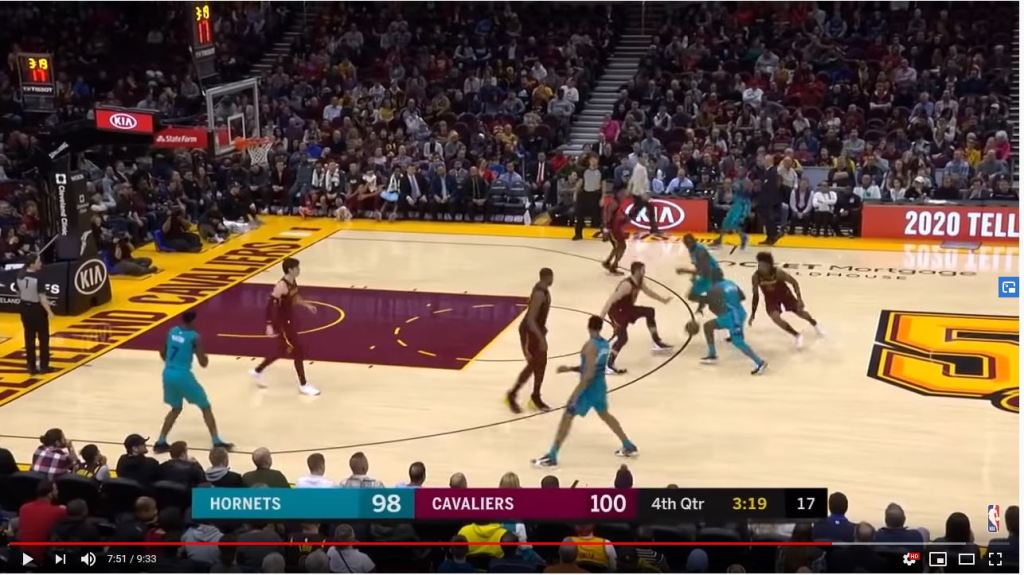
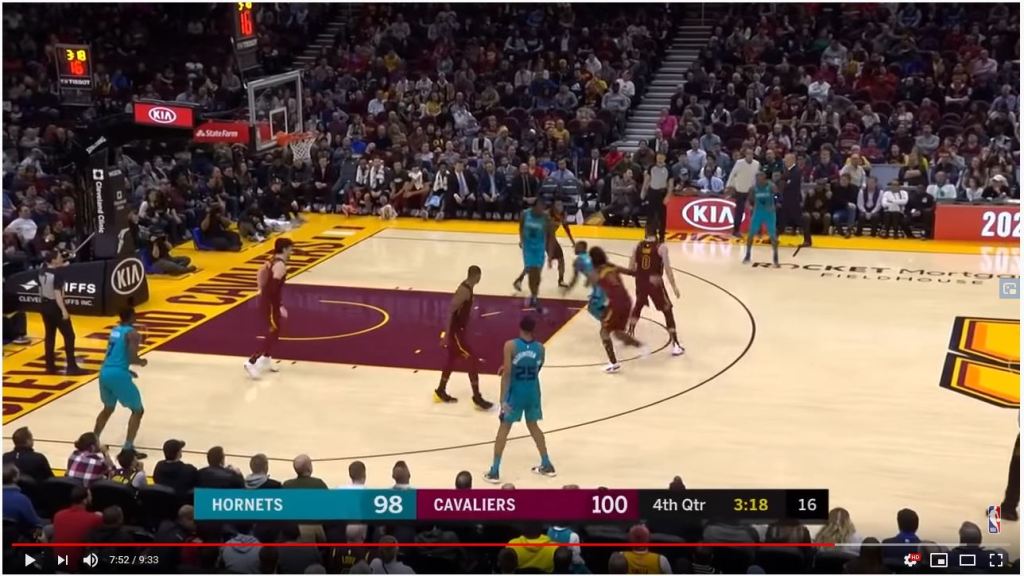
On the ensuing Charlotte possession Rozier comes right down the floor off the rebound, and receives a screen from center Bismack Biyombo. Love had been guarding Biyombo and shows hard on Rozier. To Rozier’s credit and the slow-footed Love’s detriment, Rozier crosses Love, who fails to impede his progress. Porter was Rozier’s man, but he went over the top of screen and now can’t recover since Love failed to keep Rozier in front. This means the man guarding the weak-side corner- Osman, should come to help. He doesn’t. Tie game. 3:16 left. Cavs call timeout.

Love tries to keep Rozier in front
Love is too slow. Osman appears ready to help.
Osman is still standing there. Easy layup.

Coming out of the timeout Beilein draws up a play for Love off of a Thompson off-ball screen at the top of the key. Love takes an open three in rhythm but misses. 3:06 left. Still tied at 100.

Charlotte guard Devonte Graham throws a pass into the stands and the Cavs get the ball back. A Darius Garland-Love screen and pop leads to penetration by Garland down the right side of the lane. Garland kicks to Sexton in the left corner. 3 ball… got it! This is the best play you will see throughout this entire exercise. Cavs lead 103-100. 2:30 left.

Hornets come right back down and Graham answers with a 3 of his own. We are tied again. The ensuing Cavs possession has Garland bring the ball up the floor on the right side of the key. Osman comes out, slips a screen and dashes to the left wing behind the 3 line. Osman briefly flashes open but by the time he receives the pass and puts up the shot he is contested. 1 pass was made, the shot was contested, Love never touched the ball and 11 seconds were on the shot clock when Osman hoisted. Bad possession. Still tied. 1:58 remains.

Look who is open on the other side of the floor.

Sexton plays sparkling defense that leads to a Garland steal of Rozier. Garland is fouled in the open floor which leads to a review to check for a clear path foul and an unofficial timeout. No clear path foul occurred, but its Cavs’ ball and we are still tied.

Beilein uses the extra time to draw up a set play for Love coming off another screen. He takes a good shot, but misses the three pointer at the top of the key. We are still tied and there’s 1:30 left.

More good team defense in crunch time leads to a missed three by Rozier. We are really getting into crunch time now as Thompson pulls down the rebound and gets it to Garland as we get under the minute mark. Garland and Love run screen and pop again. It looks a lot like the play Sexton made a 3 on instead this time Garland takes a layup in traffic with 7 seconds still on the shot clock. Biyombo should be guarding Love at the 3 point line but he has completely abandoned his post and has come down to the key to help on the drive and ensure he retrieves the rebound. This is the most open Love has been yet, naked on the left wing at the 3 point line. We are still tied and 45 seconds remain.

Love is barely in frame, but open. Osman is open too.

On their possession Charlotte runs a screen slip that leads to a bad, contested three that Graham makes even though he had no business taking it. Basketball-reference.com describes it as a “36-footer”. I give credit to Sexton for contesting. 106-103 Charlotte. 23 ticks remain.

Beilein calls timeout and the Cavs inbound at half court. Austin Carr directly says on the broadcast “You can (afford to) go to your second or third option here and get a 3 point shot.”. John Michael makes mention that a quick 2 pointer wouldn’t be bad either. We either want to work for a 3 pointer to tie or find a quick, easy 2 pointer and allow time to still come back.

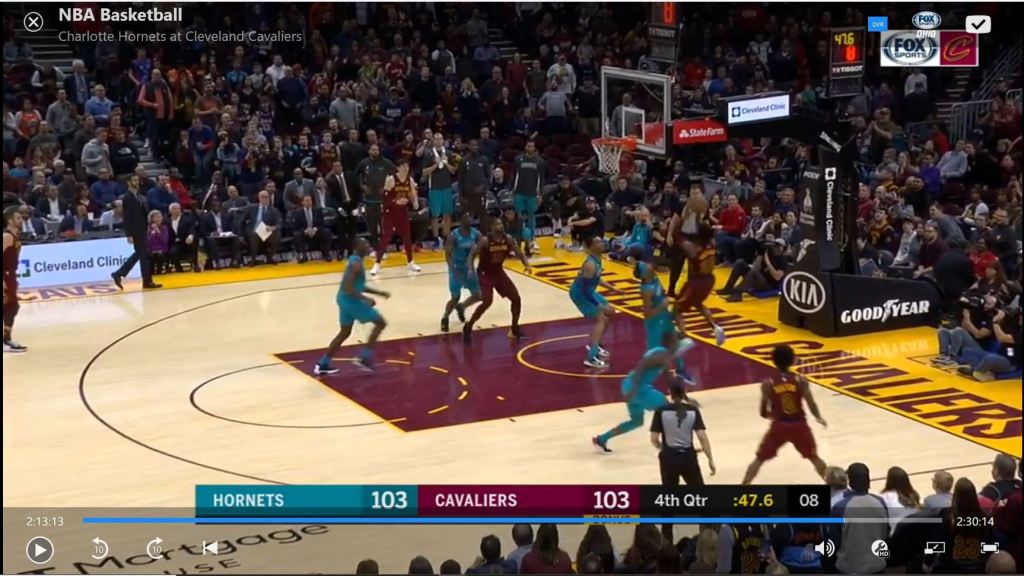
Love comes to the ball at the left wing and receives the inbound. Its a screen hand-off to Sexton at the top of the key. Sexton’s initial drive is shut down, but he tries again and dribbles into the paint. Biyombo completely leaves Love this time. You can see it down below. He knows there is absolutely no chance Sexton is going to pass the ball back out. Its another missed layup in traffic. The Cavs were down 3, Sexton took 8 seconds and only got a contested layup out of the possession. That was neither a couple passes that led to a three, nor a quick, easy 2 pointer.

Biyombo pulls down the rebound because he has nothing better to be doing; the Cavs foul twice and send Graham to the line. He makes both and Charlotte leads 108-103. 9 seconds remain. Looks like checkmate.

Beilein calls his last timeout and the Cavs take the ball out from half-court again. This time the play is a direct pass to Love in the post off the inbound. Instead of guarding Love, Biyombo is guarding Osman, but hedges inside to help on Love. Love actually notices and fires the ball out to the perimeter to Osman. 3 ball… got it! Holy cow! Someone passed to an open player, and a shot was made?! The Cavs still trail by 2 and there’s only 4 seconds left.

Actual court vision.
Cedi for 3!

The Cavs foul again and the door kinda, sorta swings open. Rozier misses one of two free throws and its a 3 point game again, but the Cavs are out of timeouts and have to inbound in the back-court. Sexton gets freed up 40 feet from the rim and fires a decent looking shot, but its no good at the buzzer. Love comes over and rubs Sexton’s shoulders. I’m not a lip-reader, but he appears to tell him “good shot!”. The Cavs lose by 2 after leading by as many as 10 in the fourth quarter.

So what do we have here? 11 possessions in the final 5 minutes for the Cavaliers. Love touched the ball on 6 of them but two of those were quick give-ups for a dribble hand-off and a screen hand-off. Three different times he was left wide open on the perimeter and four different times a young Cavaliers’ ball-handler took a bad, contested layup at the rim. That’s just as many attempts as legitimate touches that Love got in the final five minutes.

I would be frustrated too. I am not saying that Love should be taking every shot down the stretch of a close game. Absolutely not. But at the same time, each possession that didn’t involve him was absolutely poor. The only one where he didn’t touch the ball and it went well was Sexton’s corner three. Yes, Love missed 2 threes of his own. They were good, open shots. They weren’t contested layups with two or more defenders draped over the shooter while the best player on the team stood wide-open for three. That’s how you lose games. That’s not how you build any type of winning culture. That’s the type of thing that leads to this:

A good friend of mine texted me and said he thinks Sexton lost track of the shot clock. Could be, but it seems more like Sexton just doesn’t have any real vision. He isn’t really a ball-handler. He couldn’t see Love standing near the paint with the 6 foot tall Chris Paul on him. Love literally has 9 inches on him! I think that’s what Love might have meant on Saturday when he blew up at Altman and said the Cavs have “no feel”. These young guys have no feel for how to operate a professional level offense. What is Coach Beilein teaching these guys anyway? The crazy part is that with the shot clock running down, Love found a half decent look for Osman for three, and they got foul shots out of it. That would not have occurred unless Love did what he did.

Yes, Love is being surly, but I think he has good reason. Quite genuinely, if placed in this position I think a certain former Cavaliers’ star would act very similarly as well. In fact, this on-court attitude is somewhat reminiscent of LeBron taking himself out of plays while Kyrie Irving and Dion Waiters fought over the ball in 2014, or the month long pout-job he did in January of 2018 to force Altman to re-form the Cavs roster at the trade deadline.

I don’t think Love means anything ill by what he is doing, but he is frustrated. I can’t blame him for that. Unfortunately for him, he might have to ride out the storm for this season. A Love trade still seems like a rigorous endeavor at this point.

More on that to come…

MLB’s Negotiating Terms With Minor Leagues Are Dirty, and Hurt the Game

In an effort to cut costs earlier this off-season, Major League Baseball created a proposition to cut affiliations with up to 42 Minor League Baseball teams. That’s right. The same billionaires that are comfortable shelling out $324 million to Gerrit Cole over 9 years and $245 million over 7 years to Anthony Rendon are worried about their ability to cover the expenses of the Staten Island Yankees and the Burlington Bees (Angels affiliation).

They have brought this proposal to the negotiating table against the Minor League Baseball, as the agreement between the two parties is set to expire after the 2020 season. Eliminating the current affiliations would make the 42 teams independent, meaning they would no longer have a league or players. They would still exist as businesses, but they would be be fending for themselves and would have to find new independent leagues and their own rosters. MLB has taken what is usually a formality of negotiation and renewal and turned it on its head.

So why is this happening? Really, this began in 2014 when a lawsuit was filed in the State of California by minor league players alleging that their wages, which can run from $1000 a month to $3,000 a month depending on the level they play, were unfair and violated minimum wage laws. Major League Baseball is responsible for these wages and has benefited since 1938 from a government ruling that stated that minor league baseball players are seasonal employees, and therefore not protected under the minimum wage. This ruling was renewed in the US Government’s March 2018 spending bill, that was passed specifically with a statement that excluded minor league baseball players from federal labor laws.

Backing up though, that 2014 lawsuit was established as class action in 2017 at the Federal level. A US Magistrate Judge ruled that a collection of players who played in the California League could continue as plaintiffs. However, similar players playing in Arizona and Florida were ruled out until this past August when the US Circuit Court of Appeals in California ruled 2-1 in favor of including the players from additional states in the class action. This also means that even more players can join and ultimately, maybe be entitled to not just improved wages in the future, but damages resulting from their lack of pay in the past. While it has not been a huge story, this definitely has not been a great public relations situation for MLB and they have to figure that in the long run, this lawsuit might not turn out in their favor.

To their credit earlier this year, the Toronto Blue Jays (run by former Cleveland Indians President Mark Shapiro) announced they would be raising their minor league wages by 50 percent. However, they are the only organization to get out ahead of this issue and improve wages for their minor leaguers.

I’m sure the other owners can see this controversy brewing though. Its ultimately not a good look for the teams to be paying their farm hands so very little. Unfortunately, the solution they have come up with doesn’t seem very even handed either. It appears that they all aim to follow the example of the Houston Astros organization (since they’ve just been so classy lately) and cut minor league affiliates while banking on improved player development technology to account for the smaller talent pool. One aspect to not be neglected here is that technology. If teams can use Rapsodo to better measure spin rate or SwingTracker to better judge and correct flaws in a hitters swing they don’t have to play as much of a numbers game when hoping to find talent.

Are you with me so far? Because its about to get worse.

With all of this in mind, and the above mentioned Major League/Minor League negotiations going on, Manfred took it a step farther last Friday, publicly threatening to cut ties with Minor League Baseball as an organization entirely. The statement comes it seems from a point of frustration in negotiations. Manfred has been vocal recently about Minor League Baseball’s inability to be flexible in talks and further, how he did not care for how public the Minors organization has been with the press about the removal of 42 teams. The commissioner apparently decided the best way to take out his frustrations about his counterparts playing the press as a negotiating tactic… was to also play the press as a negotiating tactic. And he sure did swing for the fences.

To be clear, cutting ties would not mean the abolition of minor league baseball, but rather, Minor League Baseball. It would mean that MLB would be negotiating with the individual teams instead of all of them together in one organized entity. This set up with provide MLB with a huge amount of leverage to do whatever it wants in the talks, being able to throw its proverbial weight around since it would be working from such a great place of financial power.

So here we are. The billionaires club that is the MLB owners have grievances about having to make sure their employees are paid the minimum wage. So much so that they want to eliminate 42 teams worth of roster spots. Never mind that five full months of pay at $1700 a month for a first year AA player comes to $8,500. Add a little extra cash for how the season extends into September and that player is getting compensated about $9000 for their talents. For those of you keeping score at home, the poverty threshold for a single American under 65 years old is $11,770. It sure is a darned shame those poor billionaires can’t even muster up the extra $2770 just to get their AA players (never mind players below that level) to the poverty line without cutting teams out of the equation.

Additionally, minor leagues as an institution are a gambit that the largest growing sports league in America, the NBA, only recently has gotten into, but now nearly every NBA team has a G League Affiliate. Baseball has over a one hundred years of infrastructure working in its favor. Yet, the NBA is able to pay its G-Leaguers $35,000 salaries.

This all goes without mentioning each team of course has its own season ticket salespeople, game-day operations managers, and concessions workers among other occupations. With the fate of their teams in jeopardy, so are all of those jobs. Those jobs are in danger today based solely off of association.

And yet even further, not only would all these people be hurt, but the owners would likely be hurting the welfare of the game. One of the best marketing benefits that baseball has is its established network of minor league teams. If you just live in or around a small city there is likely inexpensive, professional baseball near you. There are 261 teams worth in America. You might not be able to afford lower level seats in the big city, but you’re likely to be able to watch the stars of tomorrow in that town nearby, all up close and personal. Maybe one or two of them will even make it to the show and that will encourage you to start watching their Major League club on television (queue baseball’s biggest money maker: the television contract).

To be fair, yes. Minor League Baseball should likely be willing to negotiate on some things. Maybe they can take on a greater portion of overhead costs or be less dependent on the Majors for improving their facilities. They could even take on a part of player salaries. But, there are 4 countries recognized by the United Nations that make less money in GDP than the New York Yankees just committed to Gerrit Cole (I keep mentioning Cole. This isn’t about MLB players. They are the product. They have earned their payday from the owners). The $209 million each team received in revenue sharing in 2018 would pay for nearly six-thousand $35,000 NBA G-League sized salaries.

For the MLB owners to work for the removal of 42 teams and all the jobs and economic impact that come with them though is dirty business. Dirty business that seems to be a positive for them and them only, with even the game itself possibly taking a hit.

And now they’re threatening to take their (probably juiced) ball and go home if they don’t get what they want.

If even the purveyors themselves aren’t looking out for the game, who is?

If Indians Were Looking to Improve By Trading Corey Kluber, Now Wasn’t the Time to Do It

When I started writing in this space I promised Cleveland baseball content, which to this point, has actually been conspicuously absent. I had another post all punched out and ready for editing today, but then I started getting the alerts early this afternoon on my phone. Truthfully, I was hoping to not have to start Indians content this way:

The Cleveland Indians have traded two-time former Cy Young Award winning ace starting pitcher Corey Kluber to the Texas Rangers for outfielder Delino DeShields Jr and rookie relief pitcher Emmanuel Clase.

The acquisition concludes over a year of trade discussion about Kluber, that dates back to talks from before baseball’s 2018 Winter Meetings. Talks about Kluber continued all last winter, but the Indians could never come to terms with any team and decided to begin the season with Kluber and his $17 million contract on their books in a continued attempt to compete for the World Series.

Ultimately, that move might have proved costly. Kluber was not good in April at all, posting a 5.80 ERA in 7 starts. This sample size was small, but not promising before a line drive come-backer by Marlins outfielder Brian Anderson nailed Kluber in the pitching arm on May 2nd and ended not only his night, but his season. It likely also diminished his trade value. Kluber was injured through the July 31st trade deadline and a return in August proved impossible after he suffered an oblique stain while rehabbing his arm in the minors.

The Indians came into this off-season with all that baggage around Kluber. Still, with a clean bill of health given trade talks commenced again about the dominant right-hander. This is the part that I just don’t understand.

A lot of fans like to lament the Dolan family. I, for one, usually don’t. I applaud them for the fact that as an ownership group they have largely hired incredibly competent people to run their baseball business and not meddle in affairs. I genuinely believe the Indians are run as one of the 5 best organizations in all of baseball and a lot of this has to do with the steady hand of ownership.

Everything I can think of would suggest that wasn’t the case with this Kluber trade. Let me be clear on why.

Kluber’s value was high coming off of the 2018 season. He finished third in Cy Young voting, posted the best ERA of his career besides years that he won that award and led the AL in innings pitched and walks per 9 innings. The $17 million he was slotted to make in 2019 was a considerable amount of money, but a relative steal compared to the $23.3 million AAV a lesser pitcher like Patrick Corbin received on the open market that winter. Names included in trade talks at the time included legitimate prospects like Padres outfielder Hunter Renfroe, who would crush 33 home runs in San Diego this past season.

A combination of the poor April and the injury that followed likely zapped a lot of that trade value. Teams were able to come into talks this winter with the Indians using Kluber’s poor performance and injury to negotiate a better deal. What is puzzling to me though is why the Indians front office would still go through with it.

This is a staff that largely loves to sell high. They did not do this whatsoever with Kluber. If I was in their position I would have to question an offer like the one that was ultimately accepted. Kluber may be coming off of an injury, but it was a freak one, not based on stress or miles on his arm, but by an accident. There was no structural damage to his elbow or shoulder. There should be no reason to expect the injury to linger. Further, his poor month to begin the 2019 season was just that: a month. What are you more apt to trust? The one month of ineffectiveness he struggled through in 2019, or the six seasons of dominance that came before it? This was the perfect opportunity for the Indians to shelf the trade talks and let Kluber return to form. A likely better performance and a clean bill of health could either lead to the dominant ace you know helping propel your ballclub to 2020 playoff hopes, or at least a better value at the trade deadline. To be clear, my beef is not with trading Kluber at all, but for trading him now and for what was received in return.

Instead, Kluber was traded- when his value probably couldn’t have been any lower than its been since talks commenced. Why? As stated before, the Indians front office deserves a lot of credit under the Dolan’s ownership. With the exception of the Manny Acta years they have provided competitive baseball consistently while at the helm. If I can see the flaws in the trade they just performed, I’m sure they are aware of them as well. So what’s the deal?

Remember how I congratulated the Dolans on not meddling? Well, maybe they have started. Its likely not a coincidence that Kluber’s $17 million is coming off the books in return for a paltry rookie contract and the projected 2nd year of arbitration contract of $2.4 million for DeShields. We already know that the marching orders last winter were to cut payroll, and cut payroll the Indians did in the removal of Lonnie Chisenhall, Michael Brantley, Andrew Miller, and Cody Allen among others from the roster via free agency. Maybe this is all step 2 in that process, but it couldn’t come at a worse time.

The Minnesota Twins won the AL Central last year. It was the first time since 2015 that the Indians didn’t carry that pennant. The Chicago White Sox have amassed a strong lineup of hitters that appear ready to break out. With the right smattering of pitching, that becomes a very talented ballclub also looking to usurp the Tribe in the standings.

The Indians answer to all of this so far? Trade their somewhat expensive, but relatively reasonably priced ace pitcher when his value is lowest.

Speaking of… what have the Indians gotten in return? To be frank, there actually is at least a little good news here.

DeShields is a light-hitting right-handed outfielder that played exclusively in centerfield last year but can play leftfield as well. He hit .249 in 2019 with just 4 home runs and a fairly average .325 OBP, but did steal 24 bases. His weighted Runs Created plus (wRC+) was just 72, and is just 76 over his 4 year career (100 would be average, higher is better). Defensively, he held the 4th best Range Runs for any centerfielder in baseball, while being a middle of the pack quality centerfielder otherwise. Oddly though, he hasn’t played any other position than centerfield since 2017, an area likely to be patrolled by Oscar Mercado in 2020 and beyond for the Tribe. Ultimately, DeShields was worth 0.8 Fangraph’s WAR in 2019. His career high is 2.1 in 2017 when he hit .269, scored 75 times and had 29 stolen bases. Basically, he’s a fast, athletic outfielder that was taken 3rd overall in the 2014 draft, but few other tools ever developed.

Clase is a right-handed rookie relief pitcher with a fastball that scouts absolutely adore for both its velocity and movement. He only pitched 23.1 Major League innings in 2019, but posted an ERA of 2.31 in those innings. He has shown an ability to limit walks, both in the minors and with a walk rate of just 6.4% for the Rangers last season. His combination of a blazing fastball, able to regularly hit 99 MPH, while not walking many hitters is a talent beyond his years. He also incorporates a slider, but will likely automatically be the biggest “power arm” in an Indians bullpen that often got by with only finesse in 2019. Ben Clemens at Fangraphs claimed he could be one of the best relievers in baseball just this past August. (If you don’t click any other link in this post, click that one. It will give you hope.) He is a legitimate solid pick-up.

Clase is the real chip here that the Indians got in return, but he projects as a (possibly even dominant) set-up man for their bullpen. Someone you hope will pitch 70 innings a year but nothing more. I truly feel the Indians could have gotten more for Kluber if they had played this right, and they likely know this too, either kicking themselves for not trading him last winter or wishing they could give it one more go this summer.

That was not be though, and it makes me wonder if the walls are closing in around the Tribe front office when all it would take is the money the Dolans had already committed in order to keep the team’s competitive aspirations afloat. It makes me really wonder what’s next.

It makes me not so confident in a front office that has given me every reason to be.

Doncic and the Mavs Are Great… Maybe Even Historically Great

We are now about a quarter of the way through this NBA campaign and four teams that didn’t find themselves with a playoff spot last season are currently in the top eight in their respective conference. Of those teams, there were a couple you could expect a leap from. The Miami Heat and Los Angeles Lakers added star power in Jimmy Butler and Anthony Davis, respectively. Those 2 squads were poised for the leaps that they have taken. On the other end of the spectrum, the Phoenix Suns find themselves as an 8th seed today after having the worst record in the West just last year.

The team that has made the biggest leap in the standings though is the Dallas Mavericks. And news-flash: they have been really good. After finishing 14th in the West last season, just above the Suns, they are currently cemented into 2nd place, 3.5 games behind the Lakers. That’s a 12 position jump in the standings. The Mavs also have the 2nd best point differential in the Association and have won 5 games in a row including a 46-point thrashing of the New Orleans Pelicans yesterday that saw star forward Luka Doncic score 28 points in just 26 minutes.

(Full disclosure, as I have edited this post they have come back from a 20-point deficit vs. the Kings tonight and are now wrapped up in a close game. All that appears above and below does not include data from that game… I hope I didn’t jinx them. I already look silly because Kyrie still hasn’t returned to action).

Doncic in particular has been incredible. The internet has been buzzing just in the last couple of weeks about his superb play. Last year’s Rookie of the Year has already taken another step forward at just 20 years old.

At 20, the Slovenian-born former Euroleague MVP is leading the NBA in Basketball-Reference’s VORP statistic, a stat very similar to the WAR stat that is used in baseball. Let me be perfectly clear on how good Doncic has been. Doncic’s VORP of 3.0 puts him on pace to finish the season at a VORP of 11.2. Only 2 men have ever had a rating that high for a season. You might have heard of them. Their names are James and Jordan. Did I happen to mention that this guy is 20 years old?!

For those of you not as enamored with new-fangled stats, he’s also nearly averaging a triple-double with 30.1 points per game (good for 3rd in the NBA), 10 rebounds per game as a 6 foot 7 guard and 9.2 assists per game. There are 7 players in the league this year that are shooting 73% or better at the rim while taking at least 5 such attempts per game. Doncic is the only one listed under 6 foot 9 and is also the only one that has logged all his minutes as a guard, according to Basketball-Reference. All of this is coming from a guy that a lot of basketball talking heads didn’t think would have the athleticism to be a star in the NBA. He’s not perfect. He’s taking the 3rd most 3-point shots in the league while only making about 32% of them… but did I mention he’s 20 years old?!

Beyond Doncic, this team has been incredibly sound. They’re first in the NBA in Offensive Rating and have the fewest turnovers per game. Sixth-man Tim Hardaway Jr. has the best turnover percentage in the league while being one of three double-digit scorers on the squad alongside Doncic and power forward Kristaps Porzingis.

The X-Factor here though is Porzingis. Last year’s big name acquisition before the trade deadline is only 20 games into his return from a torn ACL that caused him to miss all of last season. The Mavericks gambled when they traded for him and to be fair he isn’t a sure thing. His scoring numbers are down. This has been the least efficient shooting season of his career by True Shooting Percentage (.499) and he’s averaged fewer points per game than any season other than his rookie year. However, he’s rebounding at a better clip than he ever has (15.0%) and is 5th in the league in blocks per game (2.0). I would say this signifies that he is playing hard. His offense is going to come. This is already the league’s best offense and Rick Carlisle knows a little bit about how to showcase an over-sized power forward who can shoot from anywhere on the floor.

For perspective on this team’s brilliance with the ball, last year’s Golden State Warriors have the best Offensive Rating in NBA history at 115.9 for a full season. Right now, this year’s Mavericks are at rating of 117.9. I know we are only 22 games in and I am getting ahead of myself, but they are on a record pace and Porzingis is likely only going to get better. If he can become the more adept scorer that he was while playing for the Knicks this team could even find another gear. This could be a historically proficient offense.

Outside of Doncic and Porzingis they have had real professional efforts from the rest of their roster. Hardaway has scored 12.5 points per game off the bench, Dwight Powell’s defensive field goal percentage (57.7) puts him in the company of other respected big man defenders like Marc Gasol and Mitchell Robinson. Bench guard Delon Wright is 10th in the league in Offensive Rating.

Yes, this team seems somewhat devoid of star power outside of their two top guys, and really Doncic is head and shoulders above Porzingis at this moment. It isn’t all positives. Their performance bares similarities to LeBron in his first go-round with the Cavaliers, although to this point Doncic has even out-paced LeBron’s age 20 season.

This is only the beginning though. Porzingis is just 24 and I think I remembered to mention that Doncic is 20. ESPN’s Zach Lowe calls the Mavericks quite possibly the next team to have a roster with a “Big Three” a la LeBron, Kyrie Irving and Kevin Love or Ray Allen, Paul Pierce and Kevin Garnett. Even if they don’t add a big piece, Dallas has become an organization of great stability and infrastructure under Mark Cuban, Donnie Nelson and Carlisle. They should be poised to be a real problem in the West for years.

The Dirk Nowitzki story might have just ended in Dallas, but a new and possibly even bigger tale may just be beginning.

Kyrie Irving Will Not Be Returning for Games in Cleveland or Boston. A Conspiracy Theory?

The Brooklyn Nets have announced that star point guard Kyrie Irving will miss the next three games with a shoulder impingement, however this is not new news. Cavalier fans should be familiar by now with Irving’s injury woes throughout his career. Beyond that, this particular shoulder injury has ailed him for over a week now. He was last seen on the hardwood on November 14th in a 101-93 loss in Denver and if he misses the next three games as scheduled he will have missed seven in total.

What is really newsworthy here though is who those next three games he will miss entail. The Nets are hitting the road right now and are headed on a three game trip that will take them first to New York (okay, so in that case maybe they aren’t hitting the road quite yet), and then to Cleveland and Boston next week.

For those of you who might have been hit on the head or just don’t pay close attention, Cleveland and Boston are the last two cities that Irving played for. Not only did he play in them and depart, but neither departure was exactly… amicable.

After three straight finals runs with the Cavs Irving requested a trade, likely tanking any legitimate chance at a second NBA title in the LeBron era, and being the first domino to fall in what ended up making the King himself pack his bag and head for the sunnier pastures of Los Angeles.

Starting with the 2017-2018 season, Irving then spent the next two campaigns in Boston after an abysmally executed trade sent him to the Celtics. Irving’s problem has never been his play on the floor, and he continued to be one of the prime scoring guards in the league for Boston in 2017-2018, averaging 24.4 points per game on a career high True Shooting Percentage. Fortunes turned though as an injury late in the year caused him to miss the playoffs. Young stars like forward Jason Tatum and guard Jaylen Brown thrived without Irving on the floor and really came into their own, making it all the way to Game 7 of the Eastern Conference Finals. When Irving returned in 2018-2019 it proved too difficult for the team to mesh both personalities and play styles between Tatum and Brown’s emergence, Gordon Hayward’s return from injury and Irving’s desire to remain top commander of both the ball and attention. Irving departed unceremoniously in free agency, but not before an ugly playoff performance that saw him shoot the worst percentages of his playoff career and put up negative values for Offensive Win Shares.

For both the friction he caused and the false promise of his skill in the playoffs, many Boston fans were happy to see Irving go. They were likely only happy to see him return next week in a Brooklyn uniform so that they can boo the pants off of him. Boston is an opinionated city. They are going to let you know where you stand, and Irving very well might be basketball public enemy #1 right now. Needless to say, Irving seems to have drummed up some ill will on his way out of both of his previous situations.

Further, this would have been Irving’s first return to the TD Garden. He has also only played in Cleveland one time in four opportunities since leaving the Cavaliers, and that was the very first game of the 2017-2018 season, his very first as a Celtic and first as a non-Cavalier. He has not played in this town since. Even with the Celtics in the playoff chase last year he skipped both late season opportunities to play against the Cavs in February and March. Both times he ended up playing the game both before and afterward indicating no injury kept him out of the lineup. Maybe we ought to be paying closer attention to when some of these guys take their “Load Management” days off.

What am I trying to say? Shoulder injury or not, Irving might be ducking these games in Cleveland and Boston. I’m not the only one saying it either. The Athletic’s Joe Vardon reports that two sources tell him Irving flat out will not travel to either city. Further, ESPN’s Kendrick Perkins has stated he thinks Irving was never planning on playing in either city for these upcoming games.

I’m not willing to go to a full conspiracy theory like Perkins and say Irving is currently sitting out to make missing these two games believable. Even in this era of player empowerment I don’t think a team is going to be receptive to a player on a contending team disappearing for that long as an… emotional precaution (think about that box score note… “DNP- Emotional Precaution”). However, it is an awfully convenient coincidence for him to take his time recovering his shoulder and then maybe come back when the Nets return to Brooklyn after their game in Boston.

You would think then that Irving is trying to dodge the same kind of venom in Cleveland that he is likely to receive in Boston. What is strange though is that in that one return he actually received a fairly mixed reception. And of course he did. You must remember after all that he was the man that hit the game-winning shot in Game 7 of the Finals. Really, even with the his messy departure there is good reason to revere him in Cleveland.

It seems to be Irving’s own attitude though that gets in the way now. He truly is a perplexing individual, and frankly I think its all ego. Its almost like those old memories are beneath him. This is the man who decided he didn’t want to live the basketball version of the good life. He didn’t want to play second fiddle to LeBron and be able to gobble up the victories and Finals runs that came with that experience. He wanted to go out on his own and prove himself. Honestly, I really think there is something to respect there but at some point he is working against his own best interest. Sure, he wanted to win. I have no doubt about that, but he also wanted to be the man at the same time. Nothing less would suffice. Here we are two years later, and Irving is now in Brooklyn, with Kevin Durant in tow. Maybe Irving has convinced himself Durant will never be the top 3 player he was in Oklahoma City and Golden State and that he is still primed to be the man in Brooklyn for years to come. Or perhaps Irving realized he could really use the help after all. Its all too hard to tell.

What I can tell is that its likely that same ego that is telling him to not bother to return to Cleveland or Boston. Its funny. I’m not even sure he harbors any malice for the fans or the city of Cleveland in particular. I literally think that for him the victory of the 2016 Finals wasn’t good enough because LeBron was the team leader and best player. Even though Irving made the Finals-clinching shot. Even though he scored 41 points in Game 6. Some how, some way, in that mind of his that was still a hollow victory. LeBron was running the show and he wasn’t. It doesn’t count, and not only does it not count, but he doesn’t want to re-live it.

The Boston stuff? That’s a LITTLE more understandable. Naturally, I think we would all rather he soak in the boo birds and then go out and silence them with his play. That would likely be the impressive way to perform, but if the Nets are okay with it then its totally his prerogative to avoid them. You know, to take the easy way out.

What a contradiction, and really such a shame. Irving truly harbors a ton of talent. He’s even put it to great use in his career already. I just hope some day he’s able to get over his own ego and find a new perspective. Maybe one day he will enjoy it. Maybe one day he will even play against the Cavs in Cleveland again.