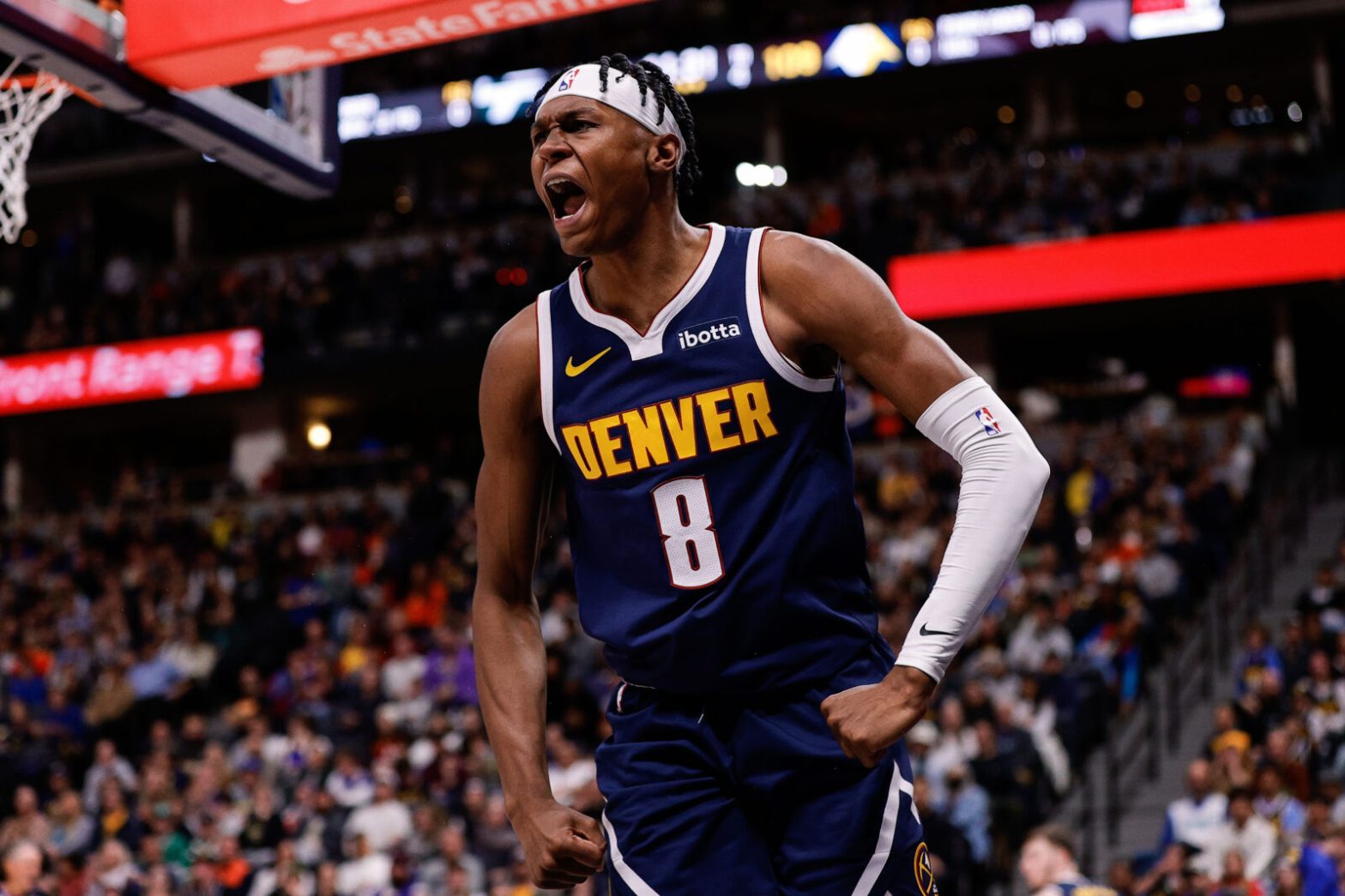
Cleveland Cavaliers Team President Koby Altman runs a team that made it to the Conference Finals for the first time in eight years this past season, but that same team under his stewardship also showed clear flaws that presented themselves as a large four wins to none chasm in those Eastern Conference Finals against the eventual World Champion New York Knicks. Clearly then, Cleveland needed to improve this summer, but for a long time, it looked like that just wasn’t going to happen.
Instead, after three months of waiting, Altman was able to pull the trigger on what ended up being a fairly complicated 5-team trade that actually melded and absorbed a Cavaliers’ trade that had been reported previously. To be succinct, the Cavaliers traded away swing-man Max Strus, guard Dennis Schroder, an unprotected 2031 First Round Pick and Cash. For their trouble, they received the rights to sign forward Peyton Watson (from Denver) to an offer sheet, as well as forward Cam Whitmore (from Washington) and the draft rights to Ismael Kamagate. Watson was then signed to a four year, $88 million contract.
In trading Strus, the Cavs traded a player that had signified the seriousness of their desire to contend when he was originally signed in free agency during the summer of 2023. Strus was brought onto a Cleveland squad that had just finished 4th in the Eastern Conference but had been bounced by the Knicks in five games in the first round of the playoffs. Perceptions were that the Cavaliers, who had been significantly outworked and out-rebounded in that series, needed to get tougher. Strus had made a name for himself as a hard-nosed player with playoff experience in Miami. He was a formerly undrafted two-way contract player that had worked his way into Erik Spoelstra’s rotation and played 25 minutes per game in the NBA Finals mere weeks before signing a 4-year deal with Cleveland.
Things started swimmingly for Strus in Cleveland. the 2023-2024 season saw him play the second most minutes and make the second most starts of any Cavalier on a team that would be hobbled by injuries, but still finish 4th in the East and this time at least make the second round of the playoffs. He would score the most Points per Game (12.2) as well as make the most Assists per Game of his career (4.0) while actually having his usage go slightly down from his Miami days, making the most of his time with the ball in his hands. Always having a reputation as a strong defender, he would also have his best defensive season by the measure of the advanced stat Defensive Win Shares. Strus stepped up and not only provided what the Cavs were hoping for, but perhaps played even a little bit larger of a role than expected due to some of the attrition that occurred around him.
Unfortunately, the injury bug would bite Strus himself over the next two seasons. He would miss the first two months 2024-2025 season with an ankle injury, but once healthy, he would shoot with some of the best efficiency of his career (44.2% from the floor, 38.6% from three). He would also defend at a high level again and even make an impact as an offensive rebounder at times, despite his lack of size.
What was more problematic was that most of his 2025-2026 season would be lost to a Jones fracture in his foot as Strus would not play his first game of the campaign until March 2026. To his credit, Strus continued to contribute once he was finally on the floor. His presence was a playoff imperative in his last season in the wine and gold as he was in and out of the starting lineup but played more then 25 minutes per game in all three post-season series. However, while Strus was a good contributor in the first two rounds of the playoffs, he really struggled in the ECF against the Knicks, shooting just 29% from the floor and while not lacking for hustle or gumption, having issues with the Knicks’ size on both ends.
Ultimately, Strus’s exit from the Cavaliers isn’t Strus’s fault. The Cavs needed a player like him three seasons ago when they were trying to establish themselves as squarely and consistently in the playoff conversation in the Eastern Conference year in and year out. That mission is accomplished. In accomplishing it, Altman maneuvered into a roster that most prominently has two All-Star guards at 6 foot 5 or under and two All-Star big men at 6 foot 11 or higher. What he doesn’t have, is someone to compliment them in between.
Strus, along with forward Dean Wade, were shoehorned into that in between role for the most recent playoffs, and while both are NBA players of their own qualities and abilities, neither of them were the right fit. Strus has the heart and effort, but at 6 foot 5 himself, just quite doesn’t have the size. Wade is bigger, but just didn’t show enough on the offensive end. Wing Jaylon Tyson could be that guy, but he is an inconsistent player about to be in his third season. He played himself out of the rotation during the playoffs with erratic play and poor shot decisions. Tyson might still be part of the solution, but that is with some strong assumptions.
Enter Peyton Watson.
Watson was the last pick in the first round of the 2022 NBA Draft. When he suits up for Cleveland this year, he will enter his fifth NBA season. After not getting a lot of run in his rookie year, Watson had been a steady producer for the Nuggets in every year following while seeing his opportunities progressively grow. He went from starting only four games in his second season to starting forty last year while shooting the ball a career high 17.7 times per game. Even with the increased workload, he shot with the highest efficiency of his career based on True Shooting% (59.4%, remember once you hit 60% you start hitting elite efficiency).
But what has likely been the leading reason for his time on the floor since his sophomore season is his ability to defend. As a 6 foot 8 forward, Watson has blocked more than 1 shot per game in each of the last three seasons. His Defensive Win Share numbers are also strong in all three years. Watson should be able to meaningfully pick up tough defensive assignments related to guards with size and forwards with speed while at the same time being a competent and effective contributor on the offensive side of the floor.
And that is the vision for Strus’s exit and Watson’s entry. Watson provides much needed size that Strus lacked, while still being able to knock down shots and stretch the floor for the aforementioned four All-Stars. He also provides similar, if not still developing, defensive prowess as Strus (and maybe slightly less than Wade, who I personally think of very highly on the defensive end). In short, Watson provides the qualities the Cavs once had, but adds on a much better fit for what they need in terms of size at small forward.
As for the other components of this trade, Whitmore was likely included so that salaries would properly match for all teams involved. From what is being said around the internet, it is likely that he will be waived by the Cavs at some point before the season starts. On the other hand, Kamagate very well may end up a Cavalier despite being a former 2022 second round pick that has spent his entire time since the draft overseas to this point.
Due to Watson being signed and traded to the Cavaliers, they cannot go over the first salary cap apron, which means even a veteran minimum deal would not be legal for them to pursue even though they still have a roster spot open. Someone like Kamagate that would be a former second rounder on a rookie deal would fit under the apron. For his part, he is an athletic big from France. He would very much be a defense-first player with leaping and shot-blocking ability. He would likely be at the end of the roster and below Thomas Bryant on the depth chart, but he would likely look the part for his role.
As far as departures, there were times during Dennis Schroder’s brief tenure as a Cavalier where he provided a much needed spark. There were some tenuous moments in the Cavs’ first round series with Toronto where Schroder’s intensity and ability with the ball were an asset. He also created some tenuous moments of his own with his play in the later rounds. I would have been fine to see him on this roster for the coming season, but if his last contribution is to help land Watson, that is acceptable as well.
Much could be made of Cleveland trading an unprotected first round pick to Denver in this deal. Maybe just as importantly, this pick was the last trade-able first round pick the Cavaliers had in their inventory, for now. The fact that this pick will not be made until another five NBA seasons are completed means that we don’t have the slightest clue which pick number it will be. That is before even considering how the new NBA lottery rules disincentivize being one of the worst teams in the league (in relation to the draft).
Yes. By 2031 James Harden will have aged out of both Cleveland and likely the NBA entirely. Donovan Mitchell, at a minimum, will not be the player he is today. His contract will have also expired with Cleveland. Even if this means assuming the Cavaliers are no longer good in the summer of 2031, we cannot just assume that the draft pick the Cavaliers just traded away will be of immense value.
In the more immediate, as this off-season has progressed, it has become apparent just how much of the Cavaliers’ short-term to medium-term progression hinges on the continued offensive improvement of Evan Mobley. With a roster that seemingly had stagnated due to the NBA’s increasingly restrictive salary cap rules and an inability to reunite with the greatest and most prolific superstar in the franchise (and league’s) history, it seemed that if the Cavs were to close the gap on the Knicks and the NBA’s other elite teams then the progress was going to need to come from within, and mostly from within Mobley.
Altman obviously hasn’t made a lot of moves this off-season, but the moves he has and has not made have spoken volumes. When he opted to not offer Mobley in trade talks at the start of the summer for neither Giannis Antentokounmpo nor Jaylen Brown, he hitched his wagon to Mobley’s hypothetical improvement. The Cavs are going to go wherever Mobley’s offense is able to take them.
Altman has given the Cavaliers’ another avenue. The 24-year old Watson presents as a solid three and defense player right now. There may be another level to his game though as evidenced by how he took up the mantle last season in Denver when their star center Nikola Jokic was injured. Watson averaged 21-6-3 during a month span while Joker was out. That is to say that Watson played his role while showing flashes of being capable of more, and that might be exactly what the Cavaliers’ need. Along with the continued ascension of players like Tyson and perhaps someone like 22-year old guard Tyrese Proctor or latest draftee guard Maleek Thomas, Watson and Mobley could continue a second timeline of competitive basketball into the early 2030s.
By trading all of Cleveland’s convenient trade-able assets (convenient meaning that parting with Tyson or Mobley or Jarrett Allen is more painful than Strus or Schroder due to the opportunity cost of the formers’ potential/All Star status) including their last available first rounder, Altman has now also hitched his wagon to Watson’s potential. Altman believes in that potential so strongly that he has chosen it, signed up to it for four years and now will have to trade an All-Star or other high potential player in order to make any more changes or improvements.
Granted, there are two more hitches on Altman’s wagon. Mitchell, who signed a new four year extension at the beginning of this summer that will take him through his age 33 season, is one of them. As Cleveland’s current best player and arguably one of the ten best players in the Association, these four years are his likely last best opportunity to lead a team to greatness. The second is Harden, who I want to give credit for waiting to sign his own pay-cut inducing extension until after the Watson trade was completed. He was also actively trying to help recruit Watson to town. While Harden isn’t the player he once was, he has shown maturity, leadership and a willingness to do whatever it takes to win this summer. Harden is still good, but isn’t the MVP-level player he once was, due to this we need to hope that a little of that self-sacrifice is able to carry over to the court. That little bit could go a long way.
Still, Watson isn’t on this team, and therefore this roster doesn’t have the potential to be meaningfully improved, without Harden’s willingness to take a cut. If Darius Garland is a Cavalier today, then Peyton Watson isn’t. I will let you do your own calculus on that.
To be transparent, beyond the fact that I do think the Cavaliers are positioned to be a highly competitive basketball team for the next two to three years, I genuinely do not know if Altman’s vision will work. Still, I do see the vision. Despite obvious headwinds, he has found a way to theoretically improve a roster that it would have been easy to run back with excuses about salary aprons and LeBron choosing Philadelphia. Instead, he’s taken a risk, and not a reckless one, but a measured and calculated one. I respect that.
Mr. Altman, I don’t know what the next few years will bring. I know even less about whether or not this team is set up for long-term success. But I do want to acknowledge your effort. I can’t call the Cavs favorites for the upcoming NBA season, but you’ve given them a better chance. I also don’t know what their standing will be five years from now, but I think you’ve given them a better chance there too.
And really, what more can we reasonably ask for?

