I think that most Cavaliers fans would agree that at the 25-game mark, they would have expected more from a team that seemed poised to threaten to make the NBA Finals coming into this season. But instead, here we are.
The Cavs currently stand at 14-11 and in 8th place in an Eastern Conference where they were expected to be one of the two best teams in the field, at worst. Expectations were high coming off of a 2024-2025 campaign that may have ended in an underwhelming fashion, but that saw them arguably sport one of the best offenses in league history.
Kenny Atkinson’s squad hasn’t been able to recreate the magic that made Cleveland not only successful last season, but one of the most fun teams to watch in recent memory. The Cavs led the NBA in scoring last season at a staggering 121.9 Points per Game. The were holistically a great offense, leading the NBA in Offensive Rating as well as in efficiency via True Shooting%. Simply put, the Cavs’ offense for the 2024-2025 season wasn’t just a runaway train. It was a marvel of engineering. It was a delight to watch due to the democratic way in which the team passed and played a beautiful brand of basketball, but also for its lack of wasted motion- its incredible efficiency.
So far this season Cleveland is a good, but pedestrian by comparison 9th in Points per Game. Their Offensive Rating places them in a very similar 10th, but more shockingly, their efficiency has taken a severe downturn. The Cavs currently rank 20th in True Shooting% as they have seen both their regular field goal percentage decrease as well as their rates from behind the three-point line.
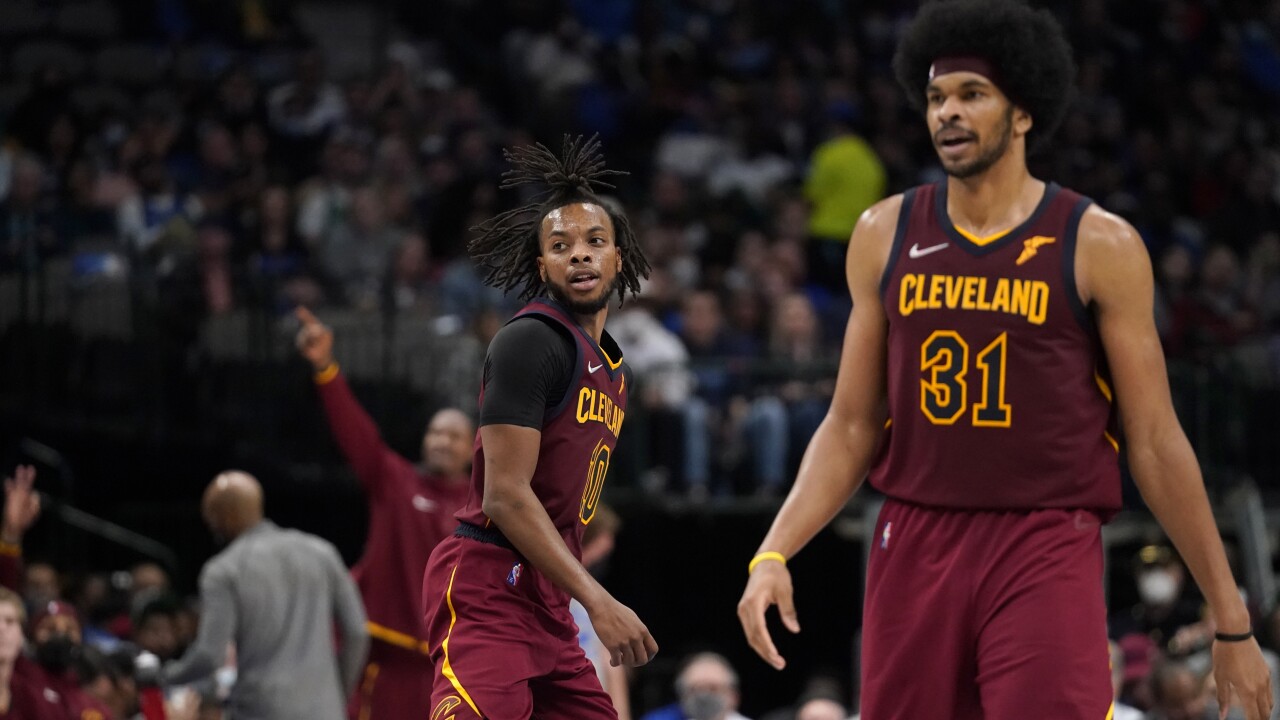
Many people thought that Cleveland would take a positive step upon the return of All-Star point guard Darius Garland after the beginning of Garland’s season was delayed in recovery from an injury he incurred in last season’s playoffs. Garland’s return could have been a second opportunity for the Cavs’ season to take off. Instead, not only did Garland find himself back out of the lineup due to injury after just a few games (he has since returned again, although the coaching staff is being careful with his use), but the Cavaliers are just 4-5 in games that he has played.
The 2-time All-Star and former 5th overall pick hasn’t been the jump start that Cleveland hoped he would be. The sample is small at only 9 games, but at this point, he is averaging his lowest Points per Game since his rookie season (14.0) while actually shooting less efficiently than he did in his rookie year (a rough 48.6% TS%).
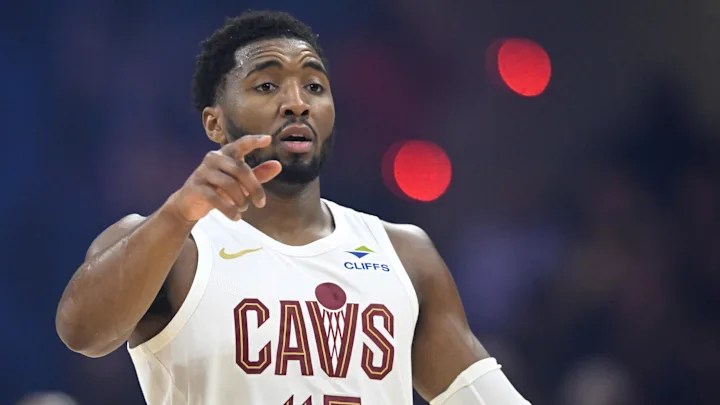
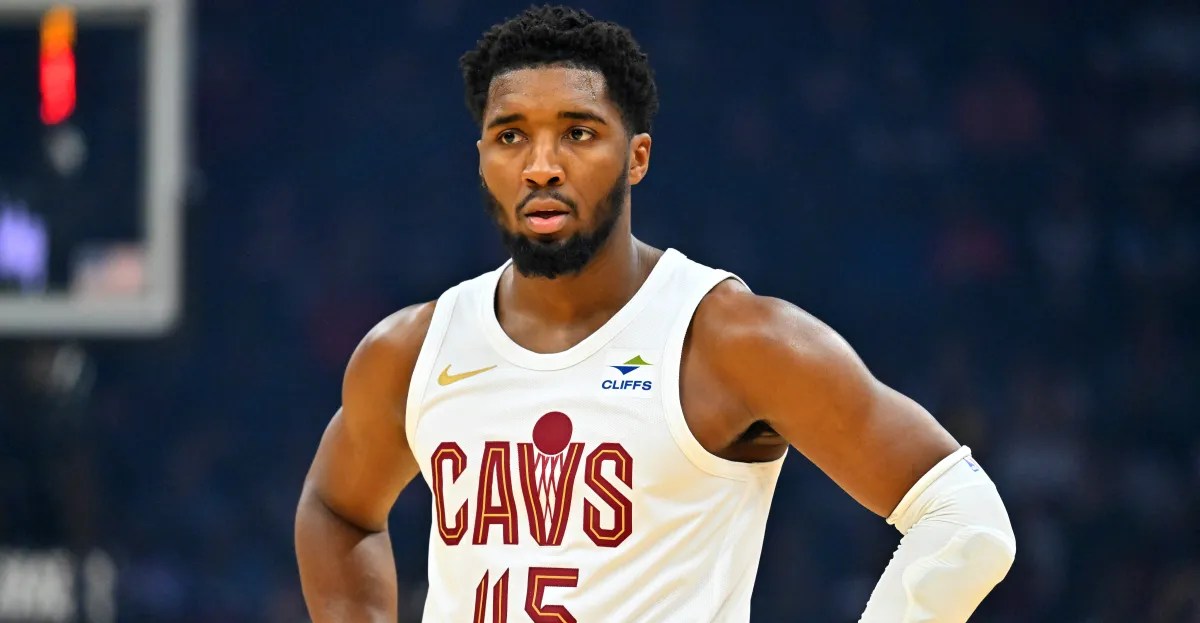
One can look at Garland’s absence as well as his ineffectiveness at the offensive end so far this season and try to point a finger at these being the Cavaliers’ biggest issues (at least offensively). Additionally, the Cavs have been bereft of the opportunity to have their entire roster at any point this season due to injuries. Sharp-shooting guard Sam Merrill was off to a hot start but has only played in 12 games due to injury. Key off-season acquisition Lonzo Ball has purposely been slow-played in order to retain his health. Max Strus hasn’t seen the floor yet this season. No Cavalier has played in every single game, including star guard Donovan Mitchell.
Garland certainly hasn’t been his best upon his return, and all these injuries have hurt, but there is one more absence that I think has had a particularly surprising impact on the Cavs’ offense. Believe it or not, I think that Cleveland’s offense misses injured center Jarrett Allen’s presence significantly.
I know this seems counter-intuitive. I acknowledge that Allen is correctly perceived as a defense-first center without much of a bag on the offensive end. I know he isn’t much of a shooter and definitely doesn’t create for himself the way that Mitchell or Garland do. But let me explain.
Allen’s offensive role with the ball in his hands is quite limited, but he does possess strong qualities. He is good around the rim, a great roll-man/lob threat on the pick & roll and a good interior passer.
As mentioned, the Cavaliers had an exceptional ’24-’25 season that saw them as one of the best offenses in the history of the sport. Allen played all 82 games in what amounted to a 64-18 campaign. While Allen isn’t a shooter from distance, he was phenomenal on the shots around the rim and in the paint that he did take. He quite literally led the NBA in Field Goal% at 70.6%, which makes for an obvious way that he contributed to one of the most effective and efficient offenses in the recent history of the sport.
While Allen’s ’24-’25 season was a high water mark for his efficiency, he generally can be depended upon to score around the rim at an efficient level. His Field Goal% for his career is 3rd best among all active players at over 63%. Interestingly, Allen has still been good enough to lead the Cavaliers in Field Goal% this season, but is currently having the worst shooting season of his career at 57.3%. At just 27 years old, I would not expect regression to be a factor here, but the time Allen has missed this season is largely due to injuries to his hands. If his hands have been ailing him, it only makes sense that the touch that he puts on the ball would be hampered.
But even with injury and at a reduced level of effectiveness, I feel like Allen’s presence has been a pivot point for the Cavs’ success this season. Cleveland has still been a better offensive team when Allen is on the floor.
As mentioned, his Field Goal% still leads the team, even if injuries have brought him down a couple of notches. Allen has also pulled down 2.4 Offensive Rebounds per Game, narrowly missing the team lead in this stat as big man Evan Mobley has pulled down 2.5. However, Allen’s offensive rebounding rate is even more prolific as he leads the Cavs in Offensive Rebound%. (minimum 13 games played and 24 minutes per game… sorry Nae’quan Tomlin). Both figures have Allen in the top 25 in the NBA, so while he hasn’t been in the very top tier, he has been a legitimate contributor. When combined with the efforts of Mobley (and perhaps Tomlin), Cleveland can mount a force on the offensive glass.
What I find most interesting though is that the Cavs play at a measurably faster Pace when Allen is on the floor. You wouldn’t think this would be the case. Allen isn’t unathletic or anything, but you wouldn’t think that the Cavs are at their fastest when their biggest man is on the floor. At a rate of 105.3, this beats out even Lonzo Ball and his penchant for pushing the ball on the break.
So in totality, Allen increases the number of possessions that Cleveland gets not only via second chance opportunities but also because something about his presence on the floor increases the rate at which the Cavs take shots. Couple that with his own ability to put the ball in the basket at a high success rate, and you can see why Allen has the 2nd Best Offensive Rating on the team (missing 1st by just 0.1) and the 2nd Best Net Rating on the team (behind Donovan Mitchell in both categories, who should get Most Valuable Player votes if he keeps his own season going).
But there still seems to be something else going on when Allen is on the floor beyond his own individual performance. Perhaps it is solely a function of his own efficiency, but the Cavaliers’ effective Field Goal% is .568 when Allen is on the floor. If that figure was Cleveland’s overall eFG%, it would be good for 6th place in the NBA. Without Allen on the floor, their eFG% is .528, which if it were their overall rate, would tie them with Brooklyn for 24th. Adding to this, the Cavs’ Offensive Rating with Allen on the floor is 122.7, which would have them as the 2nd best offense in the league. Without him on the floor, their Offensive Rating is 114.5, which would have them in 16th.
What I find most odd about this is that while Allen himself isn’t a three-point shooter, his presence on the floor seems to also affect Cleveland’s ability to shoot the ball from deep. I wasn’t able to find a specific “on-off” stat for this, but by my own math, the Cavaliers have shot 35.7% from three in games where Allen plays this season. In games that Allen has missed, they shoot just 32.3% from beyond the arc. Neither of those rates are especially good, but let’s just say that the Cavs go from being the 20th to dead last in three-point shooting in the comparison between those two rates. That’s right. If Jarrett Allen isn’t on the floor, the Cavs have shot threes at a percentage that would be worst in the league if compared to all other teams.
I can only speculate, but I feel like Allen puts pressure on the Cavaliers’ opponents to guard the paint in a way that teams don’t necessarily have to do when he isn’t playing. His ability to run to the rim, roll hard off of picks and the positions he places himself in on the floor cause defenses to have to cover not just east, west, and north at the three-point line, but also south towards the rim. This creates more shooting space and better shots for the shooters that are on the floor.
We could say that Mobley does this as well, but my perception is that Mobley tends to position himself in different spots more in the mid-range portion of the floor, therefore not creating the same spacing.
On the subject of Mobley, while the long-term narrative has been that Allen and Mobley are a tough sell to play together on the floor, especially offensively, because of their lack of effective outside shooting, they’ve actually been good together this season. When Allen and Mobley are on the floor together, the Cavs outscore their opponents by 10.3 points per 100 possessions. This outpaces the Cavaliers’ overall net rating, which is just over 3 points per 100. The only player Allen is better on the floor with this season is Jaylon Tyson (+10.7 points per 100 possessions).
Put it all together and it appears then that Cleveland’s offense while Allen is on the floor isn’t quite best in class, but is among still the best. When is he isn’t on the floor though, the Cavaliers’ offense appears to be very run-of-the-mill.
So like I said, I know it seems counter-intuitive, but Jarrett Allen’s ability to score around the rim makes him efficient in his own right. He creates more possessions for his team both via offensive rebounds and by the pace that the Cavs’ play at when he is on the floor. His teammates also shoot and play more effectively when he is on the floor this season. They shoot threes better and Allen in combination with Mobley has been a positive as opposed to a detriment.
Is it that wild to think that the Cavaliers are missing Jarrett Allen’s presence right now?
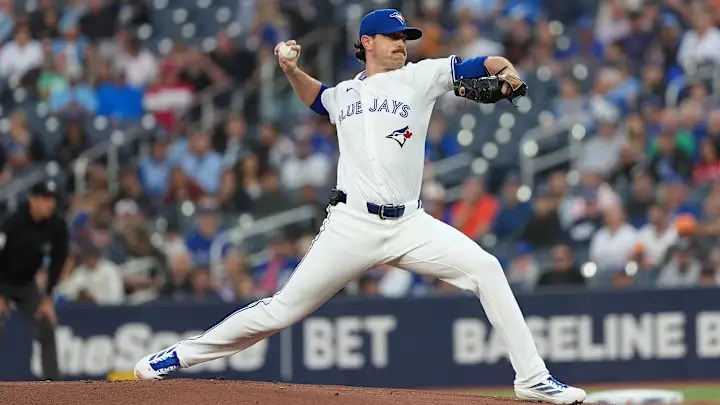
One of the first moves of the baseball off-season was when former Guardian and current Blue Jays pitcher Shane Bieber decided return to Toronto for 2026 by picking up the 1-year, $16 million option on his contract. The right-handed former ace’s decision was surprising for many.
Previous to his time in Toronto, Bieber had spent the vast majority of 2024 on the Injured List for Cleveland and spent essentially all of the first half of 2025 rehabbing from Tommy John Surgery before being traded at the July 31st deadline to Toronto.
However, Bieber would make his 2025 MLB debut on August 28th. He would make 7 regular season starts for Toronto and in those starts seemed to be pitching with a clean bill of health. To that point, he would throw just over 40 innings and pitch to a 3.57 ERA. That ERA would propel him to an ERA+ of 120 (100 is average, higher is better) and Bieber would average just over 5 2/3 innings per appearance in his return. So while he maybe didn’t pitch with the same effectiveness of his career ERA+ of 132, he was strong and healthy enough to pitch nearly 6 innings per appearance in a league where pitching that deep into ballgames is becoming less and less common.
Additionally, Bieber was part of the playoff equation for the Blue Jays in October. He made 5 appearances overall including 4 starts and while his numbers didn’t especially stand out, he held his own against the likes of the Yankees, Mariners and Dodgers. He pitched to a 3.86 ERA and more importantly, utilized his control, which is his best attribute as a pitcher. No one on the Blue Jays staff who threw 10 or more playoff innings had a better walk rate than Bieber.
All of this is to say, that while Bieber wasn’t in the ideal scenario that you would want to me in to be an upcoming free agent, he had done a lot in the last 3 months of MLB play to make a case for a significant contract.
Let’s remember that a little less than a year ago, the Detroit Tigers penned a contract with another former Guardian pitcher in Alex Cobb. In that deal, the Tigers signed Cobb to a 1-year, $15 million contract despite the fact that Cobb had dealt with myriad injuries in the last 18 months, had thrown just 16 innings in 2024 and was unclear on when he would be healthy for the 2025 season. Cobb never actually stood in the middle of the diamond for the Tigers in 2025. Apparently though, the nearly 60 innings of effective pitching that Bieber put together in 2025, his youth, the fact that he should be ready to pitch as at the start of 2026 and his Cy Young Award are worth only $1 million more than Cobb made just a year ago (not accounting for inflation either, of course!).
Then there’s Lucas Giolito. Once the ace of the Chicago White Sox, Giolito had a 3.47 ERA (129 ERA+) in 72 starts between 2019 and 2021. In contrast, Giolito would noticeably under-perform in 2022, pitching to a worse than league average 4.90 ERA in 30 starts. He would seem to bounce back in 2023, in 21 starts for Chicago he would throw to a 3.79 ERA, but the wheels would fall off after a deadline trade to the Angels. Giolito would bounce between Anaheim and Cleveland (remember that?!) to end the season and arguably put up his worst performances as a big leaguer. He would be worth -1.2 Wins Above Replacement in just 63 1/3 innings pitched in his time with the two teams. His ERA would be an ugly 6.96. He allowed 21 home runs in the 12 starts he would make after being traded and for the overall season would lead baseball in home runs allowed. His full season ERA would ultimately land just under 5.
In short, Giolito wasn’t very good and was trending the wrong direction. Even so, following that 2023 campaign he signed a 2-year, $38.5 million deal with the Boston Red Sox. You read that right. Despite all of his misfortune on the mound, Giolito got a 2-year deal making $19.25 million per year.
And yet, here is Bieber, opting in to a 1-year, $16 million deal. Admittedly, the news of Bieber agreeing to his option isn’t exactly fresh. It broke a little less than two weeks ago. But I have been sitting with it and stewing on it and I just can’t get over it. Something doesn’t compute. I am inclined to think one of two things is going on.
First, it is possible that the free agent market for this off-season is just going to be unpredictable because this is the last year of Major League Baseball and the Major League Baseball Players’ Union’s Collective Bargaining Agreement. I can envision that Bieber has decided to take this one year option because he believes the free agent market is going to be diluted by teams having concern over the “uncertainty” of the future of baseball’s financial system. This would potentially be a pragmatic approach by Bieber. Come back to Toronto, show out even more in 2026 and try to make the most money possible once the rules of the road are once again cleared up after CBA negotiations.
I have also heard from shows/podcasts that I listen to that Bieber opting in must be a prologue to an extension that he is working out with Toronto. That too could have some merit, and really leads me into my other possibility, regardless of whether or not Bieber seeking an extension is entirely true.
Bieber, the other players in Toronto, the organization at large and the fans- I can only imagine have a strong feeling of unfinished business right now. Being a Cleveland baseball fan, I can empathize. They got literally as close as possible to winning a World Series as they could without actually doing it. Bieber, of course, played a major role in their undoing, allowing the go-ahead home run to Dodgers’ catcher Will Smith in extra innings of Game 7 of the World Series.
I’m not naive. I know money is one of the most prominent motivating factors for baseball players in where they decide to play when given the choice, but I don’t think it is the only factor. After getting that close, particularly after having worked so hard to rehab and get back into games and then have some legitimately good moments along with one really painful one, I wouldn’t blame Bieber in the slightest for wanting to run it back in Toronto.
And yes, maybe an extension is on the horizon. Bieber had only known Cleveland’s professional organization since being drafted by the team in the 4th Round of the Amateur Draft in 2016. When he went to Toronto though, he went to an organization led by Team President Mark Shapiro. Shapiro had been in the same role in Cleveland as recently as just months before Bieber’s drafting. Shapiro’s lineage continues in current Guardians’ Team President Chris Antonetti and General Manager Mike Chernoff.
Bieber was also one of six former Cleveland organization players to play for Toronto in the 2025 playoffs (Bieber, Andres Gimenez, Ernie Clement, Myles Straw, Anthony Santander, Nathan Lukes). That’s nearly a quarter of their roster. So while Bieber left Cleveland, his destination was about as close to the Guardians organization that you can possibly get. Even the playoff outcomes are on brand, though the financial resources are more robust with the Blue Jays.
The point here is that not only does the way in which the season ended leave Bieber invested in a return, perhaps even at a discount, but in a lot of ways the comfort-ability and culture that he feels may also have been a draw. I know all I am doing is speculating, but if I’m onto something, I would applaud Bieber for making a decision to stick with not just what he knows but what has proven to be successful on the field. I would applaud him for wanting a second chance to get to redeem his personal 1997 Charles Nagy moment.
I think the real question here is if other players will follow in kind. I don’t just mean Toronto’s free agent infielder Bo Bichette either. I wonder if such a prominent World Series outcome, an infectious offensive strategy that mixes the long-ball with fundamentals, and the opportunity to play with Vladimir Guerrero Jr will draw many free agent’s attention to the Blue Jays. For their part, Toronto has the backing of an entire country behind them. They have the financial resources to support free agent reinforcements. With how close they got, it may not even take all that much more.
After losing in the World Series in 2014, the Kansas City Royals went out and got DH Kendrys Morales and SP Edinson Volquez in free agency. They would go on to add utility-man Ben Zobrist and another SP in Johnny Cueto at the deadline. These were savvy moves, but weren’t super-ultra attention-getters. Between all four players there are six career All-Star appearances and one Silver Slugger Award. Those four players would help propel the Royals to the Commissioner’s Trophy in 2015.
Toronto doesn’t need to run out and convince Kyle Tucker to come north of the border. They don’t need to have feel anxiety because of what happened in the past when they tried to court Shohei Ohtani. They just need to find the right mix of veteran talent that’s still got something left in the tank and wants to get over the hump as badly as they do right now.
Can they do it? For what its worth, I think at least Shane Bieber thinks so.
If you have read the news that Carl Willis intends to return as Guardians’ pitching coach in 2026, you likely breathed a small sigh of relief (and if hadn’t read that, you can let it out now!). Part of me wouldn’t blame you. Willis’s reputation as one of the best pitching coaches in the sport presently, and perhaps in the sport’s history, has solidified over the years.
That reputation is largely staked on being the pitching coach for five different Cy Young Award winners over the course of a a 20-year career with Cleveland (in two different stints) as well as Seattle and Boston. To put it another way, if you’re a fan of a team which Willis has been a pitching coach of, there’s a 1 out of 4 chance that the Cy Young Award winner in your league is on your team in that given year. That’s how prolific his time has been.
The other item that Willis has most been able to stake his reputation on is the “pitching factory” that he has helped develop in Cleveland. These items go hand in hand because when you think of that “pitching factory”, you probably think of how Cleveland has developed pitching stars and award winners like CC Sabathia, Cliff Lee and Shane Bieber. However, this phenomenon also relates to the Guardians and Willis’s ability to get the most out of all pitchers- not just his stars that could win hardware. This is especially true in his most recent tenure with the team that started in 2018.
Former Guardians pitcher Mike Clevinger pitched to a 3.52 ERA in 186 2/3 IP in Cleveland under his first pitching coach, Mickey Callaway (another great pitching coach, but reportedly with severe issues off the field). Clevinger pitched to a noticeably better 2.92 ERA in 348 2/3 IP under Willis in Cleveland. Although Clevinger’s worse numbers under Callaway could be attributed to being a younger, more inexperienced pitcher, or a smaller sample size, Clevinger also never pitched better after departing Cleveland than he did under Willis. His ERA was actually a much worse 4.27 in his years after making his exit from the Guardians and he only pitched in 8 MLB games in 2025 at the age of 34.
Another recent example of a pitcher finding his best success specifically under Willis was former Guardians starter Cal Quantrill. All four of Quantrill’s seasons in Cleveland match up with Willis’s tenure and in those seasons, Quantrill pitched to a 3.58 ERA and an above average ERA+ of 114. In his other seasons in the Majors, both before and after his time in Cleveland, Quantrill’s ERA punches in at an ugly 5.24. In no other stop outside of Cleveland has he performed as an above average pitcher by ERA+.
Willis’s successes aren’t just limited to the starting rotation though. Enyel de los Santos, a journeyman of a relief pitcher who has pitched for 8 teams in his 7 MLB seasons, had his best numbers in his 2 years with the Guardians, despite them being the largest sample to draw from.
De Los Santos pitched to a 3.18 ERA in 119 innings for Cleveland in 2022 and 2023. This is far and away the most MLB action he has seen with any team as he was a significant contributor for Cleveland in those two years. His ERA for every other team he has pitched for combined is a full two runs higher at 5.21 over the course of 195 1/3 innings. Yes, you could consider these samples small and unreliable, but a full two runs difference specifically when he was with Cleveland is quite noticeable.
Interestingly, while Willis’s reputation can be staked back to his first go-round in Cleveland, starting in 2003 as the pitching coach for Eric Wedge, this more recent foray in Cleveland seems to really be the most prominent success of his career. While he has only been at the helm for a single Cy Young Award since re-joining Cleveland in 2018 (Bieber in 2020, also a shortened season) Cleveland is 4th in ERA and 6th in FIP since he took up the mantle as Terry Francona’s pitching coach.
None of his previous time-spans as a pitching coach measure up to this. In fact, you could make the argument that up until this stop in Cleveland, maybe Willis’s reputation was a little out-sized. His teams often finished middle of the pack in stats like staff ERA or FIP over his time in town. While individual pitchers like Sabathia, Lee and the infamous 2016 AL Cy Young Award winner Rick Porcello (another example of a pitcher having his best success under Willis) flourished and won awards under him- the overall body of work was actually a little less impressive.
All of this is to say, that while Willis is currently 64-years old and it seems that his continued work as the Guardians pitching coach seems to be hinging on a year-to-year basis, he is seemingly doing the best work of his career. What we have seen from the Guardians’ pitching staff- most recently carrying this most recent iteration of the team so that they could overcome a 15.5 game deficit to win the American League Central division- has been remarkable.
I understand though if the tenuous nature of Willis’s future gives some fans pause, but I don’t think that is entirely necessary. The Guardians pitching infrastructure has weathered a lot in recent years. By my count, at least three current MLB pitching coaches were pilfered from lesser roles in the Guardians organization (Ruben Niebla for the Padres; Matt Blake for the Yankees; Brian Sweeney for the Royals). There are likely other underlings that have also been pulled away to work in other organizations. Yet, the Guardians pitching factory continues to bang out success after success, year after year.
I think it is very easy to look at coaching staff roles like pitching coaches and think that the type of success the Guardians have built starts and ends with one man. But in 2025, baseball teams have organizational philosophies on pitching (and hitting… and base-running… and defensive positioning… and countless other things). These philosophies aren’t the brain-work of any single individual. They are built upon the consensus of smart baseball people and they are spread not just across the Major League team but across the entire organization through the minors. Willis’s role is to use his vast experience to be a prominent voice in helping build that consensus. His job is also to express those philosophies- and not solely his own- to his players at the Major League level.
Willis has a major (I emphasize: major) hand in the ideas and methods that have made the Guardians successful. However, this isn’t an “I alone can fix it” situation. While the organization is certainly in fantastic hands right now, there will come a day when he departs, and a lot of the ideas and great habits they have built aren’t going to just wash away because he singularly is gone.
Willis deserves all the respect that he gets. His reputation at this point is rightfully excellent, but so is the Guardians organization’s reputation as a bastion of pitching development overall. That reputation is just as deserved, which should allow all of us to breathe a little easier.
That’s where baseball fans are headed. The calm, even at times malaise, of a six-month regular season is about to be replaced with the spastic short-series chaos of the MLB playoffs. Prepare yourselves. For while the 2025 regular season has had several incredibly memorable moments, those moments came from a built-upon extended tension. Cal Raleigh’s 60-homer season as a catcher is awe-inspiring in part due to the sustained excellence of six months of play. The Cleveland Guardians may have changed the course of their season in a way that was historic, but they did it over the course of a month.
The regular season is built on sustained successes day after day. Days turn to weeks. Weeks turn to months. Months turned into full bodies of work that get you into the post-season. For the post-season itself though, the key moments are ridiculously granular. Key at bats turn into key innings. Those innings change wins into losses and vice versa.
The Milwaukee Brewers led baseball with 97 wins this season. If they were to go on to to win the World Series, they will need 11 more wins to do so. I am trying to put this in perspective. If the Brewers proved themselves to be the best team in the sport this year with those 97 wins, then each of the 11 post-season wins they need to cement themselves as the best team in the game are worth about 9 regular season wins.
I hope that makes sense. The point I am trying to make is the incremental difference we see between how teams established themselves to get here and the sheer impact of individual games from hereon out. That’s what makes the MLB playoffs arguably the most exciting and drama-filled post-season of any major American sport. At this time or year, a switch flips and suddenly an at bat goes from a drop in the bucket to a much more prominent portion of the concoction.
For my part, having the Guardians make the post-season, let alone on an improbable run that saw them stifle a 15.5 game deficit over the course of the second half, makes the scenarios even more intense. However, I think anyone even moderately interested in the sport cannot deny the intensity and myth-making that this portion of the calendar can bring. When thinking of this phenomenon I am reminded of something Oscar Wilde once wrote and that Gene Wilder then made even more famous for less cultured audiences like myself in Willy Wonka and the Chocolate Factory.
“The suspense is terrible… I hope it lasts”.
And of course, I hope it lasts for my Guardians. That will provide me the most enjoyment. But even if it doesn’t, I will lick my wounds and get engaged all the same in pretty short order. What lies ahead is too compelling not to be drawn back.
With all that said, the other byproduct of all this intrigue is variance. Naturally, the sheer impact of each at bat, inning and game at this point in the calendar is directly tied to the smaller sample in which these games will be played. And that’s fine. I don’t say that to diminish the moment. Baseball has been playing “best of” series to determine its champion in some form for 125 years now. You stand toe-to-toe in October and beat the other best and you get the trophy. Thems the rules that we all agree to. That’s how you earn it.
But that often means, that while they are fun to do, playoff predictions are often not worth the paper they are written on. It is ironic, in a sport that has devoted itself so much to statistical analysis, often being on the cutting edge compared to other professional sports, we accumulate all this data over time to get to this moment.
Well, some of it might be useful now. Some of it might not. And we don’t know exactly which part will be useful. I wouldn’t say throw it all out, but good luck deciphering the right components to tell me what is going to happen 2 minutes, let alone 2 series from now.
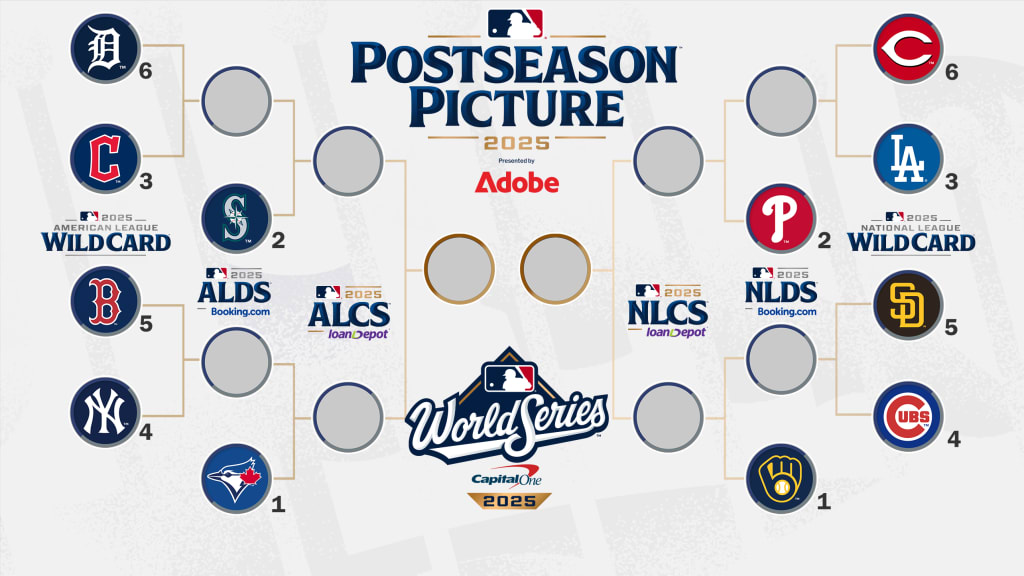
Despite all that, it is fun to make predictions. So, in the spirit of that fun, and on the off-chance that I won the lottery in picking the right tidbits that will be put together to predict the October that lies ahead, here is one of the possible 2,048 ways that the MLB post-season could go. I will also provide a few a nuggets of information for each outcome as I see it. I want to directly mention that I am aiming to be objective in these predictions, despite my Guardians fandom. That said, we’re going to rip the band-aid right off and start with my favorite squad of 26.
AL Wildcard Series
Guardians over Tigers in 2.
At this point, I think Cleveland lives rent free in Detroit’s head. Having relinquished a 15.5 game division lead, Detroit stumbled into the playoffs losing 13 of their last 16 including 5 of 6 vs Cleveland in the last two weeks. They have likely back-to-back Cy Young Award winner Tarik Skubal ready to pitch in Game 1 and the Tigers were 21-10 in games Skubal has started over the course of 2025. However, Cleveland has beaten him twice in two weeks. I’m not sure the mystique is there.
Red Sox over Yankees in 3.
I know Boston is without Roman Anthony, and hasn’t looked like the same offense without him, but Boston has been able to put a lid on one of the best offenses in baseball over the course of their matchups this season. Many prominent pitchers for Boston- Garrett Crochet, Bryan Bello, Lucas Giolito, Aroldis Chapman and Garrett Whitlock- had success vs New York with ERAs at least below 3.50. It’ll be close. This will be (one of) the first Wildcard Series in the 6 team per league format to go to 3 games. Sounds like a perfect billing for Red-Sox Yankees.
NL Wildcard Series
Dodgers over Reds in 2.
Considering the fact that coming into the season, no one expected the Dodgers to need to play in the Wildcard series due to their bevy of talent, it would be absolutely wild if Cincinnati pulled the upset. Considering that the Dodgers outscored the Reds by double in their regular season matchups (30 runs to 15 runs), it would be even that more shocking. That goes without mentioning that the Reds snuck in with just 83 wins with the support of the Mets own late season collapse. Never say never, but I just don’t see it. The Dodgers are veteran enough to take care of business here.
Cubs over Padres in 3.
Speaking of in-season matchups, you can use them to predict absolutely nothing here. Not only did the Padres and Cubs split their season series at 3 games each, but they both scored/allowed 25 runs against each other. Much has been made of the Cubs slowing down and playing near .500 ball in the second half. The Cubs were the 3rd best offense in baseball by wRC+ in the first half and were only 15th in the second half. However, they’re back to 5th place since August 19th. The lull seems to be over. Meanwhile, San Diego is the 3rd worst home run hitting team in the sport in a time of year where one swing is much more important. I like the Cubs. I think they’re legit. More to come.
AL Division Series
Mariners over Guardians in 4.
Like I said, I am being objective. Seattle has the 3rd best pitching staff in the sport by xFIP. With the bye, they are going to get to rest and line up Bryan Woo, George Kirby, Logan Gilbert and Bryce Miller in whatever order they want. Cleveland has hit the ball better during this late season stretch but they have the potential to be overmatched here. Seattle has also hit the 3rd most home runs of any team since the trade deadline. And its not just Cal Raleigh. Julio Rodriguez, Jorge Polanco and Josh Naylor have also slugged over .500 during that span. The Mariners are stacked.
Red Sox over Blue Jays in 5.
Jose Berrios had been moved to the bullpen and then got injured. 41-year old Max Scherzer and his 5.19 ERA are probably going to have to make starts for Toronto. Kevin Gausman and Shane Bieber can be great, but there isn’t much behind them. Down the stretch, Boston really struggled vs left-handed pitching, with an 85 wRC+ in September. However, all the good pitchers Toronto does have are righties, where Boston has been an above average offense, even without Anthony. If you’re looking for an unlikely hero, look out for rookie Nate Eaton who has hit .316 since August 15th.
NL Division Series
Dodgers over Phillies in 5.
Philadelphia’s wRC+ over the course of the season was 109. Against the Dodgers, it was just 72. They hit just .170 against the Dodgers’ pitching staff this season. Four of their starters- Alec Bohm, Brandon Marsh, JT Realmuto and Max Kepler- went a combined 2 for 57. For their part, the Dodgers have gotten strong starting pitching performances from Yoshinobu Yamamoto, Blake Snell and Clayton Kershaw down the stretch. All three threw more than 40 innings with a FIP better than 3.10 since August 15th. Can Kershaw make a post-season statement in his final innings before retirement?
Cubs over Brewers in 5.
Milwaukee has had a great season, but they were 28th in home runs in September. No one hit more than 3 homers for them in the month. Even worse, none of Christian Yelich, Jackson Churio or Wilson Contreras were league average hitters down the stretch. As said earlier, the Cubs offense has rebounded. To be fair, pitchers Matthew Boyd and Shota Imanaga haven’t been good lately either for Chicago (5.31 and 6.51 ERAs in September, respectively), but the supporting cast around them has been solid. The bullpen has been led by Brad Keller, Andrew Kittredge and Aaron Civale. All had ERAs of about 2 or lower over the same time frame. I expect them all to help get the ball to Daniel Palencia at the back end, who can lock it down.
AL Championship Series
Mariners over Red Sox in 7.
I didn’t realize I thought as highly as I did of Boston until I did this exercise, but Seattle is just so stacked. Seattle pitching held Boston to a 59 wRC+ in their matchups this season. I mentioned their offense since the trade deadline and their starting rotation, but their bullpen also goes about five deep with lockdown guys. Gabe Speier, Matt Brash and closer Andres Munoz have been particularly good with season FIPs of 3.05 or better. Did I mention Cal Raleigh hit 60 homers while catching? It has nothing to do with the bullpen but needs repeating.
Cubs over Dodgers in 5.
The Cubs have not been a trendy team to pick to get this far. I acknowledge that. However, they outscored the Dodgers 42-31 in their matchups against eachother this year. Pete Crow-Armstrong hasn’t been the same caliber offensively in the second half, but he did hit 4 dingers against the Dodgers earlier this season. I think he can carry that confidence from earlier matchups. They also just recently got a healthy Kyle Tucker back, who not only has post-season experience but has been a long time torn in the sides of the Dodgers. I like the Cubs here to surprise some people.
World Series
Mariners over Cubs in 6.
This is easily Seattle’s best opportunity in more than twenty years to win their first World Series ever. They’ve never even made it to one. What better way to win it than to win it off the last team to break a century-long World Series drought? The Mariners biggest flaw is that they aren’t a very good base-running team. Beyond that, they hit incredibly well(3rd in wRC+ and homers), pitch incredibly well (3rd in xFIP) and field the ball at a decent level (8 Defensive Runs Saved). I think the Cubs are better than they are being perceived, but Seattle has the opportunity to just outgun everyone put in front of them. For the fun of it, let’s go with Julio Rodriguez as World Series MVP. Rodriguez had a 30-30 season while being one of the best center-fielders in baseball. His ability to affect the game in multiple ways makes him a prime MVP candidate.
And that’s my version of what is to come over the next month. If you made it this far, thanks for reading. Here’s to an October that provides a great finish to an already memorable season.
2025 has been a roller coaster, with the Guardians performing in both peaks and valleys
Really, nothing at Cedar Point has anything on this Guardians season. As I type this on Tuesday night, Cleveland finds themselves four games above .500. I know that seems pretty run-of-the-mill, but the Guardians have put together a campaign where they have played like a playoff team for ten days and then played some of the worst baseball in the league for two weeks. Then they’ll play great for a week and a half. Then look lost for an extended road-trip. They’ve done this over and over again.
That’s good context, because I- and the Guardians for that matter- are riding high again at the moment. I am writing this after the back-to-back masterful pitching performances of Slade Cecconi and Joey Cantillo against the Royals. The Guardians have looked fabulous in the first two games of a four game series here in early September. So far, they have outscored Kansas City, another team which they are competing with for the final American League Wildcard spot, 12-2 in the series. Simply put, things are looking up… again.
The Guardians went from looking like serious competitors when they took three of four from Detroit at Comerica in May, to looking like pretenders when they followed up that series by going 6-13 in their next 19 games.
They could have been left for dead after losing ten in a row in late June and early July. Or when a sweep at the hands of the Braves in August was followed up with a southwest road-trip that saw them go 1-6.
Instead, here we are. 74-70. A mere 2 games out of the final Wildcard spot.
The good vibes have me thinking. What is it really going to take to close the deal? After more than five months of play, the Guardians, and all MLB teams, are down to less than 20 games remaining in their seasons. The possibilities that were endless when spring was upon us are now becoming quite finite as autumn starts to forebode. We are at a point where we can trick ourselves into drawing conclusions from the remaining schedules. It is NFL season now. Some people love play the schedule game with their NFL team- trying to determine the wins and losses on the upcoming docket. Well, we have a similar number of MLB games left relative to an NFL schedule.
So, I did the same. Using a combination of won-loss records and run differentials both over the course of the entire season and the last forty games, I tried to make some informed determinations on the remaining schedules not just for the Guardians, but for the teams they are competing with for playoff opportunities. Detroit, Seattle, Texas and Kansas City were given consideration. For the sake of time, Tampa Bay didn’t make the cut.
Admittedly, while even having the best intentions and trying to use data to make these determinations, baseball is going to be baseball. The chances of me nailing all of these outcomes is probably pretty low, but I do think there were some things to be learned from the exercise regardless.
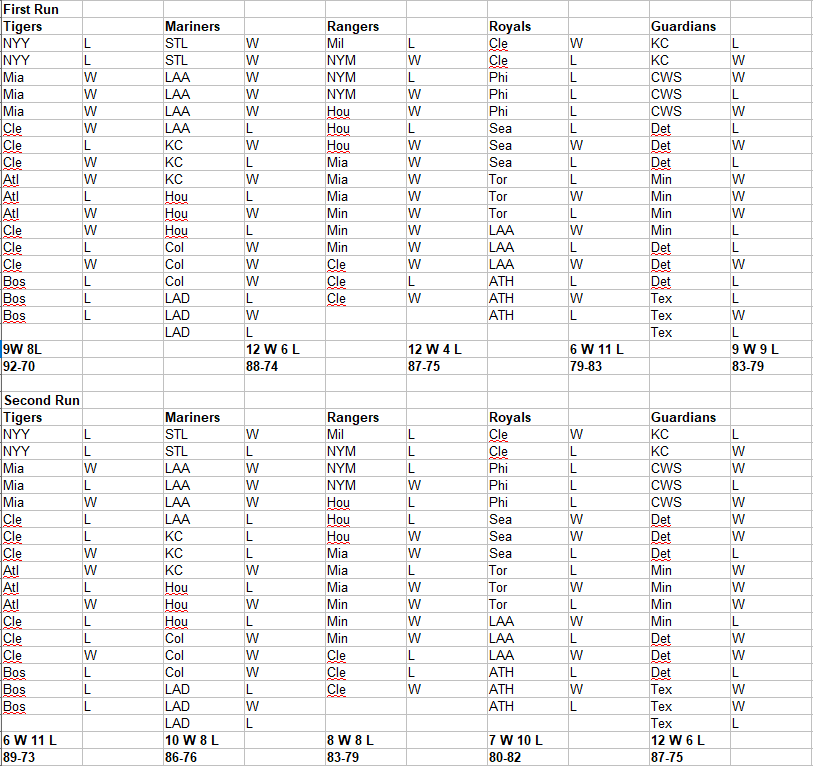
And I have to be honest, with all the good feelings I had, the process was a bit sobering. I love how the Guardians have played over the last week or so, but they have some challenges they are up against. I actually ended up running through all five teams schedules twice. In the first iteration, I just played it straight. I tried to make decisions without having the express goal of getting the Guardians into the playoffs. The results, at least from my perspective, weren’t ideal.
Guardians: 9-9 rest of the way, 83-79 overall
Tigers: 9-8 rest of the way, 92-70 overall
Mariners: 12-6 rest of the way, 88-74 overall
Rangers: 12-4 rest of the way, 87-75 overall
Royals: 6-11 rest of the way, 79-83 overall
By these calculations, Detroit retains their commanding lead on the AL Central, winning it by 9 games. Seattle ends up holding on to take the final Wildcard spot while Texas plays incredibly well down the stretch but just barely misses out.
There are a couple things to address here. A lot has been made of how poorly Seattle has played lately. The media has been talking about them as a team that could cough up their spot in the playoffs. To that point, they are 17-16 since August 1st, and have a positive run differential over that time frame. Not amazing, but also not exactly abysmal. They are currently playing a series with St. Louis (below .500 for the season, -30 since August 1), have four games against a lousy Angels team (-129 for the season) and get to play Kansas City and historically bad Colorado yet. The fact of that matter is that while they haven’t been the team that was challenging for the AL West division earlier in the season, they aren’t playing all that poorly and they have some potential easy Ws coming.
Texas is +22 in run differential since August 1st and are among the best teams in their last 10, going 7-3. They get the benefit of playing Miami, who has been putrid as of late (-62 since August 1, went from 53-55 to 66-78) and Minnesota, who has been the worst team in the AL Central since the All-Star Break. They also play Houston, who is actually -29 since August 1st and whose clubhouse is a bit of a mess right now with their pitchers deliberately crossing up their catchers.
But most notably, they play the Guardians in the very last series for both teams’ seasons. That series has the opportunity to decide post-season fates. If I am playing it straight, even with the strong showing this week, I can convince myself that the Rangers will get to 12 wins in their remaining games by winning series vs the Mets, Astros, Marlins, Twins, and yes, Guardians. Texas is playing better ball than Cleveland. Depending on how you measure things, Seattle is too.
The Guards though? To their favor, they get the White Sox and four against Minnesota (ironically, a rain out earlier in the season may work in the Guards’ favor as the Twins’ roster is much worse now than it was then). Unfortunately, they also have nine games to play against Detroit and Texas, and while trying to be perfectly (perhaps overly) objective, I couldn’t bring myself to have the Guardians win any of those series. I still fear this is a .500 team, or slightly above, and my results landed them at .500 the rest of the way, and slightly above for the season.
Like I said earlier though, baseball is going to be baseball. There is a world where things fall more so in the Guardians favor. This is a world where Seattle and Texas continue to get win-loss results closer to .500, like they have been getting. This is a world where Detroit realizes they aren’t playing for much the rest of the way. So, I took another swipe at these predictions and did so not trying to be overly unrealistic, but just with the idea in mind that things could go the Guardians way. Here is what I came up with.
Cleveland: 12-6 rest of the way, 87-75 overall
Detroit: 6-11 rest of the way, 89-73 overall
Seattle: 10-8 rest of the way, 86-76 overall
Texas: 8-8 rest of the way, 83-79 overall
Kansas City: 7-10 rest of the way, 80-82 overall
Cleveland comes up short in the division still, but is able to snatch the final Wildcard spot away by 2 games. I come to this conclusion without having Seattle or Texas below .500, but the Guardians need to pick up the pace. In this scenario, they need to split the remaining 2 games with Kansas City, then take every remaining series, including both against Detroit. Given the fact, I have given them a 2-game lead by the end of the season, they do have a little bit of margin for error on the “win every series” requirement, but it sure does make for a good and obvious goal. 12 wins also seems to be the benchmark. In both scenarios that I put together, 12 wins was the peak and 12 wins either got you in or onto the doorstep of the playoffs.
I’m about to play Captain Obvious here, but for the Guardians to make the playoffs, they are going to have to do something they haven’t been able to do for most of the season. They are going to have to play consistent, winning baseball for more than 2 weeks at a time. As much as the narratives about Seattle are what they are, the numbers suggest those narratives are overstated and the Mariners aren’t going to just hand it over. Even if they do, Texas has played well and has a schedule the rest of the way that they very well could thrash.
I’m not saying there’s no chance, but I am saying that if the Guardians are going to do this thing, it is going to take an impressive run to get it done. It may even come down to the final series of the season.
What I am saying is, stay tuned. This isn’t over, and it could be a lot of fun. Considering the last two nights, it already has been.
If you’re interested in my predictions, I am leaving a screenshot of them below. Forgive the lack of pretty formatting.
Baseball fans (and really fans of everything, in general) are always so eager to make a snap reaction about their team (or anything they’re enthusiastic about) when a season begins. Within a week, some fans surely know that their team is either World Series bound or headed for the dumpster. But we all know these reactions are rarely grounded.
To the contrary, sometimes cliches are true. Baseball really is a marathon. Even the sometimes prescribed waiting period of 40 games to start a season before judging a player or collective team’s talents isn’t nearly enough. You need look no further than the 2019 World Series Champion Washington Nationals, who found themselves with a 16-24 record at the 40-game mark, in order to find a counter example.
I personally find that you usually do have a general idea of what a team might be somewhere between the 40-game mark and Memorial Day, but I also think it is usually a good idea to check back every 40 games or so and re-assess. See what changed. If you are eager to know who will win a marathon then checking on who is doing well on mile 7 is a good idea. Checking back on mile 13 and mile 20 though just seems like an even better idea (not to mention the finish line).
Well, the Major League Baseball season just hit about mile 20 over the past week. The Guardians have played 123 games, or about 76% of their season. This feels like a great time to take some inventory and see where the Guardians stand as the stretch run appears on the horizon. With just under 40 games remaining, there is still plenty of time to speculate on both post-season glory or how the season could end in ineptitude and disappointment. In order to cut through the reckless speculation, let’s take a look at where we have been, in order to have the best idea of where things are going.
At an ultra high level, the Guardians find themselves at a record of 63-60, in 2nd place in the American League Central Division (though 8.5 games back of a very strong Detroit Tigers team) and 3.5 games out of the final Wildcard spot in MLB’s extended playoffs. I wouldn’t even think to suggest that they are in the catbird seat to challenge for a World Series based off these basic facts. However, 3.5 games out of the Wildcard is legitimately within striking distance. It is not absurd that the Guardians could make the playoffs. From there, baseball’s playoffs are famously noisy in terms of outcomes. The right team getting hot at the right time can, and many times does, end up winning the big trophy.
The point is that even though factors are stacked against them, we can squint our eyes and make an argument that this season is very much not over for the Guardians. But we need to deal in shades of gray. Just how likely is it for the Guardians to sustain the quality baseball they have played since the All-Star break and to parlay that into October success?
Let’s look at some specifics and try to get an idea, and in doing so, let’s start with the tough part.
The Offense/Position Players
It is important to remember that 2024’s significantly improved team that made it all the way to the American League Championship Series did so partially on the back of taking a lethargic offense and turning it into a league average one. The Guardians posted a weighted Runs Created+ of exactly 100 (for those that don’t recall, this is an all-inclusive hitting stat where 100 is average and higher numbers are better) in 2024, as it seemed they were starting to build an offensive core that would at least perform competently and could perhaps take another step or two forward in development.
Instead, Cleveland’s offense has taken a noticeable step backward in 2025. They rank 27th of worse in wRC+, On Base Percentage, Slugging Percentage and Barrel Rate. A team that has a recent reputation as a contact hitting team, they actually rank dead last in Batting Average. They also rank dead last in xwOBA, a statistic that measures quality of contact. None of this is good, obviously, and the poor results come despite yet another superb season from Guardians star third baseman Jose Ramirez.
Ramirez is slashing .291/.364/.554. While last season was a marquee season for him because of his near 40 homer-40-double-40 steal totals, he finds himself on pace for similar numbers this year even if not hitting those exact benchmarks. Ramirez is on pace to smack 30 doubles and 33 home runs while he is also on pace for a career high 47 steals. He’s done this while being banged up at times. He’s only missed a few individual games for the Guardians, but did sit out from the All-Star Game in order to heal up. By Wins Above Replacement, Ramirez is on pace for one of the best seasons of what is looking more and more like a Hall of Fame career. The Guardians offense faltering hasn’t been due to any step lost by their most important player.
Additionally, I want to acknowledge how DH/1B Kyle Manzardo has stepped up and emerged as a legitimate threat in the Guardians lineup. Manzardo came up last year as a highly-touted prospect but with little proof of Major League success. That uncertainty was amplified by the fact he struggled early in the 2024 season and was demoted before showing strides later in the year and having positive moments in the playoffs.
2025 has been an opportunity for Manzardo to really establish himself, and he has run with it. He is slashing .238/.323/.476 and is on pace for 19 doubles and 28 homers. If there is any criticism to levy on Manzardo, it is that his skills at first base could use work and he has missed opportunities to play more because of that poor glove as well as how he has been used as a platoon hitter. I will say that it does seem his inability to hit lefties is a little overstated, though his numbers against LHP are juiced by a few homers in a small sample. He is hitting just .182 vs LHP this year. This all suggests to me he isn’t entirely unplayable against lefties and should start some, but is neither an auto-start or auto-bench option against them.
With those positives being established, not much else has been very peachy for the Guards’ offense. Just to get it out of the way, back-up catcher Austin Hedges has been his usual self. He is slashing .139/.229/.243 with a horrid 35 wRC+. But this is who Hedges is at this point. This is who he has been for the last four seasons. This is actually his second-most productive season of these last four. The Guardians signed up for this offensive production when they put him on the roster. It comes with the territory of the defensive savvy and clubhouse vibes that he brings. All that said, he does have more than 130 plate appearance this year, and that isn’t nothing.
From there, it really has been a lost season for outfielder Lane Thomas. Thomas was acquired at the deadline last year from the Washington Nationals and after a rough start was a huge contributor in September and during the playoffs. Part of the reason the Guardians made the deal to acquire him was because he was under contract for 2025 as well and could contribute this season.
This season never got off the ground for Thomas. He was hit by a pitch on the wrist on Guardians’ Opening Day, tried to play through injury, but ultimately ended up on the Injured List. He’s made two more trips to the IL since due to plantar fasciitis that still plagues him now. In his time at the plate, there’s no way around it, Thomas has been awful. He’s has a .160/.246/.272 slash-line, translating to a 47 wRC+. He has 2 doubles and 4 home runs in 39 games played.
I want to emphasize, Thomas is not some buy-low candidate the Guardians picked up in hopes of reclaiming last year. He is a 7-year veteran who hit .250, averaged 20 home runs a season and a 106 OPS+ over the last 3 years before this year. He’s a good ball-player. This year has just been a year of horrific injury luck, to the point that I wonder what his free agency even looks like.
The other side of the coin with Thomas is that he had been slated to play most days in center-field for the Guards. Instead, the team has had to scramble to fill that hole, which has mostly been filled by Angel Martinez.
Martinez is a player that had a lot of buzz after a strong showing in 2024 Spring Training and about his first ten games in the Majors in that same regular season, but he hasn’t been able to show sustained success at the plate in the Majors. Martinez’s plate discipline is lacking. He doesn’t walk. His OBP is just .265, and when he does swing and connect, his quality of contact is the worst on the team by xwOBA. He has some value because of an ability to play several positions, but it is becoming clear he isn’t a prime option as an everyday center-fielder, which he has had to be for most of the season.
Another value decision the Guardians made was to cut ties with Tyler Freeman just before the start of the season, trading him to the Colorado Rockies in exchange for a young player with a history in the organization as well- Nolan Jones. Presumably, this trade was made because Jones had power potential in his profile as a hitter that Freeman did not. However, nothing has gone to plan. Jones’s bat hasn’t been powerful at all. If anything, it has been a wet noodle. His SLG (.297) is lower than his OBP (.309), neither of which are good. In 2023, when Jones looked like a future slugger for the Rockies, 42% of his hits were extra base hits. This season, just 27% of his hits are extra base hits.
To use another hitter for reference, Daniel Schneemann has been a middle of the road bat for the Guards this year (an accomplishment for a former 33rd round pick that wasn’t expected to make it this far, I’m not going to dwell on him long, but shout out to Schneemann and the season he is having, too). 39% of Schneemann’s hits have been of the extra base variety. So, 27% isn’t looking very good, particularly for a guy that was supposed to have power as one of his qualities.
To a lesser extent, shortstop Brayan Rocchio and catcher Bo Naylor have been disappointments as well. Rocchio’s issues are more segregated to the early part of the season when he really struggled. Overall, he hasn’t hit the ball with much authority. He is 2nd worst on the team in Isolated Power, behind Jones, and doesn’t walk enough. His season wRC+ is 74.
However, he was demoted in May and was re-called on July 1st. Since returning, he has been much better, hitting .285. Both of his home runs and 11 of his 14 doubles have come since returning. Rocchio showed flashes last post-season too, so it is hard to say if this new him will be the real him long-term, but he his at least showing strides.
As for the younger Naylor, hitting .184 doesn’t cut it unless you’re Kyle Schwarber. He does walk a lot- in 12.1% of his plate appearances- which keeps him from being entirely unplayable. Still, the organization has invested a lot in Naylor over these last two seasons and the return has been underwhelming.
There are some other players, of course- Schneemann, Steven Kwan and Carlos Santana, among others- but the above are the players that have stood out as particularly good or bad (unfortunately, most have been bad). Everyone else I would rate as some level of acceptable.
Before we move off of the position players, I do want to mention that the Guardians’ fielding has been a positive. Depending on your stat of choice, they are somewhere in the top 6 to top 10 in fielding. Kwan is having another standout year in the field, although interestingly, its his throwing arm that has really set him apart. Kwan leads baseball in outfield assists at last check.
Schneemann has also been excellent despite the fact he’s been asked to play five different positions. He has been an above average fielder at all of them, and has added great defensive versatility to being a solid hitter. And that would bring us to the other, more glamorous portion of run-prevention.
The Pitching: Starters
In a way, the Guardians have actually been pretty fortunate health-wise this season. Kolby Allard and Doug Nikhazy have combined for three spot-starts, outside of that, Cleveland has used 7 starting pitchers in total despite one of them getting suspended for an extended period.
The one other starter that departed the rotation was Ben Lively, who was looking to build on the success he had in reclaiming his career in 2024. Unfortunately, Lively’s season ended early as he needed Tommy John surgery. Results-wise, Lively had been Cleveland’s best starter early on. He posted a 3.22 ERA in his limited time. Some of the underlying metrics though still suggested he was a pitcher that needed a short leash and would struggle in his third time through a lineup. Regardless, he will not been seen again until late 2026 at the soonest.
Also in relation to underlying metrics, Lively’s replacement in the rotation was Slade Cecconi, who the Guardians received from Arizona in the Josh Naylor trade. Cecconi has looked decent, though inconsistent in his time on the big league club this year, a 4.50 ERA would suggest as much. What I find more concerning is that he has given up a lot of home runs while not striking many batters out at times. A team worst Home Runs per 9 Innings rate of 1.7 speaks to this. He has had as many starts where he has given up multiple home runs as he has where he has given up none (Tanner Bibee has been homer-prone as well, but has 10 no homer starts vs 6 multi-homer starts, for reference). Nearly half of Cecconi’s starts have also contained 3 or fewer strikeouts (21% of Bibee’s had 3 or fewer). Cecconi also has the worst quality of contact stats on the staff. I’m afraid some of the success he has had could be the product of smoke and mirrors.
Having referenced Bibee, I want to add the additional context that he is certainly having a down year himself. In his 3rd MLB season, a 4.54 ERA and 1.45 HR/9 are both worsts. He has allowed 4-homer and 3-homer games within this season as, showing serious susceptibility to the long-ball. It also seems like he isn’t getting hitters to chase this year in a way he has in the past, leading to more deep counts and labor on his part. I will say in his defense that his quality of contact stats suggest he is the 12th most unlucky pitcher in baseball this year. So some of his struggles are likely an aberration and the pitcher he has been the last two season is more in line with who he really is. Still, the results are what they are.
Lastly in terms of the rotation, I am high on what Joey Cantillo can be. Having started the season in the bullpen, I was surprised how inconsistent he was there. I thought his stuff would play really well in short spurts, but I think he has actually looked better as a starter overall. As a rookie, I’m encouraged by a 3.93 ERA overall and his FIP of 3.56 as a starter is a great indication that he can be successful in the rotation. If he can get his command right (one in every 8 hitters is a walk- not good) the Guardians could really be onto something.
So I don’t omit them, Gavin Williams remains a pitcher with great potential. We saw what he could do with his recent near no-hitter, but he needs to attack hitters more, avoiding walks and deep counts. Logan Allen has been significantly better than last season and is showing the potential to be a quality back end starter moving forward. Both of their seasons have been decent. I do have some concerns that Williams has been slightly lucky. The Guardians could also get back John Means before the season ends and I am curious what the former Orioles ace could be coming off of Tommy John surgery. The fact that they have the ability to keep him on the roster in 2026 could be a large positive.
Admittedly, the overall outlook for the starting rotation above has potential, but isn’t currently all that rosy. The overall results suggest this too. The Guardians starters this year have been middle-of-the-road in ERA (18th), but FIP and expected FIP suggest they have been slightly worse (both are 24th). Local media has been generally positive about the starting rotation lately. The truth is they are better than last year’s rotation that was lucky to pitch into the 5th inning at times, but overall they haven’t been especially impressive. They’ve looked more impressive just because of how wobbly they were last season. That leaves us with the undeniable strength of the team.
The Pitching: Bullpen
While last season’s bullpen was otherworldly- leading baseball in most statistical categories- this year’s has been great, but not to the same extent. The Guardians are 4th in bullpen ERA and 3rd in bullpen FIP, which shows they are still among the cream of the crop even if they haven’t reached last year’s level,
While most of last year’s usual suspects returned this year and performed well, Tim Herrin is the one outlier. As the lefty in last year’s Big Four, Herrin has really struggled with command this season, walking a startling 1 in 6 batters he faces and spending a good portion of the summer in the minors.
However, the emergence of fellow lefty Erik Sabrowski has softened the blow. Sabrowski came up big down the stretch last season and seemed poised to continue to provide depth to this year’s bullpen before elbow inflammation made him miss most of the first half of the season. He has been exemplary since being called up and has really provided a shot in the arm for a bullpen that lost significant depth with Herrin’s struggles and Emmanuel Clase’s suspension. Sabrowski has posted a paltry 1.06 ERA this season and is striking out hitters at a higher clip than Cade Smith.
Speaking of Smith, he continues to reign as one of the dominant arms in all of baseball. Smith has allowed just 2 home runs in 55 innings pitched. Nearly one in every three hitters he faces is a hitter that he punches out. Hitters are hitting just .167 on his fastball, one of the best in the game, and he is on pace to be worst more than 2 WAR as a reliever.
One other reliever I specifically wanted to call out is Matt Festa. Festa has been a bit of a whipping boy on the internet this season, and admittedly, his results on the mound haven’t been great. He has posted a 4.99 ERA and he struggles to put hitters away at times as he isn’t much of a strikeout pitcher. Still, he’s posted a FIP of just 3.27, which is a better number than from the well-trusted setup man Hunter Gaddis. There is information here to suggest that Festa has gotten unlucky. Couple that with a willingness to pitch in a number of situations and even sometimes on three days straight, and in some way, I think Festa is a bit of an unsung hero of this bullpen.
And the flexibility that Festa has shown isn’t really just limited to him. I love how manager Steven Vogt has handled the bullpen after Clase’s disappearance. There has been a “next man up” mentality across the board and while Vogt has tried to stick to some defined roles, guys have been stretched to pitch in odd situations at times when things don’t go according to plan. The Guards pen has responded by collectively pitching to a 2.93 ERA since the suspension. Somehow, they have gotten stronger despite the adversity and while losing one of their best arms.
So, What Does This All Mean?
All of this being said, let’s go back to the beginning. The Guardians find themselves above .500 more than 120 games into the season and within 3.5 games of a Wildcard spot. October baseball isn’t out of the question and once a team gets into the tournament, anything can happen. But how likely is it?
Honestly, I don’t think very. While the Guardians’ record suggests that their positioning is decent; it also suggests something else that is clear: this Guardians team is a step backward from where they were last year. In some cases, like in the case of Lane Thomas, the Nolan Jones trade or the unfortunate news surrounding Emmanuel Clase, Luis Ortiz and the Gold Glove second baseman that was traded in order to get Ortiz, this season is an entirely lost season.
That’s not to say this Guardians team is terrible. I don’t believe that by any means. However, when you consider how the offense has suffered this season, the starting rotation has marginally improved and the bullpen is still a strength but not the superpower it was last season, it is easy to see where the slip ups have come from. This team didn’t improve in meaningful ways to get them to the next level.
Further, when considering their negative run differential and the fact they are just 27-37 against teams above .500, I have to say this isn’t a bad team, but it is not a particularly good one.
What will the final stretch of the season bring? There is still some small chance the Guards could sneak into the post-season. I think that would be a great goal for them, but I don’t expect a deep run. At the same time, this team very well could sputter down the stretch and end the season below .500.
I think the most likely answer is somewhere in the middle. This is a .500 ball-club or slightly above that. Cleveland might make September interesting, but as much as I want to see more than that from them, I don’t see the chance for it before 2026.
“Hey Mr. [pickupsportstalkcle]! Tell me where have you been? Around the world and back again…”
I last posted on this little corner of the internet that I own five years ago. I have to be honest, I was shocked when I went to the homepage a moment ago and saw the dateline on my last post was August 7th 2020. I just so happen to be sitting here beginning to type this new return post on August 7th 2025, literally 5 years to the day later. I didn’t plan it this way.
In a way though, what lays below is kinda neat. I encourage you to scroll down and see what I was writing about five years ago. It is like a time capsule. Baseball hadn’t quite returned from the COVID delay yet. I started what I had planned to be a recurring segment about much maligned Cleveland relief pitchers of the past (the Gasoline Gang!), never to return to the subject. There’s an NBA playoff plan in there for the upcoming bubble. All these things feel so quaint now. It is so easy to lose track of how time changes the world when you’re living in it every day. I don’t mean to make this deeper than it needs to be because all I’m really doing is prattling along on me keyboard about sports, but the world has significantly changed since the last time I hit the submit button on this site.
So, what happened? Why, after making pretty consistent contributions to this page back in 2020, did I suddenly just drop off a cliff? Did the return of sports in the weeks that followed my last post distract me? Did the games returning satiate my boredom and leave me no reason to type away about USA Basketball teams or Cleveland baseball alternative histories?
If you’re reading this now, there’s a decent chance you know better than that. The fact of the matter is that while I did stop writing here, for the vast majority of the last five years, I didn’t stop writing altogether. Many of you followed me on that journey and I appreciate it. I know my following isn’t large. Mostly friends and family, but all the same, thanks for clicking on this.
I hope I won’t bore you to death, but I just feel like I need to write out how I’ve made this giant circle back to this space. Next time I get back on here, we can get back to the more traditional conversation. I promise it won’t be another five years. Before we can get to the part when I stopped writing here though, I think I just want to start at the beginning.
I remember sitting in my apartment with my now-wife several years ago. I don’t remember exactly when, but it was probably around 2017 or 2018. We were just lounging. I had been watching the Indians’ game that had just ended and we hadn’t decided what we were going to do next. The post-game show was on and Al Pawloski and Jensen Lewis were recapping the happenings of the day. Without prompting, my wife expressed to me something along the lines of “How do you get a job doing what they (Al and Jensen) do? You could probably do that.”
I’d like to think in some small way she was right. Perhaps I am still kidding myself all this time later, but while I do have a Sport Management degree, I never went to broadcast school like Mr. Pawloski and I never played in the bigs or had biceps the size of Jensen Lewis’s. It was a nice thing for her to say, because I am a baseball/sports fanatic and think I do know what I’m talking about to an extent, but I shrugged it off at the time. If anyone is going to believe in you like that, it should be your future wife, but that doesn’t make it a reality.
I also remember sitting in my old work office downtown. This was definitely in 2019. A good friend and co-worker of mine was establishing himself as an IT professional at the time, and like many things in his life, he had jumped into it head first. That isn’t a slight, by the way, he’s an accomplished IT manager now, but all the same, when this guy gets the itch to start a new task or hobby, he tends to do it to the fullest extent.
Anyway, this friend of mine came into my office that day. I don’t remember the entire context of the conversation, but what I do remember was that he was very excited because he was just started a YouTube channel dedicated to IT tutorials. Like I said, he was full-go on IT. He had the itch and was going to use his new found skills not just for work, but to start a personal project and make some media on the side.
From here, I forget all the details, but I imagine that after telling me about his channel our conversation invariably turned to sports and I likely was going on some tangent about one of Cleveland’s teams. What I do remember though was that my friend said something like, “You should make your own sports blog,”
To be fair, I would have considered this individual my friend back then when he said this, but we weren’t as close as we could get in the coming years as we both matured professionally and worked our way up at the company at which we were working. It meant something to me when my wife said I should be making some sort of sports media, but it meant even more for him to say, because he has less reason to talk me up.
I did have both of their compliments reverberating in my head though. I had a good job at the time (still do, but more on that later). I wasn’t necessarily looking to risk it all and leave it all behind to get myself on ESPN or something, but I think a sense of maturity and confidence that I didn’t have when I was younger (and may have told me to check out broadcasting when I was in school, perhaps) told me that it wouldn’t hurt to look into what it costs to own your own web domain.
It turned out that at the time buying a WordPress domain cost about $60 a year. That’s about the same as a game for my Playstation 4 would have cost. Knowing that and after a little more consideration, I decided to give it a whirl. Why not? What do I have to lose?
And for the next ten months or so, I had a blast creating on here, but as I was doing it, I also felt the need to be networking. Reddit is my social media of choice. Please don’t judge. I like that fact you subscribe to topics as opposed to people and it is essentially a forum.
Reddit would also be a great place to post my articles if it wasn’t for the fact that self-promotion is so frowned upon there, but I did find a sports-blog sub that allowed people to post their own work. And that subreddit is where I met a gentleman by the name of Vince Quinn. Vince was working in sports talk radio in Philadelphia at the time and was starting his own blog and podcast website. He jumped on the subreddit asking questions that I didn’t have the answers for (SEO was a topic, I remember) but he and I hit it off in DMs about our specific projects and he told me he was hiring a group of writers for his site. He saw some of my work and asked if I was interested.
And THAT is why my work tapered off here at PUSTCLE. Well… partially. I started working with Vince in the spring of 2020, which was also around the time that my day-job career started taking off. I had been asked if I wanted to step into a management role right around the time that Vince asked if I was interested in writing for his site.
For about four or five months I managed to juggle it all, writing MLB-based posts for Vince (Triple Play and then Last Out Media) while still putting everything else on this page until this fell by the wayside in the summer. I genuinely enjoyed my time writing for him. I was a bit of an outsider in that most of his writing team was based out of Philly, but those were a really great group of people that made me feel welcome and supported my work (shout out to Francisco Rojas, who invited me on his YouTube channel and is still going there today).
Unfortunately though, Vince and the small group who were in on the project with him decided their future was in the podcasting side of things more than the blogging or writing side. They closed the blog down a little more than a year after I joined. I kept contact with some of that old writing group for a while. They started their own Substack and I think I posted a thing or two on it, but I was feeling the itch to be able to write about my local teams and wanted to find a new platform.
And about that time I got Zach Shafron’s attention. Zach operates Cleveland Sports Talk, a fan site for Cleveland sports. He was in need of Guardians writers at the time and I was happy to make that my specialty. CST ended up being the site where I would have the longest tenure. I believe I was there for more than three and a half years and I know I contributed more than 100 posts about the Indians/Guardians during my time there. Some of my favorite work, like my article about how the Indians turned a $3000 signing bonus given to Bartolo Colon into several star players over time is on that site. He was great to work with, helped come up with ideas and would occasionally challenge me to write on topics that I otherwise would not have written about.
Over time though, I felt a little bit pigeon-holed writing about just the Guardians. I am sure that if I had talked to Zach about branching out he would have let me. More importantly, Zach required three posts a month from his writers. That is in no way a ridiculous or unreasonable request, but that management job that I was working in the day was growing and growing.
Setting aside writing, that day job had grown to be too much. I want to be careful with how I say this. It wasn’t that there was any individual piece of the job that I felt like I couldn’t do. It was that there were so many individual pieces to the job.
I’m not here for anyone to feel bad for me. Many people out there work longer hours than I did. Many of them have to in order to survive. But, I was working consistent 50-55 hours weeks- five full work days plus a couple hours of work on Sundays. This wasn’t once in a while. This was every week, week after week. I feel like I’m generally an optimistic and pleasant person to be around, but I know my moods grew more frustrated and irritable. I was stressed and quicker to be negative. I wasn’t being me.
It didn’t seem like the expectations of my employer were going to change any time soon. I remember driving home after one long day at work, sitting in the car in silence and asking myself why I was doing this to myself. The only word that popped into my head was: “money”.
Again, I understand that for some, that would be more than enough reason. I am talking from a place of privilege. But, I decided that if my employer wasn’t going to change their expectations, it was time to find a new employer. I needed to choose myself and while I didn’t want to go broke, I would be willing to concede some earnings for the right work-life balance.
And I was serious about my decision to the point that I knew that I was going to have to set aside writing for a while. That was a big deal for me. Over those four years I had been telling myself that even if I was frustrated with work, I wasn’t going to let it not allow me take the time to do something I enjoy like writing. But at that point, I knew I needed to focus on finding a new job so that hopefully I could return to writing without feeling the stress to fit it in. I just wanted to be in a better overall state of mind.
So, I reached out to Zach and let him know I had to step away. Given the fact I did it during the Guardians’ season, I am thankful for how smoothly he took it (I know it was a free fan site, but still). My goal was to go full bore into a job search. And that’s what I did, except I did get distracted.
This spring I was browsing around Reddit again and stumbled on a post in the Guardians’ subreddit. This post came from a Twins fan (a brave soul) who had an idea for a podcast he wanted to put together. The idea was to take a fan from each of the five American League Central teams and do a weekly recap show about the division.
I had literally just committed myself to my job search, but the idea of podcasting had been on my mind for a while. At the same time, I knew that I did not have the knowledge or skills in order to administer or carry on air my own podcast. An ensemble cast type of show was exactly the type of thing I would be interested in. I couldn’t risk that another opportunity would come up in the future, so I reached out to that Twins fan.
He goes by the name of Eric and now he, myself, Lee from Detroit and Sam from Kansas City get online and talk about our teams once a week. I am fortunate in that the podcast isn’t a one person show in the way my writing is. I do all my own editing in my written work and I am finicky about it so it takes some time. The fact that I just need to do a bit of research the day before and then show up for the show for two hours was a huge boon that allowed me to keep creating while looking for a job.
Which brings me to now. Exactly one month ago, I started a job with a new company. I’m not just a little stitous; I’m entirely superstitious and don’t want to say too much positive about the new place because of that. But I will say that I am putting in an honest full work day that I can be proud of while not feeling the grind and stress I felt at my old employer. Things are looking up.
And this week, I got another itch. I got the itch to start writing again. So, I’ve been sitting here putting this together for the last couple of hours. I really enjoyed my time writing on CST, but I’ve decided I want the freedom to post as frequently or infrequently as I want. I am going to keep it to sports, but I also want to be able to write about whatever sport that I want. The Guardians and Cavs and their respective leagues will remain my bread and butter. I will continue my informal “no Browns/NFL” policy, but I’ve expanded my sports palate a little in recent years. The WNBA and NASCAR are probably as far on opposite sides of the cultural spectrum as possible, but I like them both. You might seem a little something about them at some point. My Columbus Blue Jackets’ fandom has waxed and waned in the last half decade based upon how accessible their games are for me on television. They very well may make an appearance as well here.
I’m sure Zach would probably be flexible with me and willing to work with me, but more important than post schedules and content, I just am at a point where I want to be entirely in control of what I put out and when. It is about comfort and it is about being accountable to myself and myself only in this little hobby I’ve developed over the last five years.
That’s why I’ve written this today. I guess this is a bit of a journal or diary entry more than anything else. If you’ve made it this far, thank you for reading, both in this post and over the last five years.
When I first started doing this, I cared more about if I was getting views or not. I don’t want to do that now. That sentiment was coming from a place of insecurity about spending my time on writing in the first place. Don’t get me wrong, it is nice to know that people are looking at my posts, but I’m not going to consider my writing more or less worthy based on view counts. I wrote this today for me. There is a sense of perspective in my family, friends, work and hobby life all mixed in to what I just recapped. It felt good to put together. It was fun. That’s why I want to do this again. Fun.
So, I am going to dust off my little corner of the internet here and you’re welcome to join me. Whether there’s zero, one or one thousand of you- let’s have some fun.
Coming into Thursday night, the Cleveland Indians offense has been absolutely lackluster. Having scored 12 runs over their past 8 games, they outscored themselves during that time span on Thursday alone with their 13-0 drubbing of the Cincinnati Reds.
Man, that had to feel good. It must have felt like a step in the right direction. But what got us here? What caused what was considered to be a very competitive ballclub to average just 4.25 hits per game over the course of more than a week? Better yet, which is the aberration? The 13-run onslaught of Cincinnati, or the 8 games that came before it.
To answer, let’s take a deeper look at the stats that the Tribe have put together early in this short season. For clarity, all stats mentioned from this point on come from before Thursday night unless mentioned otherwise.
Let’s start with something basic. So much of today’s game comes down to the Three True Outcomes: home runs, strikeouts and walks. The only team that has played a full schedule and hit fewer homers than the Tribe are the Washington Nationals, who have been without their premier power hitter for most of the season. Additionally, the Indians are striking out in 25.7% of their plate appearances, which is 7th worst in the league and nearly 4% more often than last season. In contrast, bases on balls are also up. They have walked on 10.6% of this season’s plate appearances (ranking 8th), and honestly, walking is the best thing this offense has had going for it.
With that acknowledged, let’s look at little closer at their strikeout rate and why it may have risen from last season. This conversation will need to start with OF/DH Franmil Reyes. Reyes, with his all or nothing style, will hurt the Indians K-rate solely by the fact he is on the team for the entirety of this season, as opposed to last year when he joined the team at the trade deadline. It’s only been 12 games, but Reyes has stuck out in 34.1% of his at bats, that’s the 19th worst rate in baseball. Obviously that number isn’t great, but it becomes worse when you consider that the only player of the 18 worse than him that has a worse walk rate is Braves infielder Dansby Swanson. He also has the 4th worst slugging percentage of any of the top 20 most K-able guys in the league. That’s not exactly what you were hoping for out of an integral piece of the heart of your order every day.
The strikeout-woes don’t stop there though. Four other main building blocks of the every-day lineup: Jose Ramirez, Francisco Lindor, Carlos Santana and Oscar Mercado are all also striking out at greater rates than they did last season. With Reyes included, this group is 5 of the top 6 players on the team in terms of plate appearances- the players your are depending on every day.
Ramirez and Lindor in particular seem to be swinging and missing more often in certain situations. Ramirez has swung and missed 12% more often this season on balls in the strike-zone than he did last year. In contrast, Lindor is swinging at balls outside the zone just as often as he did last year, making it seem as though he isn’t chasing any more or less than he has historically, but he is swinging and missing on those balls outside of the zone 23% more often. For his part, Mercado isn’t swinging and missing more, but rather taking more strikes, 13% more in total. All of these are likely contributing factors to each players increased K-rate.
Still, that brings us to when Cleveland actually does put the ball in play. The Indians came into tonight in dead last in all of the following categories: Isolated Power (.081, and a 32 point gap between them and 29th place Arizona), Batting Average (.181), Slugging Percentage (.262) and weighted Runs Created+ (59, 100 is average). Thursday night came at just the right time because these numbers are abysmal. What they tell us is that when the Indians make contact, they likely aren’t hitting the ball with much authority. Base hits are hard to come by, extra-base hits are even rarer. I have already mentioned the team’s inability to homer. In addition, the only teams with fewer doubles than the Tribe coming into tonight were the Phillies, Marlins and Cardinals- all teams who have had their schedules halted by COVID-19.
So, is this poor contact here to stay? The Indians also rank 27th in Batting Average on Balls in Play. Most statisticians consider this statistic to be at least partially luck-based, and that is the point. Ranking so low, with a BABIP of .233 when the standard is between .250 and .300, would suggest that the Indians are having bad luck at least some of the time when they put the ball in play. They are getting the baseball equivalent of facing the highest scoring team in fantasy football each week.
The known lack of power (another thing to suggest a lack of authority when making contact) is a very real concern though. Coming into Thursday night, the Indians ranked dead last in baseball in Hard Hit % as calculated by Baseball Savant. Essentially, the rate at which the Indians hit balls with an Exit Velocity of 95 MPH or greater is worse than any other team in the league. But that brings us to a new question. Which individual players are contributing to this bad funk and how? The obvious answer is “everyone”. No one looks good when you can’t muster 2 runs per game, but let’s be a little more concrete than that.
At first glance stalwarts of the lineup like Ramirez, Reyes and Cesar Hernandez are doing their part and have hard hits at a rate much better than the 29.5% team average, the same cannot be said for Carlos Santana. Just a quarter of his contact has been hard contact. For comparison’s sake, the median player in the league for hard contact would be Phillies shortstop Didi Gergorius, who is making hard contact 36.8% of the time. Santana ranks 218th and only two Indians rank above the median- Ramirez and Hernandez. Neither of them ranks in the top 90.
This proves that the performance data at large has been poor. The players that the Indians were dependent on to produce in this lineup have not performed in a way that would encourage you to want to continue to send them out to the field every day.
So, what has changed? Santana struck nearly 45% of the balls he hit in 2019 at 95 MPH or better. For Reyes it was more than half! We know for a fact this is a funk and not bad luck. What’s the problem?
One possible reason for this poor performance is that the Indians are all seeing less fastballs than they did in last year’s campaign. Lindor saw a combination of fastballs and cutters for 57.4% of the pitches he saw last season, according to Fangraphs. This year that number is just 43.8%. Lindor is most emblematic of the Indians problems in this regard, seeing nearly 14% less fastballs, striking out nearly 7% more often and having both worse hard hit% and average Exit Velocity than he did in 2019. The Indians as a team are being served up straight fastballs on just 45.7% of the pitches that they see. That’s the 3rd fewest in the league.
The Indians have also seen the 3rd lowest rate of pitches in the strike-zone in the entire league. This would explain their strong walk rate, but it would also show that pitchers are willing to allow those walks in the effort to generate strikeouts. A 1-out walk doesn’t matter much when the runner is stranded on first following 2 Ks. This pattern also likely ties into the heavy use of harder to control off-speed pitches.
Something strategic is happening here. Most notably over the last three full seasons, no baseball team has not had at least half of the pitches they’ve seen be fastballs. Yes, I’m sure some small sample tomfoolery is at play here, but there also seems to be a game-plan to attack the Indians hitters with the off-speed. At large, baseball is trending towards more off-speed pitches. The Tribe’s lineup is going to need to be able to adjust in order to succeed.
There have been few silver linings. Cesar Hernandez has been impressive in an Indians uniform. He hits the ball hard at an impressive rate and while an average launch angle of -0.4 degrees isn’t desirable for mos,t he wears it well when you consider his speed. There should be lots of base hits at the top of the order coming from him if he can keep it up. His .302 Batting Average and .412 On Base % show just that. Also, when Mercado has made strong contact, he’s absolutely been robbed. A good rule of thumb is that half of all balls hit at 95 MPH or more should land for some sort of hit and are especially likely to go for extra bases. Mercado is just 2 for 8 on such batted ball events and has yet to record any extra-base hits. The biggest silver lining of all of course is the 13-run rampage of the Reds which highlighted the Indians ability to take pitches and included a bases-clearing double by Hernandez on an off-speed pitch in the 10-run 7th inning.
Largely though, the actions on the field are supported by the numbers we garner from those actions. It hasn’t been pretty.
That brings us to what we have learned. I came into this hoping to find some reasons for hope; something that would suggest the Indians early doldrums were obviously fake and easily a matter of some force of bad luck. Instead, what I’ve found is bleak. Fueled by an inability to counter act a combination of off-speed pitches and pitches out of the zone, the Indians strikeout more often in 2020 but more importantly, when they do put the ball in play, they make the weakest contact in baseball. Both the best and worst of this scenario though is that it has been the stars of the lineup who have failed just as much as everyone else. That type of poor performance will absolutely tank this season if it continues, but the fact that proven commodities on this team have under-performed means that if they start playing at a level they are known to be capable of then there is a ton of room for improvement for this offense.
Personally, I will trust the proven commodities. Let’s see if they can take some momentum into the weekend series with Chicago.
I did something amazing on Saturday. I watched live baseball. This wasn’t the live baseball from half a world a way in South Korea at 5 in the morning. No, this was Major League Baseball. In prime time. On a Saturday evening! My own complaints about potentially not being able to watch my games just a few months ago seem so callous. The context of COVID-19 has thrown us all for a loop at the very least (and hopefully nothing more than the context; stay safe everyone!). Yet finally, after four months of waiting, Major League baseball games that count towards the official record will begin in just a matter of days.
Saturday’s tune-up between the Indians and the Pittsburgh Pirates got me back in the right mind-frame. It was glorious! And with that, I have a Cleveland Indians Season Preview. What you are about to see is what I determine to be the most likely roster, filled with stat projections. These are projections that I developed in my own rudimentary way for each player on the roster for the course of the 60-game season. Indeed, the numbers you will see will be a PUSTCLE exclusive. I hope to go back and compare them to the real life final stats when the time comes.
Obviously, there is going to be more static in a 60-game season then there ever would be in a traditional 162-game tilt. That small sample size could be cause for all sorts of crazy happenings. I just did my best to not overthink the situation and put together some numbers that will likely make sense.
Along with those numbers will come a profile of each player. This was quite the under-taking as I give a few sentences on each player I expect to be on the initial 30-man roster, but I hope it brings a bit of color and context for what’s to come.
With all that said, let’s get started with the starting lineup. This lineup will be based partially on what the Indians rolled out in their exhibition game on Saturday, partially what I know Indianns manager Terry Francona wants to do with its construction and partially my own thoughts on how it will break out.
Leading off for the Cleveland Indians:
2B Cesar Hernandez (PUSTCLE Proj: .270/.345/.405 6 HR 25 RBI 30 R 5 SB 0.9 WAR)
Hernandez replaces long-time second baseman Jason Kipnis at the same position and manager Terry Francona hopes to slot him in as the lead-off man for the 2020 campaign. He was signed to a 1 year, $6.25 million deal by the Indians this off-season after fulfilling his arbitration years with the Philadelphia Phillies. The 30-year could be quite capable in the lead-off role, but will need to find a way to re-find his patience at the plate. His walk rate fell from 13.4% to 6.7% between 2018 and 2019. He will have to do better than last year’s OBP of .333 if he wants to sit atop the Indians lineup. His history suggests he could bounce back, and a change of scenery might help.
3B Jose Ramirez (PUSTCLE Proj: .241/.345/.442 9 HR 29 RBI 33 R 11 SB 1.6 WAR)
Which version of Jose Ramirez will we get over the course of a 60-game season? No one knows, and the answer might be the difference between an AL Central crown and a season of disappointment. Ramirez can absolutely carry the Indians offensively at times when he is hot, but that will only come if the struggles at the plate that plagued him over the last half of 2018 and first half of 2019 (he hit .217 over that span) are over. In a season of uncertainty, that’s a hard variable to bet on, but if he can deliver then the Indians could have one of the best offenses in the American League.
SS Francisco Lindor (PUSTCLE Proj: .277/.337/.517 14 HR 33 RBI 45 R 8 SB 2.2 WAR)
Francona has made it clear he would like Lindor to hit third in the lineup this year rather than lead-off, and surrounding him with Ramirez and Carlos Santana should provide him ample opportunities to both score and produce runs. Enough has been said about Lindor’s auspicious future with the organization, but I think he sees the season through as the Indians stay in contention (spoilers!). He’s the motor that keeps the offensive machine running. He’s one of the ten best players in baseball. They absolutely need him.
1B Carlos Santana (PUSTCLE Proj: .265/.371/.477 11 HR 34 RBI 36 R 35 BB 1.3 WAR)
34 years old and in the final year of his contract, the Indians will need another strong, professional campaign out of Santana. 2019 was likely the best full season of his career, compiling his best weight Runs Created+ (135) and Wins Above Replacement (4.4). Hopefully extended rest and a shorter season will help stave off a decline but I do expect a small regression to the mean. Still, Santana’s eye at the plate is slump proof and I expect him to perform admirably in the clean-up spot behind Ramirez and Lindor.
The most immediately impactful piece of last season’s Trevor Bauertrade, Reyes jumped into the Indians lineup and belted 10 home runs over 51 games while hitting a total of 37 over the course of his first full season. The Indians finally have the true, blue right handed power hitter that they’ve been missing for eons. I don’t think Reyes will disappoint whatsoever unlike the prospects that came before him. At 25 years old, you might be looking at the best righty power hitter in a Cleveland uniform since Manny Ramirez. Reyes fills out a very respectable top 5 places in the batting order.
We now arrive where things get a bit messy: the corner outfield roles. The Indians will be Santana’s 4th team in 7 years in the Majors. Much like Reyes, he has serious power potential. He smacked 21 homers in 121 games last year for Seattle and 30 in a full season for Milwaukee in 2017. Also like Reyes, he lacks grace, coordination and especially range in the outfield. The advanced numbers dictate that right-field is where he will hurt you least, and that’s where he has played most, so that’s where I stuck him. Expect Francona to use his fully bevy of roster options to replace Santana with defense when the Tribe is leading close games late, but he will have to really on some much needed offense that Santana could provide early in games.
CF Oscar Mercado (PUSTCLE Proj: .268/.338/.432 7 HR 26 RBI 36 R 15 SB 0 WAR)
An Indians rookie that quickly became a fan favorite last year, Mercado is the one sure-fire outfielder that we can assume will be suiting up every day for the Tribe in center. He is sure-handed, but I think some of the flashy plays he made throughout last season made him appear to be slightly better than he really was. He finished 13th out of 30th in Ultimate Zone Rating per 150 Games in center-field. Respectable, but not elite. Offensively, the pressure will be off as he will not likely be hitting in the 2-spot this year. I have some concerns about a sophomore slump, but not enough to not think he shouldn’t be the Indians CF in 2020 and beyond.
C Roberto Perez (PUSTCLE Proj: .231/.318/.420 8 HR 21 RBI 15 R 0 Passed Balls 1.0 WAR)
The Indians took a gamble last season and tradedYan Gomes, handing every day catching duties to Perez. Lots of fans scratched their heads as Perez hadn’t shown a real ability to be productive at the plate, but it appears regular at bats was all Perez needed to get rolling. Perez went on to slug 24 home runs, and while he will swing and miss, the combination of being the best defensive catcher in baseball (30 Defensive Runs Saved! Next closest was JT Realmuto with 12. Twelve!) and having the ability to hit the ball out the park is more than comforting to be able to pencil into the lineup if you’re Francona. Perez should have been an All-Star in 2019. Hopefully continued at bats mean continued production.
LF Greg Allen (PUSTCLE Proj: .254/.313/.325 2 HR 12 RBI 18 R -0.3 WAR)
Allen has been penciled into left field for his defensive prowess, hopefully compensating partially for Domingo Santana’s foibles by pairing him with two more rangy outfielders to help cover ground. Also equipped with a very strong throwing arm, Allen can handle the fielding duties of playing every day. Whether he can hit will be another question. He isn’t a power threat and only walks in a brutal 4.6% of his plate appearances. Without a high average, he won’t put his speed, his best offensive weapon, to use. If he can’t hit, Allen might not be in the starting lineup for long.
Bench
C Sandy Leon (PUSTCLE Proj: .183/.246/.290 2 HR 8 RBI 8 R 0 WAR)
Former Red Sox backstop Sandy Leon will be the reserve catcher on the roster in order to spell Perez. He takes up the mantle after the Indians did not return last year’s backup Kevin Plawecki. Leon is what he is, a serviceable back-up catcher and nothing more. Honestly, he is a tiny bit of a downgrade offensively from Plawecki if my projections turn out to be right, but Leon is an above average pitch framer (12.5 Fangraphs Framing Runs for the Red Sox in 2018), something the Indians definitely value historically. If he can’t generate runs, maybe Leon can prevent some behind the plate.
IF Mike Freeman (PUSTCLE Proj: .251/.327/.338 0 HR 6 RBI 8 R 0.1 WAR)
Freeman got his first real opportunity to play every day down the stretch last year with the Tribe due to a number of injuries. While he has some significant limitations as an every day player, he showed an ability to contribute, hitting .300 from August 1st until the end of the season. A versatile fielder who can play an position on the infield, his familiarity will be welcome off the bench and spelling the occasionally starter. Expect sure-hands and above average range on the infield. He could play more if Hernandez proves ineffective at second.
IF Yu Chang (PUSTCLE Proj: .206/.294/.333 1 HR 5 RBI 6 R -0.1 WAR)
In my opinion, the winner of the final position player spot on the roster because he has absolutely knocked the cover off the ball during Summer Camp. Having come up and played late last season for the same reasons that Freeman did, Chang appeared often over-matched at the plate in his brief run at third base before getting injured himself. He had just 4 extra-base hits in 84 plate appearances. The Taiwan native might have been all the better for his first taste of the Majors though. However, there is definitely a bit of a head and heart situation going on for me. Chang seems like a qualified kid with a good head on his shoulders. I want to root for him, and I’d love to see him hit at the Major league level. The numbers right now don’t dictate that will happen, but it seems he has done enough this summer to earn this spot.
OF Tyler Naquin (PUSTCLE Proj: .261/.301/.387 3 HR 15 RBI 15 R 0.2 WAR)
If anyone benefited from the prolonged layoff, its Naquin. He would have missed the beginning of the regular season in March as he was recovering from a torn ACL, but that is all ancient history now. Naquin is primed to be ready on Opening Day and probably has the best case of anyone to replace Allen or Domingo Santana in the starting lineup. It either falters expect to see a lot more of Naquin. Often referred to as a platoon player, Naquin’s wRC+ against lefties is actually better than vs. righties (111 vs 98, respectively), although its in limited left-handed at bats. He absolutely can play every day if needed.
OF Jordan Luplow (PUSTCLE Proj: .261/.353/.483 6 HR 18 RBI 23 R 0.3 WAR)
Luplow made a name for himself playing smashing left-handed pitching for the Tribe last season. Unlike Naquin, his reputation as a platoon player is deserved. Last year saw a wRC+ of 198 against lefties and just 48 against righties. That’s staggering! Expect him to play often against lefties again this year, probably spelling either Allen or Naquin, and adding another strong outfield arm to a squad that has a number of them.
UT Jake Bauers (PUSTCLE Proj: .213/.315/.370 4 HR 18 RBI 17 R -0.2 WAR)
I said Chang would be the last man on the roster. Honestly, it might actually be Bauers. A former top prospect gained in the Yandy Diaztrade (remember, along with the return of Carlos Santana), Bauers was given every chance to play and succeed last season but struggled. He needs to put the ball in play more, striking out on over 27% of his at bats last season. This spot could have easily gone to Bradley Zimmer who has hit the ball in Summer Camp as well as Chang has, but Bauers is more versatile and durable. He can spell Santana at first base as well as play the outfield. That being said, if Bauers struggles again expect him on the taxi squad and Zimmer in the show.
(edit: it turns out Bauers was sent down today. Oh well, I am leaving him in since this is my projection. My outlook on him stands, and the fact is Zimmer has earned the right to still have the chance to make the team with how he has in in the lead up.)
Starting Rotation
SP Shane Bieber (PUSTCLE Proj: 6-4 82 IP 3.65 ERA 1.8 WAR)
Bieber has been named the Opening Day starter by Francona and he hopes to prove that last year’s uptick in production is sustainable. 2019’s All-Star MVP put together a great sophomore season that saw him finish 9th in baseball in Swinging Strike rate- that was better than Stephen Strasburg and Noah Syndergaard. Bieber loves to pound the strike-zone, but a move to throw effective pitches outside of the zone last year likely aided him. We will have to see if the league adjusts, but at this moment he seems fit to fill the void left by the Corey Kluber trade.
SP Mike Clevinger (PUSTCLE Proj: 6-2 69 IP 2.56 ERA 1.9 WAR)
The decided #2 starter on the squad can be absolutely dominant for stretches and will try to bounce back from injuries that put a damper on what was otherwise a really strong 2019 season. Clevinger averaged a career high of over 95 MPH on his fastball last year after a winter of tinkering with his mechanics at Driveline in Washington. His K/9 went up while both BB/9 and HR/9 went down. Clevinger found another gear, and comes into the fold this season as the second head of a 2-headed monster at the front of the Indians rotation. Either Bieber or Clevinger can be aces. The Tribe hopes they have a pair.
SP Carlos Carrasco (PUSTCLE Proj: 5-5 74 IP 3.83 ERA 1.8 WAR)
Honestly, its just good to see him back in full form. 2019 wasn’t a great season for Carrasco on the field and it was an even worse one off of it. The worst full-season ERA of his career is nothing in comparison to the leukemia diagnosis he received a little over a year ago. The fact he returned to the field last year was astonishing. The fact that he wants to pitch during a pandemic is awe-inspiring in regards to the love he must have for the game and his teammates. Great pitcher, even better person. I see no reason why a clean bill of health wouldn’t mean the 33-year old Carrasco returns to form.
SP Aaron Civale (PUSTCLE Proj: 3-4 51.1 IP 3.74 ERA 0.8 WAR)
Civale burst on the scene during the chaos that became the 2019 Indians starting rotation and immediately left an impression. He put together the best resume last season of any of the young starters that could fill the remaining rotation spots, posting a 2.61 ERA between July 23rd and September 27th of last year (the calendar dates of this season). At 25, he attacks the zone much like Bieber and can do it with multiple breaking pitches that project to make a formidable repertoire. If he can make the kind of leap that his teammate did in throwing purposeful pitches off the plate then look out. If not, then expect a pitcher that had a hard hit rate of 38.4% last season to have more batted balls find green grass or the other side of the outfield wall. The Indians have built a young pitcher factory though, so I am leaning towards a solid year from Civale.
SP Zach Plesac (PUSTCLE Proj: 4-3 55 IP 4.30 ERA 0.4 WAR)
Another youngster thrust into the show last season due to attrition that performed admirably and might end up better for it. I remember his first start. It happened in a downpour in Boston. He competed and handled the Red Sox in Fenway during a deluge until the game got delayed for over an hour. Then he came back out and battled some more when the skies cleared. The Indians won 7-5. That was his first start!That’s proof enough of the moxy that Plesac has. Concerns with Plesac are much like with Civale. Did he get a little lucky last year while pitching to contact? A Batting Average on Balls in Play of .255 would suggest he did (.300 is average and lower suggests good luck hitting balls at fielders) and so would a Hard% of 38.1. Plesac will have to miss some more bats in 2020 in order to be successful and his stuff doesn’t project as well as Civale’s. I’m a little less bullish here.
SP Adam Plutko (PUSTCLE Proj: 2-3 40.2 IP 5.43 ERA 0.3 WAR)
Likely headed for the long-relief role to open the season, Plutko will take up that duty at a time when it might be more important than ever. A shortened training camp might mean the Indians staff won’t be at full stamina, especially their youngsters, and Plutko could play a vital role some nights bridging the gap between someone like Plesac and the regular bullpen. He could also take the reigns on the 5th starter role if someone falters and while his Major League career hasn’t been mind-blowing so far, he can eat innings and keep the Tribe in ballgames if he stays away from the home run ball (2.09 HR/9 over his career)
Bullpen
RP James Karinchak (PUSTCLE Proj: 3 Holds 28 Ks 15 IP 3.24 ERA)
Everyone’s favorite fire-balling young reliever prospect. The Indians were so devoid for power arms last year the people were left clamoring for Karinchak’s ascension. They didn’t get it until late September and by then it was too late. Karinchak has an absolutely electric fastball that averaged nearly 97 MPH in his brief Major League stint last year, but control is a question. Still, this kid posted a negative FIP at AA in 2018. I didn’t even know that was possible. I’ve got him slated as not throwing a lot of innings, but bullpens are fickle and susceptible to the hot hand. The Indians could ride Karinchak a lot if he is firing on all cylinders.
RP Hunter Wood (PUSTCLE Proj: 2 Holds 23 Ks 23.2 IP 4.99 ERA)
Acquired from the Rays in a seemingly low-key trade at the 2019 deadline, Wood was placed into Major League action last season with the Tribe and sported a respectable 3.86 ERA in that time. Projecting as a control pitcher with a good cutter, he would do well to return to a 2018 form that saw him give up less than a homer per 9 innings and led to an ERA of 3.70. His home run rate was nearly double with the Tribe last year. That will be key Wood’s success out of the pen.
RP Oliver Perez (PUSTCLE Proj: 13 Holds 32 Ks 25.1 IP 3.77 ERA)
The only member of the Indians staff affected more than Perez by the 3-batter rule would be Francona himself. Perez was in the top 5 in appearances of 3 batters or less last season. So was former Indian Tyler Olson (according to Ben Lindbergh of Fangraphs’ Effectively Wild podcast). Two of the top 5 played for the Tribe and while Olson is gone, how Perez will be used will be a new puzzle for Francona. The grey-bearded 38-year old that debuted as a starter back in 2002 actually has allowed an OBP Against of .320 vs righties over the last three seasons, which is serviceable enough to get by. This suggests that he can pitch full innings, provided there’s at least a lefty or two mixed in and I expect to see him a lot as one of the few relievers I wouldn’t consider a question mark.
RP James Hoyt (PUSTCLE Proj: 1 Hold 21 Ks 17 IP 3.63 ERA
The Indians took a flier on Hoyt in 2019 and he proceeded to bank 42 relief innings in the minors before piecing together a 2.16 ERA over 8.1 innings in the show. That was good enough to be supplied with a 1-year Major League contract and a chance to prove himself after multiple seasons of not being able to stick in the Astros organization. If he can induce ground-balls with his combination of a sinker and slider, he could prove a very valuable asset in the Indians bullpen, but Francona has yet had opportunity to show real confidence in him.
(edit: Hoyt was sent down today as well. Things are happening in real-time. The season starts in 2 days. So be it.)
RP Phil Maton (PUSTCLE Proj: 2 Holds 20 Ks 17.2 IP 4.96 ERA)
Maton is a former Padres farm-hand that the Indians got for the low, low price of some International Slot Money last July. In trying to bring his career back to prominence, he pitched 12.1 innings for the Tribe in 2019 and had an impressive 2.92 ERA. That was night and day from the horrific 7.77 ERA he had with the Padres. The biggest difference was staying out of the middle of the plate in Cleveland. Even though his walk rate spiked, he allowed homers at less than a third of the rate that he did in San Diego. The Tribe will have to find out if that is small sample static or if Maton can work to make more quality pitches, even if it means more walks.
RP Dominic Leone (PUSTCLE Proj: 2 Holds 28 Ks 23 IP 6.09 ERA)
A four-year veteran that will be on his 5th Major League team the first time he suits up for the Indians, Leone had his best season in 2017 with Toronto. He now comes off a much worse 2019 campaign with St. Louis that saw him create soft contact a paltry 8.9% of the time. The Indians are very much going out on a limb here and trying to recreate a ballplayer that had a 2.56 ERA over 70 innings just three seasons ago. The Cardinals believe that was an aberration. The Indians plan to find out.
RP Adam Cimber (PUSTCLE Proj: 5 Holds 21 Ks 22.2 IP 3.95 ERA)
Cimber was acquired in the 2018 trade that also netted Brad Hand from San Diego and while he was dynamite for the Padres early in his rookie year, he hasn’t posted an ERA below 4 since. He’s going to have to be better this year as he along with Perez, Nick Wittgren and Brad Hand are likely going to be arms that Francona is going to have to trust most. He’s walked more than 3 batters per 9 innings since joining the Indians, and that will have to change if he is going to be the dependable piece they need.
RP Nick Wittgren (PUSTCLE Proj: 5 Holds 23 Ks 22.2 IP 3.39 ERA)
Wittgren was the Indians most pleasant discovery out of a bullpen that had a lot of question marks last season. He was traded to Cleveland in February 2019 for a mere minor league relief pitcher and posted his second season with a sub-3 ERA in a row after also doing so in 2018 with Miami. There are concerns with Wittgren in that his homer rate spiked in 2019 and he relies predominantly on his fastball only, but 2019 was also the home of the best WHIP of his career and he should have the opportunity to really settle into a role as the 8th inning guy this season for the Tribe.
CL Brad Hand (PUSTCLE Proj: 14 Saves 40 Ks 27.1 IP 1.83 ERA)
Which version of Brad Hand will we get? The one who posted a 2.58 ERA between the start of 2016 and the end of June 2019 or the one that has posted an ERA of 4.91 since? Something was physically wrong with Hand as last year went on and that can explain the woes he faced. Only 5 full seasons of relief, even taxing ones of 70+ innings is far too soon to be suffering from the syndrome too many miles. Hand will likely be fine, he may even be the dominant self that got him to the 2019 All-Star Game. He will absolutely be relied upon, and probably be ridden harder than ever in a 60 game season where every lead matters, particularly when the rest of the bullpen has so many questions.
Who Did We Miss?
OF Delino DeShields– defensively minded center-fielder received in the Kluber trade. Currently has COVID but should make the roster assuming a full recovery.
OF Bradley Zimmer– healthy for the first time in 2 seasons and really hitting well in Summer Camp. Could take a spot if someone like Chang or Bauers struggles.
IF Christian Arroyo– Received last season from Tampa along with Wood. A versatile infielder that could step up if Freeman or Chang don’t work out.
SP Jefry Rodriguez– acquired as part of the Gomes trade, can start or relieve and did both last season in between an injury. Pitched admirably as a starter early in the year but ultimately only has 2 dependable pitches. Probably a good reliever long-term.
RP Emmanuel Clase– received in the Kluber trade but got popped for PEDs this off-season. He throws absolute fire, but we will not see him until 2021 at the soonest due to the 80-game suspension.
If you made it this far, congratulations! For a team that’s light on payroll, the Indians are fairly star heavy. They have 2 pitchers and 2 hitters (assuming Ramirez is right) that are at the absolute top of their craft. The first 5 spots in the batting order are formidable, but after that we get to some questions.
Domingo, Allen, Mercado, Naquin, Luplow, Bauers… can at least 3 of those guys be above average offensive players? Can Roberto Perez replicate last seasons production with the bat? The Indians are talented enough to win the AL Central, but they need these things to happen offensively.
Starting pitching should be strong. The top of the rotation is one of the best. If Carrasco is right and one of Civale, Plesac or Plutko can be on then this is going to be one of the best rotations in baseball, but someone must emerge from the bullpen to get games to Brad Hand.
To me, this is a good roster but far from a flawless one. I don’t trust that there are three strong enough outfielders in that bunch or that there is enough arm talent in the pen to make the Indians a top team. They will be competitive, they always are, but this roster feels like it has the same needs that it had back in November. Hernandez is an upgrade over Kipnis at this juncture in their careers. Everything else is marginal.
Projected Record: 32-28, 2nd in AL Central, 1 Game short of a Wild Card Spot
I write this late in the day of an ultimatum. An ultimatum that appears it will go unanswered.
I am paraphrasing, but Saturday, after weeks of dickering back and forth between the Major League Baseball owners and the Players Association the players came to a conclusion. That conclusion was that any further negotiations between the two sides would be fruitless. Their effort to bring baseball back to the public for the 2020 season has gotten nowhere. Knowing that the agreement both sides signed back in March allows the Commissioner’s Office to unilaterally impose a season that allows for full prorated pay for the league’s players (their biggest sticking point), those players essentially told the owners to let them know when the season will begin. They don’t want any more offers.
This was just last week!
To be fair, their frustration is understandable. Negotiations from the ownership side never showed much good faith. Offer after offer, all seemingly shared with the public before the Player’s Association, essentially amounted to about the same thing: playing a season of games totaling anywhere from about 70 to about 80 contest, while being paid for only a portion of those games played. The owners, in an effort to cover the losses they know are coming by playing any games at all, were trying to pass that cost on to their most expensive employees by trying to get them to pay games for free. Meanwhile, when the owners actually did budge a minute amount, when the number of games they were willing to pay for went up, that benefit came with the caveat that that additional pay came as playoff bonuses. These bonuses hinge on the hope that the COVID-19 pandemic won’t worsen in October to the point where the playoffs would be cancelled altogether. No playoffs would mean no slightly raised percentage of pay, which would mean no guaranteed extra benefit for the players. I could see why they are frustrated.
For me though, the truth from very early on is that these negotiations, and possibly even the entire baseball season, has been doomed from a very early point in time in this process. There is one little detail early in this disappointing story that I point back to and consider the moment things went awry. I think this element will ultimately derail the season when it does inevitably return at the Commissioners imposition, which today seems even less likely to happen that it even did yesterday. But I digress from my point, what was that early moment?
Meanwhile, there are no such dates for MLB. We can be somewhat confident that baseball is coming, but the organization of such matters has suffered while the players and owners fight like cats and dogs over cash. There are other matters that could be pointed to that would be at fault for this, namely the owners’ inability to provide an offer that committed more monetarily to the players than the bare minimum, but ultimately I actually think the hitch in giddy up of both sides was that the bubble concept was thrown away early on.
After Trout, probably the games’ best player right now, and Kershaw, the best pitcher of the last decade, went public about their distaste for the idea it seems to have really lost all traction in baseball circles. To be fair, there were some major obstacles with its execution to begin with. Any type of bubble or hub would have had to have been in some combination of Arizona and/or Florida. There would need to be enough facilities between the pro ballparks, or even spring training and college facilities in those states in order to cover all thirty teams. How would you decide who gets to play where and with what perks? Playing at your home ballpark vs. playing at a college yard vs. playing in your home spring training facility can provide unfair advantages and disadvantages all in their own rights. Additionally, time zones would play a factor, as would playing in the Arizona or Florida heat. Night games would be a must, and with the possibility of east coast teams playing continual 9 PM start times in order to start late enough by Arizona time then fans would bear the burden of late nights.
However, even with all the issues involved, going to a bubble or hub format would have been the best thing for baseball. Why? Because it would give the best opportunity to make sure the season happens from start to finish. Remember, it’s the idea that the disease expert is touting.
With the bubble system scraped, the league intends to try something else. The league will be broken into three groups of 10 teams, based on proximity to one another by location. Home ballparks, albeit empty ones, will be used and teams will travel. The biggest problem Trout and Kershaw appeared to have with the bubble was the inability to see their families. This regional plan will obviously counteract that. They’ll be playing from home like any other season.
When I saw this originally, I didn’t think it was the worst. To me, it felt like MLB was trying to create three Koreas. Allow me to explain. The Korean Baseball Organization has been playing games since May 5th, while using fan-less home ballparks. It’s a ten-team league that is permitting team travel. Does this all sound familiar?
But then I thought about it a little more. Korea has been able to perform this plan for several reasons. For one, at most traveling in the KBO means 4.5-hour bus rides from home to the opposing ballpark. Teams don’t fly at all. On top of that, Korea has just generally done a better job than the US at containing the spread of COVID-19. They haven’t been perfect, but they have certainly been better.
So while breaking MLB up by its three divisions would likely mean travel between cities like Pittsburgh and Kansas City, trips that would be around 13 hours long if done by bus, even with these shrunken footprints it’s likely that air travel would not be eliminated. That means increased exposure for players and personnel. That means upping the likelihood of contamination between those same players and personnel as they live in their homes and behave likely differently than they would if they were being monitored from hotels. When you factor in that the majority of the NBA and NHL seasons are done and the playoffs are on the horizon, it all means that chance that something will go wrong is a lot more likely in baseball than it is in basketball or hockey. At some point the law of averages will come into play.
And here is what I think its ultimately the crux of the issue. The MLB owners are doing their darnedest to do two things. Those things are minimizing the financial loss of operating a season without attendance and making sure that the playoffs happen because that’s when their TV contracts pay out the most cash. No playoffs mean even worse losses. Not playing in a bubble raised the likelihood that something will go wrong, therefore raising the likelihood the season doesn’t get played in full and therefore raising the likelihood that the owners don’t get that playoff money. Its why they wanted to tie more money for the players to the playoffs in the first place. With that situation placed in front of them, with the added carrot of the fact they would also be having to maintain their regular facilities (I would assume having to upkeep your spring training park or the University of Arizona’s facility would cost less) it became apparent to them that they needed to play, or at least pay for fewer games.
On the other side, the Player’s Union refuses (and rightfully so) to play any more games than the playoffs for free (players don’t get paid for the playoffs in a regular year anyway). They don’t want to set a precedent that would be used against them in the approaching Collective Bargaining Agreement.
Rock? Meet Hard Place. I hate to think that perhaps some of this heartache could have been avoided if Trout and Kershaw had not been so steadfast in their early refusal to go into a bubble.
After all, LeBron James has agreed to go into a bubble. Maybe you’ve heard of him? He’s only the most famous and impressive American athlete on the face of the planet right now. His brand outweighs that of Trout or Kershaw by leaps and bounds. If he’s not too good for a bubble, then why should they be?
Yet, it’s not that simple. Trout’s wife is expecting and honestly, the owners in MLB never really did a good job of selling the idea of a bubble to begin with. In contrast, the NBA sold it marvelously by comparison. It’s not a bubble, it’s a campus. It sounds like players and personnel will be allowed to mingle about and socialize among their facilities quite well as long as they just don’t leave. Further, the league is allowing family visitation once a certain number of teams are eliminated from the remainder of their season. Maybe most importantly, the bubble idea was suggested for Major League Baseball while the hope still existed that the season could be several months long. Kershaw mentioned this directly, not wanting to be deprived of his family for months on end.
Which leads me to my final point. The season is no longer going to go on for months on end. On Saturday Jeff Passan suggested on SportsCenter that a perceived season of about 50 games wouldn’t even have to start until August in order to be completed by the end of September. For example, had the regular season gone as scheduled, the Cleveland Indians would have played their first 50 games in less than eight weeks. We are no longer talking about locking players away for five months at a time. Should the bubble concept be back on the table for baseball? If they want to ensure they get their season in, then it should be. This spring has already been a sham for the league and its players, the last thing the owners and players need now is to have drug each other through the mud for a month just to return, have something go wrong and have the remainder of the season cancelled. The NBA laid a blueprint. Play your regular season in Arizona and Florida and allow family in the bubble once the regular season ends.
It’s the best solution that you have, and it’s been staring you in the face for months now.