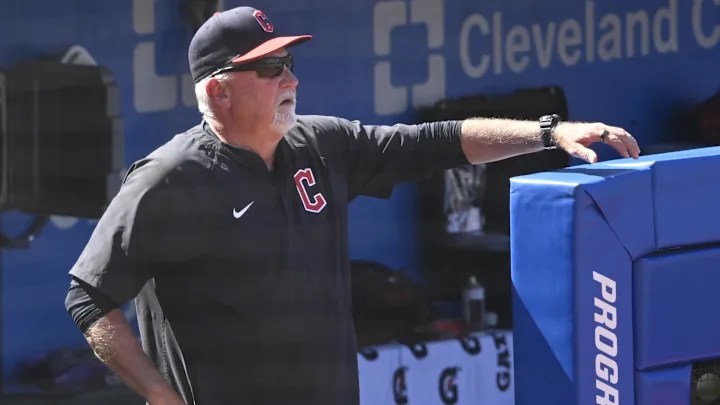
If you have read the news that Carl Willis intends to return as Guardians’ pitching coach in 2026, you likely breathed a small sigh of relief (and if hadn’t read that, you can let it out now!). Part of me wouldn’t blame you. Willis’s reputation as one of the best pitching coaches in the sport presently, and perhaps in the sport’s history, has solidified over the years.
That reputation is largely staked on being the pitching coach for five different Cy Young Award winners over the course of a a 20-year career with Cleveland (in two different stints) as well as Seattle and Boston. To put it another way, if you’re a fan of a team which Willis has been a pitching coach of, there’s a 1 out of 4 chance that the Cy Young Award winner in your league is on your team in that given year. That’s how prolific his time has been.
The other item that Willis has most been able to stake his reputation on is the “pitching factory” that he has helped develop in Cleveland. These items go hand in hand because when you think of that “pitching factory”, you probably think of how Cleveland has developed pitching stars and award winners like CC Sabathia, Cliff Lee and Shane Bieber. However, this phenomenon also relates to the Guardians and Willis’s ability to get the most out of all pitchers- not just his stars that could win hardware. This is especially true in his most recent tenure with the team that started in 2018.
Former Guardians pitcher Mike Clevinger pitched to a 3.52 ERA in 186 2/3 IP in Cleveland under his first pitching coach, Mickey Callaway (another great pitching coach, but reportedly with severe issues off the field). Clevinger pitched to a noticeably better 2.92 ERA in 348 2/3 IP under Willis in Cleveland. Although Clevinger’s worse numbers under Callaway could be attributed to being a younger, more inexperienced pitcher, or a smaller sample size, Clevinger also never pitched better after departing Cleveland than he did under Willis. His ERA was actually a much worse 4.27 in his years after making his exit from the Guardians and he only pitched in 8 MLB games in 2025 at the age of 34.
Another recent example of a pitcher finding his best success specifically under Willis was former Guardians starter Cal Quantrill. All four of Quantrill’s seasons in Cleveland match up with Willis’s tenure and in those seasons, Quantrill pitched to a 3.58 ERA and an above average ERA+ of 114. In his other seasons in the Majors, both before and after his time in Cleveland, Quantrill’s ERA punches in at an ugly 5.24. In no other stop outside of Cleveland has he performed as an above average pitcher by ERA+.
Willis’s successes aren’t just limited to the starting rotation though. Enyel de los Santos, a journeyman of a relief pitcher who has pitched for 8 teams in his 7 MLB seasons, had his best numbers in his 2 years with the Guardians, despite them being the largest sample to draw from.
De Los Santos pitched to a 3.18 ERA in 119 innings for Cleveland in 2022 and 2023. This is far and away the most MLB action he has seen with any team as he was a significant contributor for Cleveland in those two years. His ERA for every other team he has pitched for combined is a full two runs higher at 5.21 over the course of 195 1/3 innings. Yes, you could consider these samples small and unreliable, but a full two runs difference specifically when he was with Cleveland is quite noticeable.
Interestingly, while Willis’s reputation can be staked back to his first go-round in Cleveland, starting in 2003 as the pitching coach for Eric Wedge, this more recent foray in Cleveland seems to really be the most prominent success of his career. While he has only been at the helm for a single Cy Young Award since re-joining Cleveland in 2018 (Bieber in 2020, also a shortened season) Cleveland is 4th in ERA and 6th in FIP since he took up the mantle as Terry Francona’s pitching coach.
None of his previous time-spans as a pitching coach measure up to this. In fact, you could make the argument that up until this stop in Cleveland, maybe Willis’s reputation was a little out-sized. His teams often finished middle of the pack in stats like staff ERA or FIP over his time in town. While individual pitchers like Sabathia, Lee and the infamous 2016 AL Cy Young Award winner Rick Porcello (another example of a pitcher having his best success under Willis) flourished and won awards under him- the overall body of work was actually a little less impressive.
All of this is to say, that while Willis is currently 64-years old and it seems that his continued work as the Guardians pitching coach seems to be hinging on a year-to-year basis, he is seemingly doing the best work of his career. What we have seen from the Guardians’ pitching staff- most recently carrying this most recent iteration of the team so that they could overcome a 15.5 game deficit to win the American League Central division- has been remarkable.
I understand though if the tenuous nature of Willis’s future gives some fans pause, but I don’t think that is entirely necessary. The Guardians pitching infrastructure has weathered a lot in recent years. By my count, at least three current MLB pitching coaches were pilfered from lesser roles in the Guardians organization (Ruben Niebla for the Padres; Matt Blake for the Yankees; Brian Sweeney for the Royals). There are likely other underlings that have also been pulled away to work in other organizations. Yet, the Guardians pitching factory continues to bang out success after success, year after year.
I think it is very easy to look at coaching staff roles like pitching coaches and think that the type of success the Guardians have built starts and ends with one man. But in 2025, baseball teams have organizational philosophies on pitching (and hitting… and base-running… and defensive positioning… and countless other things). These philosophies aren’t the brain-work of any single individual. They are built upon the consensus of smart baseball people and they are spread not just across the Major League team but across the entire organization through the minors. Willis’s role is to use his vast experience to be a prominent voice in helping build that consensus. His job is also to express those philosophies- and not solely his own- to his players at the Major League level.
Willis has a major (I emphasize: major) hand in the ideas and methods that have made the Guardians successful. However, this isn’t an “I alone can fix it” situation. While the organization is certainly in fantastic hands right now, there will come a day when he departs, and a lot of the ideas and great habits they have built aren’t going to just wash away because he singularly is gone.
Willis deserves all the respect that he gets. His reputation at this point is rightfully excellent, but so is the Guardians organization’s reputation as a bastion of pitching development overall. That reputation is just as deserved, which should allow all of us to breathe a little easier.
 Pick-Up Sports Talk: Cleveland